Vault Wars
Players: 3-5
Playing Time: 45-60 minutes
Designer: Jonathan Gilmour
Publisher: Floodgate Games
The biggest weakness of Vault Wars is also its greatest strength: auctions. As fun as they are, each vault introduces a unique approach to the auction. Making a slow game even slower, and impacting my enjoyment as a result.
Pros
- Knowing only bits of information going into an auction allows for a lot of speculation
- Different vaults and their specific auction styles change the game in every auction
- Set collection, specifically of dragon eggs, makes you weigh up the odds and take risks
Cons
- Slow auctions that take a while to finalise
- Each auction requires an information dump before it begins, slowing down an already slow game
Vault Wars is a small box bidding game in the same vein as Smile and High Society. Where each round you’ve scavenged the leftover items from a failed Dungeons and Dragons campaign. Now it’s up to you to auction these items off for profit; Storage Wars style.
How to play
You begin a game of Vault Wars with a hand of vault cards and two aspiring hero cards. These heroes will give you extra points if you meet their objectives by the end of the game. Meanwhile, the vaults are worthless. At least right now, but they could hold untold riches or be empty. Nobody knows!
Regardless, you’ll first draft a hand of these vault cards by picking one and passing on the rest. Then after you return to a full hand, each player gets a turn to start an auction by selecting a vault card.
These vaults tell you how many treasure cards are in the vault and up for auction – you’ll draw that many from the treasure deck. Each vault card has its own rules surrounding who sees what, as well as other conditions and rules that may take effect. However, in general, there are some treasure cards face up, some face down, and some get looked at privately. Meanwhile, the auctioneer gets to see and know everything.
After players gain their information about the auction, and palates are sufficiently whetted, the auctioneer starts by setting the base price. This is the only time the auctioneer gets to bid, and they only win if no one else puts their money into the auction.
Everyone else takes turns either raising the current bid or passing. If no one raises the bid for an entire round, then the highest-bidding player wins the vault card and the treasures within.
After everyone has a turn at being the auctioneer, it’s the end of the round. Players can now equip items for special abilities, sell off unwanted items for extra cash, or hold onto their items for gems at the end of the game. Additionally, they must pay storage fees for all the junk they’ve collected.
Players short on cash can visit the local loan shark, who will give them a nice top-up of money and a negative victory point. Otherwise, the next round starts with players selecting a new vault card from their hand to play.
The game ends when players have no more vault cards left. At that point, the winner of Vault Wars is the one with the most gems.
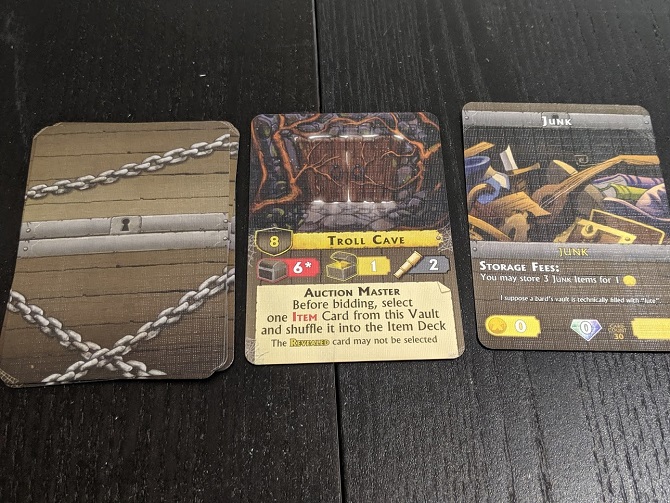
Can I get one? Do I see a two?
The way Vault Wars plays with information is a lot of fun. Except for the auctioneer, no one knows what’s in the vault being auctioned. Yet they all get a piece of information, not the whole picture. As such there’s a lot of banter thrown around the table as you’re left wondering why people are bidding, and whether or not the vault is worth it.
The exception, of course, is the auctioneer. They know everything and are usually encouraging others to bid, or discouraging them from doing anything. Although, you have no idea what’s going on in their head, as their role is not so black and white either.
With only one chance to set the bid, there’s pressure to make sure the auctioneer gets it right. A simple strategy suggests putting a high price if you want the vault, and a low price if you don’t. But in doing that, you’re broadcasting your intentions to everyone else, and they probably want (or don’t want) the same things you do.
On the other hand, there’s greed. If you want something, you don’t want to pay an arm and a leg for it. So maybe you set the initial bid low in the hopes that everyone thinks you don’t want it.
Because it changes every time you must make it, this initial pricing is a tough and enjoyable decision. You have to factor in how much money you have, how much money you want, and what the current meta at the table is.
For everyone else though, this part of the game is a standard auction. With all the tense fun that comes with putting your money where your mouth is. Yet winning an auction in Vault Wars is a funny feeling. Much like a Kinder Surprise, you know you’re getting a chocolate egg – but then what else are you getting? It’s not until you open the vault do you find out if it was a good day, or not.
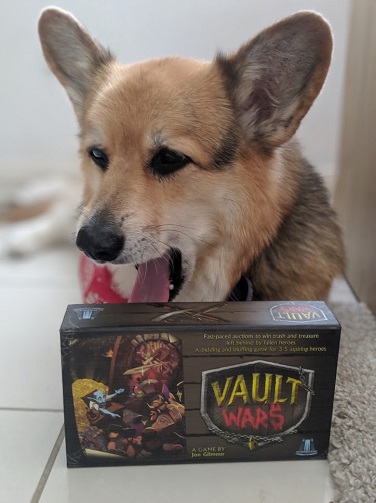
Turning light auctioning into a 3-book epic
Now, while all of this is a lot of fun, it becomes less fun as Vault Wars drags on. Maybe, I’ve just been spoiled with auction games like Ra, and High Society whose auctions are quick and snappy. But letting players come back into the auction after they’ve passed, means the auctions here are incredibly tedious. And letting players back in doesn’t add much to the outcome.
While that’s the main offender of Vault Wars‘ elongated playtime, it’s not the only one. With each vault having its own rules, and those rules needing to be read out, the game stops and starts more than traffic in rush hour. Interrupting the rhythm of the game so it never feels like you’re just playing. Instead, you’re bouncing between the two stages of auctioning and reading the rules.
Stepping away from the auctioning, Vault Wars, like Bargain Quest, nails its light-hearted Dungeon and Dragons theme. Answering the age-old question of where do shopkeepers get all that stuff? You’ll see plenty of references and get a few chuckles as vault and treasure cards pass through your hand.
So while Vault Wars has a great theme and some truly interesting mechanics. It can’t make up for the slow gameplay and overly long playtime. As such, a lot of the energy you find in other auction games is missing from Vault Wars. A bummer because there is a brilliant game in here, but it’s just not the one written in the rules.
Similar Games You Might Like

High Society Review – Appear Rich, Die Broke, and Win Anyway
Bidding high for fame is the right move until you realise the poorest player automatically loses. A satirical financial tightrope of ego and elegance.

Raccoon Tycoon Review – An Anthropomorphic Slog Through the Gilded Age
Corner the market on luxury goods and hoard railroad stock in top-hat style. A sleek economic simulator that drags on far longer than it should.
Smile Review – The Ups and Downs of Auctioning Fireflies
Nothing to smile about when you’re out of fireflies. A delightfully mean bidding game where savvy bidding is the only way to survive.
A score tells you if it’s good, but the leaderboard tells you if it’s worth the shelf space.

 Loading ...