Going back a couple of years, I hated Dungeons and Dragons.
First-level combat is uninteresting, and when playing with new players you end up spending more time looking up spells and skills than playing the game.
However, my hardline stance of saying no to D&D has waned. In large part due to watching the fine folks over at Dimension 20.
They showed me that the interesting part of D&D isn’t the combat, but what happens in between. How the characters interact, learn about the world and uncover plot points to tell a story.
The other reason I’ve softened is that some friends got into D&D and wanted to play.
Now, I’m never one to half-ass anything – even if I don’t like it. So despite my protests, I did my best to create interesting characters, take notes and be attentive.
I made a plucky rogue who snuck out of his parents’ house to go on an adventure; a merchant who couldn’t leave a dungeon because he left an irreplaceable trading permit in there; and the son of a noble who invoked his father’s name at the first sign of trouble.
Through these characters, I started to enjoy the game.
Combat still sucked though.
But I was intrigued enough to start looking at other systems. Wanderhome, a pastoral RPG, was one but it was too open-ended for my group. Meanwhile, Blades in the Dark, a game of heists and ghosts in a Victorian-era city, seemed perfect.
I floated it by my group as Peaky Blinders meets Dishonored. An elevator pitch few could refuse, and soon, everyone wanted a piece of that pie.
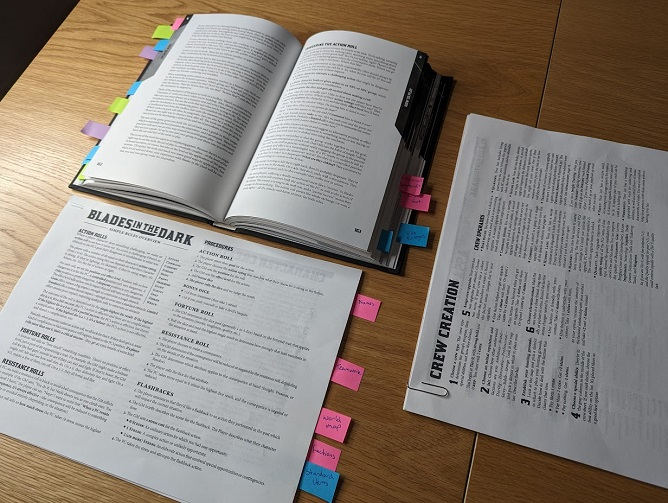
So I set myself to reading the rulebook and having a go at running my first session ever.

First-time GM as it happened
Leading up to the night, I set the mood by linking the group the Dishonored and Ocean’s Eleven trailers. Just from that, it was clear there was an appetite to play. Players were eagerly asking what they could do to prepare.
I didn’t send them the full laundry list because I’d planned the night as an introductory session. One where we would create characters and then run a simple heist to familiarise ourselves with the mechanics and world.
Also, we haven’t played too many RPGs, so it was a good litmus test to see if we wanted more.
Apparently, this was not needed, as not only had the players done their homework, but one player, who normally GMs, reviewed the rules found on the Blades in the Dark website and was ready to play.
Now, this amount of prep and energy should have brought me great joy.
But it only served to increase my anxiety.
It felt like the group was putting their hopes on me to provide a good time, and I had little idea what to do or expect from being the GM.
That’s not to say I didn’t plan. My goal was to provide an introductory session and railroad the group towards their first heist: planting a ghost-summoning artefact within a factory. Even though role-playing veterans may scoff, planning out this initial session helped me get comfortable with my role and provided a smooth pathway for us to play through.
It worked too. Despite being very nervous, after a few different interactions with NPCs, I found my groove just before the heist started. Great timing on my part, because that’s where my plan finished.
From that moment on, everything was improvised.
This was the part I was most worried about. However, once I was in the moment, it felt relatively easy to convey what was happening within the world and make a compelling story.
Preparing for the night, I read one comment that said you can’t prepare for everything, and at some point you need to trust your creativity.
This I did, and it was epic.
One player ran as a distraction on the rooftop, killing two guards before falling off and breaking their back. Meanwhile, the other two players snuck into the factory unleashing the ghost-summoning device early causing a mayhem of ghosts and guards. Before running to the exit.
By the time they all escaped, it was well past our usual going-home time. Although, everyone was having too much fun to notice.
Personally, I was wired afterwards. The first session was a great success and the gushing feedback from my friends made it difficult for me to sleep.
What to change for next time?
The trouble is, I can’t wait for the next session. Even though it’s planned for the next week, the story and the different ways it could unfold are always on my mind. So too is my improvement as GM.
Therefore, in true Agile Retrospective fashion, here’s what went well, what didn’t go well, and what I’m going to change for next time.
Things that went well:
- Letting the players control the story as much as me. Yes, I made a few NPC encounters so they got the information they needed for the heist. But those, and everything else, were off-the-cuff with me responding to what the players did.
- Not planning out the heist to every last detail, but creating a blueprint and figuring out how many guards and as well as other challenges they could interact with.
- Getting the players hyped beforehand with trailers and selling the game. Their enthusiasm made me enthusiastic. Allowing me to sell rules, descriptions and ideas that wouldn’t make sense in a normal conversation.
- Regardless of how bad the roleplaying was, everyone had a blast.
- Blades in the Dark has this idea of progression clocks. When players do something aligning with a section of the clock, they get to tick it off. These were a lot of fun and added pressure to the heist.
- Every player had some time to shine. Within the information-gathering phase and the heist, everyone had a part to play in the night going the way it did.
Things that didn’t go well:
- I struggled to give each of the NPCs a unique voice. In particular, I had two smart ruthless characters who ended up sounding exactly the same.
- Similarly, keeping track of NPCs was difficult. Especially, when it quickly became apparent we were going to have a large roster of characters.
- This comes with experience, but I struggled with my descriptions of places and people. At the worst times, I even stuttered once or twice.
- Some rules I totally forgot, and had to make rulings on the spot. I also blanked on how critical hits work, so I plan to introduce them next time.
- Mixing narrative moments within the combat was something that I didn’t get right. Like when the guards died I just narrated their deaths. Where they would usually say something or cry out in pain. There’s a balance here, but I whiffed it the first time out.
What are we going to change for next time?
- Already, I’ve organised my notes better so that rule issues won’t be as big of a problem.
- Going to focus more on the NPCs and making them more unique. How am I going to do this? I don’t know. So if you have any tips, let me know!
- Continue to look for ways for the players to shine, they’ve created a lot of information about their characters already. Now, I just need to bring that into the session.

Planning for session two
Now that session one is under my belt, you would think I wouldn’t be as nervous for the next session.
Wrong!
I’m even more nervous. There are some things they must do – like finding a healer for a broken back. The rest of it I’m leaving up to them to figure out where they want to go and what they want to do. Whether it’s to engage in the gang war of Crow’s Nest, or start figuring out a new drug they can flood the streets with, I don’t know.
This means I need to create several different heists in case they go in one direction or another. While this sounds a little too ambitious for session two, I’ll use this off-week for reconnaissance.
I will ask the group what they want to do and then craft a few different heist scenarios around their responses.
Whether or not I’ll pull off another session like the first is yet to be seen. But the excitement in the group, and willingness to have another session, means it’s worth trying at the very least.



 Loading ...