Smile
Players: 3-5
Playing Time: 30 minutes
Designer: Michael Schacht
Publisher: Z-Man Games
Despite its name, Smile can be exceptionally mean, as you can force people to lose all their points. But that aside, it’s a fantastic, tactile and tight auction game.
Pros
- Great components, with the fireflies feeling great in the hand
- The reverse auctioning is interesting, and you often want to take the fireflies
- Plotting to take cards, in the hopes of losing them later is a valid strategy and changes your priorities
- Plays quickly, so it’s great for squeezing in a game here or there
Cons
- It is a bit long, and because of the mechanics, the first half doesn’t matter
- Can be quite mean, as one auction could make you lose significant points
Ever notice how the meanest games have the nicest names? Smile, Arboretum, Dead Last. OK maybe not Dead Last, that one sounds evil. But my point stands. Smile is a new auction game that quickly turns from a light-hearted contest of collecting fireflies, into a game full of curse words and revenge plots.
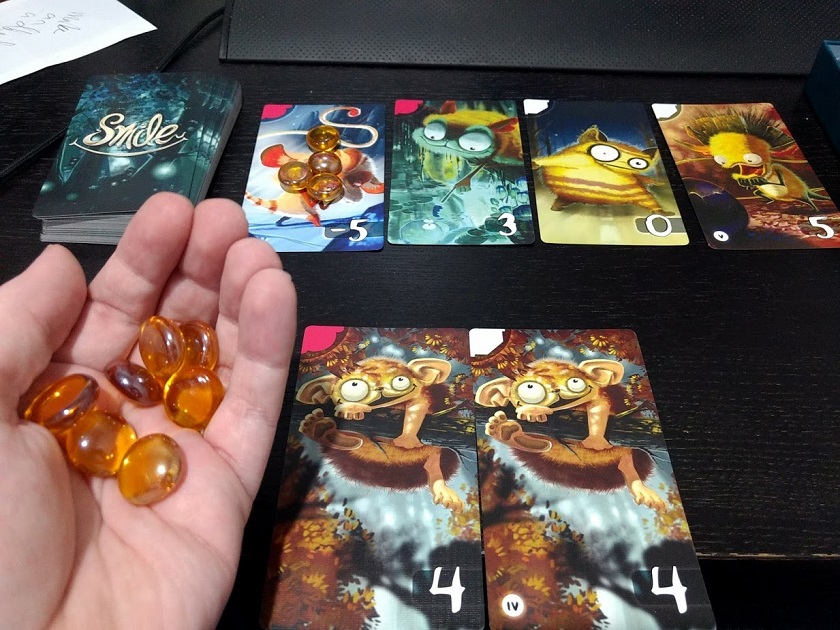
It’s an auction game where players bid on monster cards with fireflies. Except, you don’t want to win these auctions. In fact, you’re paying not to.
Each round begins with the monsters being rearranged from the lowest to the highest point value. Then one by one, they’re auctioned off.
When it’s your turn, your choice is either to place a firefly on the monster. Or pick up the card and all the fireflies already on it. In the case you run out of fireflies, then you’re forced to take the monster. No matter how icky they may be.
Additionally, if you ever run out of fireflies, you take a blue teardrop. Representing both your anguish at running out of fireflies and a negative point at the end of the game.
Once you’ve won a card, then you must sit out until a new set of monsters arrives before you can bid, or I guess not bid, again.
As you bid and collect cards, you’ll notice some cards have coloured corners. If you ever have two monsters with the same coloured corners. Then both cards are removed from the game. This can be great for removing negative point-scoring monsters from your hand. But, if you’re not careful, it can be great at removing your high point-scoring monsters as well.
After all the monsters are auctioned off, you count all the points on your collected cards. Plus one point per five fireflies, and you have a winner.
A game of fireflies and smugness
Smile flips auctioning on its head. Instead of paying to win the auction, you’re paying to make sure you don’t. At least to begin with. Each round normally starts with auctioning off cards that make your points total go backwards.
To avoid collecting these cards, you need fireflies. How do you get more fireflies? By picking up these awful cards. But it’s no good picking them up until after several players have already thumbed their noses at them.
Therein lies the conundrum, when is the best time to pick up a card?
Making matters more interesting is Smile’s closed economy. No new fireflies get added into the game – except for if someone goes broke. But even then, it’s only the one firefly. This significantly complicates the question.
Smile then becomes a game of one-upmanship and smugness. Play passes around the table, and each player smirks as they pass this challenging question to the next player.
Underneath this thick layer of smugness, there are schemes afoot.
Maybe you’ve already accepted you’re going to take the card, but then want to get a couple more fireflies before you do. Or you have a look across the market row and try to figure out which card someone else wants. Or you have a specific card in mind that you want.
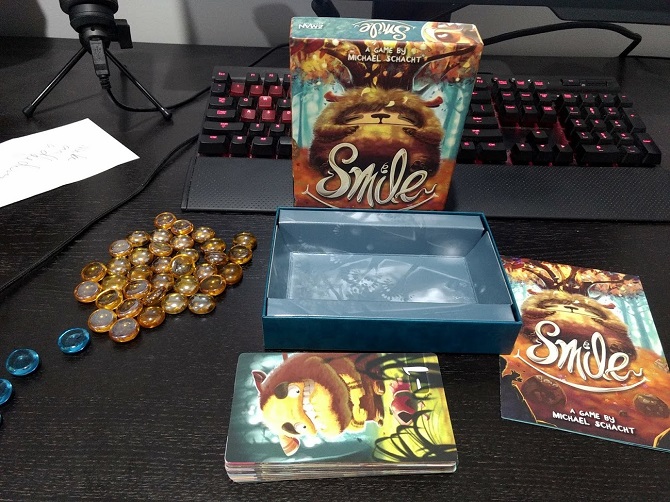
It’s these plots, in addition to managing your firefly economy that make Smile a treat of a board game. Wherein each game, the economy changes and with it all the decisions you have to make. Not to mention the glass bead fireflies feel great in the hand.

Turn that frown upside down… or maybe don’t
Beyond the calculated moments of Smile, are the moments of genuine surprise. Given the closed economy, games can sometimes feel like a foregone conclusion. However, the thing that mixes this up is the colour corner cards.
When you get two cards with the same coloured corners, you lose both cards. This can be the basis of your strategy, as you accept some bad-cornered cards early on. Expecting to get rid of them by the end game. Of course, that signals to everyone what you’re expecting to do, and can make your life harder because of it.
While this coloured corner concept is brilliant towards the later half of the game. In the early stages, it feels like you’re just collecting cards just to get rid of them. So that by the end of the game, you rarely have any cards from the starting rounds. Making these initial rounds feel unimportant, and a bit of a waste of time.
Otherwise, Smile is a mean game. It revolves around forcing people into doing things they don’t want or ruining their game plan one way or another. Specifically, if you find yourself out of fireflies. As you’ll get punished heavily for this.
For me, and some others, this risk and punishment can be fun. But your mileage may vary. In my experience, mean games can quickly put people offside.
Overall though I enjoyed Smile a lot. Its small footprint allows it to be one of those board games you always keep in your bag or take with you on the go. The auctions and decisions you make are hard but fun. Plus the feeling of jiggling fireflies is so satisfying it’s meditative. This is a good thing because sometimes you won’t be smiling!
Similar Games You Might Like

Furnace Review – An Innovative Auction Trapped in a Dull Engine
Losing bids has never been so lucrative. A genius take on auction games that cools off fast once the dry resource sorting begins.

High Society Review – Appear Rich, Die Broke, and Win Anyway
Bidding high for fame is the right move until you realise the poorest player automatically loses. A satirical financial tightrope of ego and elegance.

Vault Wars Review – Dead Adventures Don’t Need Their Loot
Going, going, dragged out. A funny fantasy-themed storage auction whose clever bidding mechanics gets lost behind a tedious amount of downtime.
A score tells you if it’s good, but the leaderboard tells you if it’s worth the shelf space.

 Loading ...

Great review of a great game!
The negative bit about how calculated it can feel, that is one place where I think No Thanks has a step up on Smile, because everything is spontaneous there. You’ve got a 31 and are forced to take a 33. Whoa! What was just drawn, but a 32!
That adds a lot of laughter to the proceedings.
But overall, I really did like Smile. I’d like to try it again.
I hope I wasn’t too negative! I mean I do like Smile, but it can feel a bit on rails at times, where you can easily tell what cards people are going to pick based on the corners. However, that might evolve over enough plays. By the sounds of things I might have to check out No Thanks! sometime as well.