Raccoon Tycoon
Players: 2-5
Playing Time: 60-90 minutes
Designer: Glenn Drover
Publisher: Forbidden Games
Raccoon Tycoon is a board game I wanted to love, it’s full of great ideas and potential. However, none of these are realised, and instead, you’re left with an open-ended game that’s a slog to play.
Pros
- Fantastic theme and artwork of raccoons in waistcoats
- A simple introduction to the 18xx genre of gaming
- Real-life market simulation of supply and demand
Cons
- The theme makes no inroads into the mechanics of the game
- Nothing pushes the game towards its end, creating overly long playtime
- Luck is a primary factor in who picks up the best building combo
Love our reviews? Buying through our links earns us a small commission at zero extra cost to you, helping us table the next big release! Full disclosure here.
Raccoon Tycoon attempts the impossible by creating a family-friendly introduction to the impenetrable 18xx genre. The genre is known for its endlessly deep decisions, and the need for a calculator to do well.
Fortunately, there’s no calculator is needed for Raccoon Tycoon, but you still get that 18xx experience with stocks, markets, and of course auctions. But it also has a fox in a top hat, and if that doesn’t get you excited. Nothing will.
At its core, Raccoon Tycoon is about getting money through market manipulation. You’ll spend turns playing cards, that give you goods while increasing the market value of other goods. When you require money, you can instead sell goods on your turn. Doing so drops the market value of that resource according to how many resources are sold.
In this way, you’re simulating a living, breathing market.
Once you’re flush with cash you can then spend your turn either auctioning a stock in a railroad company or buying a town using goods. Additionally, you can also buy buildings that give you a permanent passive benefit for the rest of the game.
This cycle of getting money, and spending money continues until all of the railroad or town cards are bought. Then the player with the most victory points wins the game.
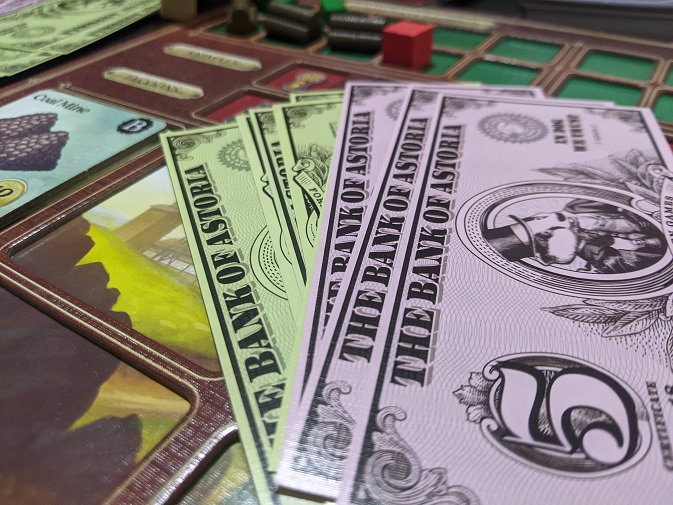
Waistcoats are in!
Raccoon Tycoon has this awesome presentation of cute and cuddly creatures dressed in clothes right out of the late 1800s. You’ll play as a dog who’s a miner for example, or a raccoon who’s a store clerk.
And that’s all the theme you’re going to get.
It looks fantastic, and the artwork is amazing, but there’s no mechanical connection to this presentation. Meaning as soon as the game begins the theme falls quickly into the background. But that doesn’t make Raccoon Tycoon a bad game, far from it. It just means there’s a lot of missed potential.
But still, this presentation gets you in the door, and once you’re in Raccoon Tycoon is easy to pick up and start playing.
What will keep you coming back is the way the market moves and simulates the stock market. It will put you in tough positions where the answer isn’t always straightforward.
For example, you may want the coal given by a card, but playing it will increase the market value of wine. Then looking across the table, you see Bob has five bottles ready to sell. If he sells those, he’ll tank the price of wine, so maybe you should sell your bottles before worrying about the coal.
This is the market trading that gets everyone excited. Buying low, selling high, having diamond hands, and going to the moon!
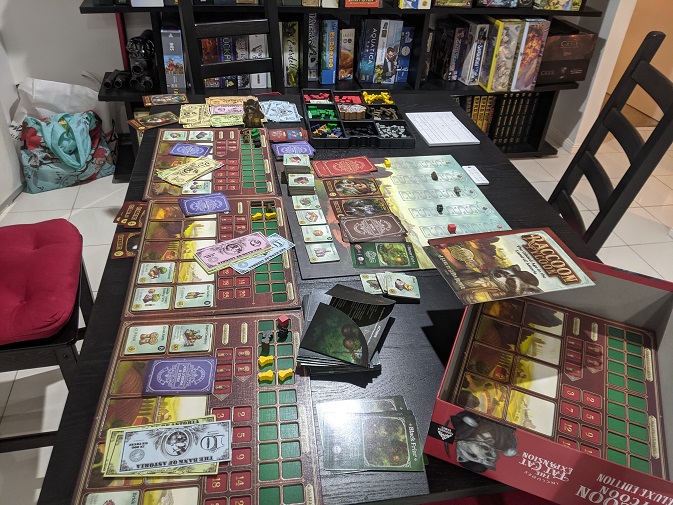
The pitfalls of capitalism
Unfortunately, Raccoon Tycoon is too good at simulating capitalism, as it’s a game where the rich get richer. While the rest of us hope we win the lotto or strike it rich writing about board games, there are no lotto or board games within this game and therefore no catch-up mechanisms either.
Being rich within Raccoon Tycoon is fantastic. You can buy the buildings you want, which generate more money, which then lets you buy more buildings. This loop is really fun, and the buildings you get are incredibly powerful. Making it feel as though your engine explodes with each new addition.
Although, with the buildings being unique, and the building market being slow to refresh, luck plays a big part in what combinations you get during the game. As a result, the winning Raccoon Tycoon feels more about luck, than being a savvy investor.
This amount of luck is not an issue by itself but becomes one when combined with the time it takes to play. By far my biggest complaint about Raccoon Tycoon is that it doesn’t drive the players to the end of the game.
Let me explain.
Both of the end-game triggers, railroad and town cards, are optional actions. Despite there being too many of these cards to begin with. The auctions for these end-game triggers were only started by players when they knew they’d win it. Except with everyone’s money hidden, nobody was willing to pull the trigger.

What about the 99%?
The winner of my games was the one who lucked into a fantastic engine. But even then, they couldn’t help but do a victory lap by collecting both the towns and the railroads. Because while individual town and railroad cards give you points, together they’re worth extra.
They had a great time stalling out the game’s end.
Meanwhile, I spent the same time with no chance to catch up. So instead of having fun, and enjoying the game as they did, I just bemoaned my piddly little engine sputtering to make a dime.
There’s so much going on within Raccoon Tycoon that you can get lost looking at the overall picture. Full of auctions, fun market manipulations, and engine-building so powerful it feels like you’ve found gold.
But all this is let down by a game that’s too long for what it is, and too filled with luck. Stumbling into having a lot of money, or a great engine is reflective of our modern society. However, it doesn’t make for an interesting board game where your decisions determine the outcome.
Similar Games You Might Like

Vagrantsong Review – Saving Souls on the Spookiest Train in Gaming
The old-timey cartoon look lures you in, but brutal token draws will break your heart. A stylish, swingy campaign filled with haunting lore.

Pandemic Iberia Review – The Only Version of Pandemic You Need to Own
Lay train tracks across 1848 Spain to outrun uncurable plagues. This clever spin on the classic formula upgrades simple movement into a satisfying network puzzle.

Empyreal: Spells & Steam Review – This Is As Exciting As Trains Get
All gas and no brakes. Use mana, spells, and teleportation to pick-up and deliver cargo in this colourful train game that trades dry logistics for non-stop tactical bedlam.
A score tells you if it’s good, but the leaderboard tells you if it’s worth the shelf space.

 Loading ...