
Disclaimer: Peacemakers: Horrors of War was provided for free by Snowdale Design, although the writing and opinions of this article are my own.
Peacemakers: Horrors of War
Players: 1-4
Playing Time: 60-120 minutes
Designers: Sami Laakso, Ville Reinikainen
Publisher: Snowdale Design
Peacemakers: Horrors of War elevates the battle for Daimyria through its streamlined setup and dynamic gameplay. Now you can end conflict while enjoying every moment!
Pros
- A massive step up from Dawn of the Peacemakers in all areas
- Streamlined setup takes only a few minutes.
- Dynamic puzzles, thanks to fluctuating motivation mechanics.
- Horror cards cycling through your deck serve as a clever reminder to avoid killing.
- Revisiting the world of Daimyria is always enjoyable, and this game is no exception.
Cons
- Gameplay can feel too reactive at times, with turns spent waiting for events to unfold.
- The indirect manipulation of the armies gives the game a unique feel, which might feel TOO passive for some players.
It’s been almost a decade since the release of Dale of Merchants and every Snowdale Design game since has been set in Daimyria. That’s six games (and expansions) taking place in this wild world of animalfolk with defining personalities.
Returning to Daimyria now feels like hanging out with a friend you haven’t seen in a while. Sure, they now have a beard, and are 20kgs heavier, but the familiarity remains. Especially, when the first scenario of Peacemakers has the Ocelots and Macaws at each other’s throats again.
If you’ve never played a Snowdale Design game before (you should), Peacemakers: Horrors of War is their second attempt with the same system as Dawn of the Peacemakers.
However, as you’ll find out if you keep reading, Peacemakers: Horrors of War offers a vastly improved experience. Tackling some of the original’s biggest issues, and adding some new twists to increase the game’s excitement.
Still, there’s one lingering issue… But we’ll cover that later.
How to play
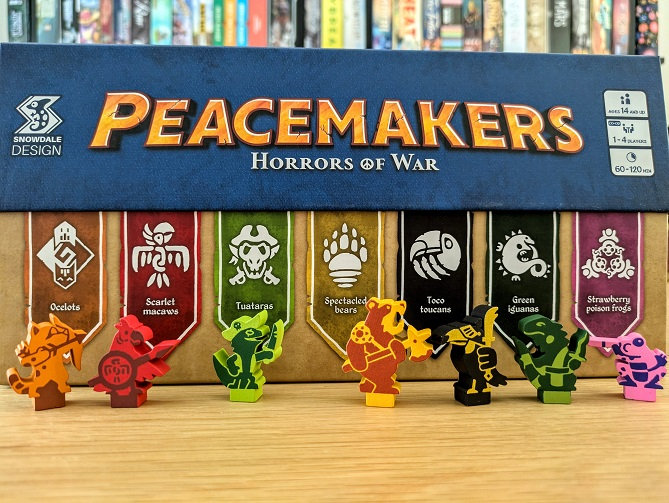
Peacemakers: Horrors of War has six different scenarios for you to put your conflict resolution skills to the test. Each scenario has (at least) two warring factions and winning requires you to decrease their motivation until they lose their will to fight.
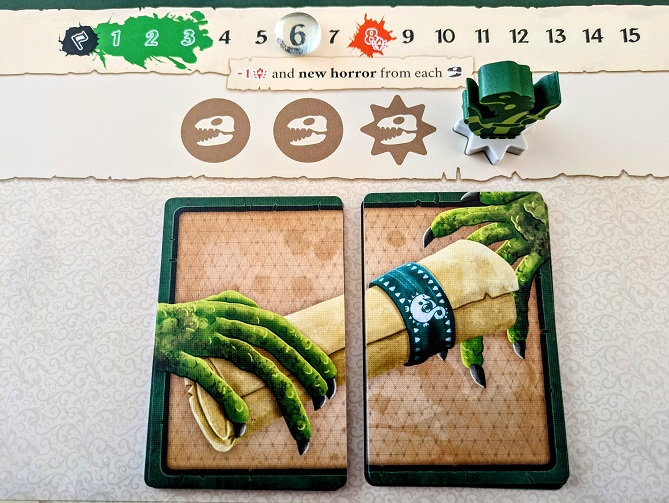
Dropping an army’s motivation to zero, or letting their leader die, causes them to give up the conflict. Letting the other factions steamroll them and cause untold casualties.
Put simply, you’re looking for a stalemate rather than a crushing defeat.
Achieving this requires you to weave between and manipulate all of the factions. Offering support to the losing sides while sabotaging the dominant forces.
Your chance to influence the armies comes at the start of the round during the Adventurer phase. Here you spend resource cards to scheme or adjust the battlefield through actions.
Each card has a unique scheme that may be charged up by the character you’re using. For instance, the Cunning Retreat card lets you move a single unit one space backward. However, if you’re playing as the fennec fox, you can move two units backwards.
Cards also have up to four common actions and deciding whether to spend your card for the scheme or one of the available actions is one of the many tough choices in Peacemakers.
These actions include:
- Survey – Scout an army’s plans by turning over the top card of their deck.
- Travel – Move around the map one space at a time.
- Fortify – Place a fortification token, reducing the damage units take on that square by one.
- Delegate – Give this card to another player.
You can take as many turns as you want and in any order. But once you’re done, it’s the army’s turn to take action in the aptly named Army phase.
All factions are represented by two decks, an order and a modifier deck. You’ll draw cards from both decks, providing armies with their turn order and actions for the phase.
Starting with the fastest army, they’ll move, attack, fortify themselves or lose/gain motivation based on the cards drawn.
For any animalfolk who dies during this phase, put a horror card on top of the resource deck – to be drawn and played the next time you pick up a card. This is gamified PTSD and represents the effects of war on your character.
Some examples include causing your character to flee at inopportune times, or steal all of the available resource cards. No matter what, they’re bad news and should be avoided if possible.
At the end of the Army phase, check to see if you’ve reached a stalemate. If not, then continue with another round. Otherwise, you’ve stopped the fighting… at least for now.
You’re not thepProtagonist
Peacemakers: Horrors of War is a weird board game because you’re not the protagonist. You’re extras blending into the background of a war acted out by the main stars. You can influence the fight with your resource cards, but you can never take up a sword and shield and enter the fight.
An example of this philosophy is the most aggressive card in the game; Food Poisoning. It can cause up to four damage to a unit without killing it. Of course, this may set them up to be killed in the next Army phase, but your hand won’t be on the guillotine.
In fact, outside of Food Poisoning, no other card allows you to damage faction units. All other cards focus on manipulating the order and modifier decks, defending and healing units, or gaining more resource cards.
This reactionary approach to cooperative gaming gives Peacemakers: Horrors of War a unique feel that I’ve yet to experience in any other game. One where you have to restrain yourself from taking action because sometimes the best move is to do nothing.
Not only is this a great shout-out to the 1983 thriller WarGames, but also the downside of this type of play.
Especially at the beginning of the game, when you don’t know each army’s power level or what they will do in the upcoming conflict. Your only avenue to understand this is to keep passing until it becomes clear which side needs help.
Coming from board games where you’re the main driver of the action, you might struggle with this. I know I did. My brain kept wanting me to jump in and be the hero. But that’s not what this game is about at all.
Peacemakers is the wars of whispers, gently pushing armies in one direction or another, managing their motivation, and hoping for a stalemate.
It gives the game a completely different feel.
As for the puzzle of reducing motivation, it’s incredibly enjoyable when you’re using your cards to sway the battle. Not as fun when you’re sitting back waiting for things to happen or you’re out of resource cards.
But that’s part of the challenge. You don’t get a lot of resource cards by design (in 4 players you only get 1 per round). So making the most of them can be the difference between a celebratory stalemate or war stories you wish you could forget.
A monumental step forward
There’s nothing worse than going to a board game night and spending the first 20-30 mins setting up. This was the case for Dawn of the Peacemakers and it got so cumbersome that I ended up finishing the campaign solo.
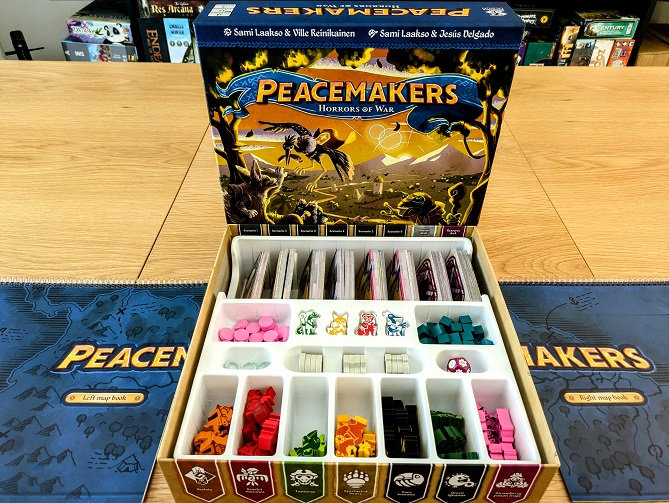
Snowdale Design has fought and won their own battle against this problem. Creating what might be the slickest, cleanest setup of a campaign game ever. Because, no kidding, I can set up any of the six scenarios in less than five minutes.
That’s a wild claim.
One I wouldn’t believe if I didn’t experience it for myself.
However, it’s true thanks to some monumental step forwards in board game production. They’ve replaced the maps, tiles and unit cards needed in Dawn of the Peacemakers with map books straight out of Gloomhaven: Jaws of the Lion. You only need to flick to the right page and everything is prepared for you, there are also some helpful tips to remind you of easy-to-forget rules.
Also replaced are stiff plastic bases from the original game. It was a pain to snap them on and off during setup and tear-down, so I’m happy to see them go. The new soft plastic bases are delightful in comparison.
The storage solution is, unsurprisingly, equally well thought out. Every scenario has a section, so you can just scoop out the cards and place them in their designated spaces.
As a result, Peacemakers: Horrors of War is a massive improvement on the original. An improvement extending beyond the production.
The motivation puzzle is a lot more engaging and dynamic in this version of the system. With cards that can cause it to spike upwards, or downwards, you need to keep an eye on it throughout the entirety of the game rather than only caring when it gets close.
There’s the character powers affecting the strength of your cards. Not a game-breaking change but enough to bend each character’s play style. Giving you a new perspective with each new character you play.
The titular horror cards, despite their grim artwork, create moments of spontaneity. Whereby you need to react to what you draw, as they can completely whiff your plans.
Finally, everything that can be streamlined has been. For instance, faction leaders are now included in the order and modifier decks – instead of being a separate thing you need to track. All health and damage have been made the same to make it easier for you to play the game and not worry about the little nuisances that plagued the original.
Peacemakers: Horrors of War is an achievement. There’s not a single poor choice in its design or production and the only reason you wouldn’t like it is because of its unique background-character feel. If you enjoyed the original Dawn of the Peacemakers this is a must-have. Otherwise, it’s a strong consideration.
Similar Games You Might Like

Daybreak Review – A Game of Hope, Strategy, and Uncertainty About the Future
Saving the planet is easy until the crisis deck dumps unstoppable disasters on your board. A hopeful engine-building cooperative game with an oppressive real-world bite.

Sky Team Review – Trust, Turbulence, and the Joy of Landing
Warning! Flying blind on bad dice rolls is going to lead to nose-diving. A silent co-op puzzle that delivers landing highs despite a dull campaign start.

Horizons of Spirit Island Review – Spirit Island on a Shoestring Budget
Trying out a top-tier co-op on the cheap gets tricky when you could just buy the original instead. A solid tutorial, but poor economic value.
A score tells you if it’s good, but the leaderboard tells you if it’s worth the shelf space.


 Loading ...

Thank you for the review, David! Glad you liked all the changes we made! The unorthodox gameplay was still something we really wanted to keep, as that’s something that makes the game really unique – in addition to the theme, of course. 😊
Thanks for stopping by! You and your team nailed it with these changes. The unorthodox game play, while sometimes not geling with my board gaming sensibilities, gives Peacemakers a unique feeling and worth keeping about!