
Disclaimer: Dawn of Peacemakers was provided for free by Snowdale Design, although the writing and opinions of this article are my own.
Dawn of the Peacemakers
Players: 1-4
Playing Time: 60-120 minutes
Designer: Sami Laakso
Publisher: Snowdale Design
Every trip to Daimyria is exciting, and Dawn of Peacemakers is no exception. Like other games from Sami Laakso and Snowdale Design, it’s filled with innovative ideas that change how you think about playing. Not all these ideas hit this time, but the potential is through the roof.
Pros
- Unique gameplay, unlike anything I’ve played
- Lots of surprises throughout the campaign
- Excellent writing and a compelling story being told
- Between slow movement and limited interaction, it’s interesting working out your most impactful moves
Cons
- Gameplay can be frustrating because it’s too passive, and you can’t do what you want
- Extremely fiddly when setting up new scenarios
- Gameplay works best with fewer players, as you get more freedom to do what you want
Have you seen the Tuxedo Mask meme? The one where he says to Sailor Moon: “My work here is done.” Sailor Moon replies, “But you didn’t do anything.” And then he waves his cloak, saying, “Didn’t I?”
It sums up Dawn of Peacemakers pretty well. It’s a board game in which you do nothing, yet at the same time, you do everything.
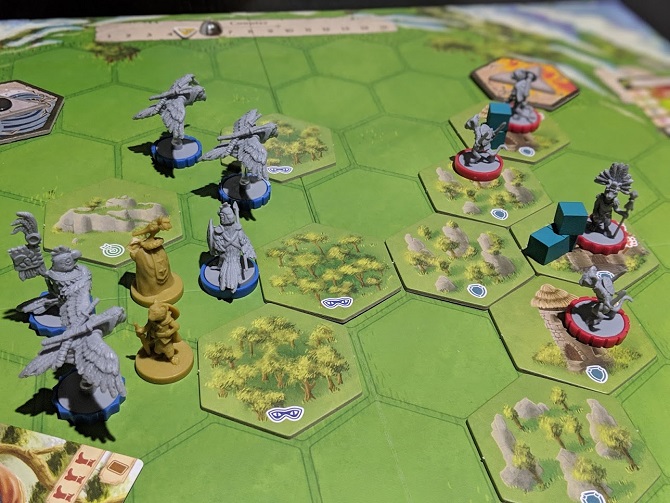
In it, you’re a peacemaker who’s been summoned to quell the brewing battle between the great Macaw and Ocelot empires. Over twelve scenarios, you are thrown into conflict after conflict, with the goal of stopping it all.
You do this by killing off units of each army demoralizing the rest of the army, or prolonging the conflict and causing both armies to tire out. Alternatively, the scenario may come with its objectives and path to victory.
Given that description, you might imagine yourself a rouge operative secretly taking out battlefield combatants. This couldn’t be further from the truth. Instead, you play it like an advisor, where you can influence but not interact with these armies. Think Jafar from Aladdin – but like a good guy Jafar.
This makes for a fascinating puzzle to solve. But feels like you’re on the sidelines for most of the game. Watching these two armies battle it out, you’ll have many turns where your best move is to pass.

Sway the tides of war
When you do get involved, the actions you take are non-combative and aren’t immediately realised. For example, you can’t actively kill off a unit of either army.
Because of this passiveness, Dawn of Peacemakers lulls you into thinking your actions are meaningless. However untrue this is, it does take a couple of plays to understand this unique dynamic.
Once you get a hang of it though, the game transforms. Soon you’ll find yourself helping both armies and slyly influencing them towards a stalemate.
This theme and gameplay of peacemaking are wildly different to anything I’ve played before, and surprisingly it works incredibly well.
Although, it’s not without its frustrations. For example, if one army runs out of motivation then the other army takes the win. So trying to simultaneously lower both armies without one ever running out, means every game of Dawn of Peacemakers ends in a manufactured cliffhanger.
It doesn’t matter if you’ve played well, or been efficient with your moves. Everything depends on the last few moves of the game. While this creates a very tense finale, it left me wondering why I bother doing anything for the first three-quarters of the game.
Great writing, shocking twists!
Like Pandemic and other cooperative games, the more players you add to Dawn of Peacemakers the less influence you have over the game. For this reason, I preferred playing it solo or with two players as it allowed me more control over the outcome.
But before you throw out the idea of maxing your player count. There’s a mechanic introduced within the campaign that drastically changes the way you seek victory. To the point, you’ll no longer be able to trust other players to do the right thing.
However, playing with the lower player count meant I could take time to dive through the lore. Each scenario has a story, and each unit has its backstory. There’s some great writing within Dawn of Peacemakers, with the small exception of the self-indulgent naming conventions.
Sure, it’s a trope of fantasy writing. But every time I can’t discern the name of a location from a cat scattering across the keyboard my immersion is broken.
Throughout this campaign, you’ll unlock new battlefields, mechanics, and components. While I’m just over halfway through, everything unlocked has been a shock.
Not all the new additions are gold though, as some cannibalise the elegance of the game. Adding a greater burden of rules than the gameplay experience they provide.

It’s not you, it’s me
Dawn of Peacemakers focuses on building the world, rather than your characters. So throughout the campaign, the world changes, but your character largely stays the same. No asymmetric powers, no levelling up, no personalised story pieces – or very few.
This was a bit saddening, as the rewards for each campaign level didn’t feel personal. Therefore I didn’t feel the same attachment as I would in other games.
Otherwise, Dawn of Peacemakers shares the same issues as other campaign games. Once you complete the campaign, it’ll never be as good. As the surprise of the story unfolding, or the unwrapping of different packages can’t be replicated.
However, the way Sami Laakso and his team add and subvert the conventions of the genre is one of the things I loved about his design of Dale of Merchants. And he brings more of that same style here. Creating an experience like none other I’ve played, and one worthy of praise.
However, because of how inactive Dawn of Peacemakers feels to play it leaves me in a weird position, where I both enjoy the game and feel lukewarm about it. Although it must be said, I’m looking forward to finishing my campaign and following the story to its conclusion.
For a more spoiler-heavy review, read the second, shorter review of Dawn of Peacemakers I wrote after I finished the campaign.

Similar Games You Might Like

Lands of Galzyr Review – Being Dunked into a Milky Cup of Storytelling
Skip the heavy battles and endless rulebooks for an app-driven storybook adventure that delivers cozy charm from start to finish. A narrative-driven campaign where every choice shapes your journey.

Raccoon Tycoon: Fat Cat Expansion Review – The Fat Cat Expansion Review – A Box Large Enough for a Real Raccoon
Adds character shields and extra building tiles to widen your scoring options. A solid addition that improves strategy but fails to fix the endless endgame.

Exploding Kittens Review – Why I’m Finally Putting This Cat To Sleep
This cat roulette runs out of lives long before the deck runs out of bombs. A slow, predictable filler that lacks meaningful choices.
A score tells you if it’s good, but the leaderboard tells you if it’s worth the shelf space.

 Loading ...

Great review, and I do look forward to seeing how you feel about it at the end as well.
I’m hoping there is a few wonderful surprises left. It’s so hard to review campaign games. 🙁
Dave, I was fascinated when I saw this game, and I appreciate your thoughts on it. I’m still on the fence about it and may sit there for a while. I’m in the middle of trying to get Pericles and some other intriguing wargames to the table as well, some of which have very interesting mechanics. But this one is a different kind of war-game — like Roots with a mediator! Thanks for the review.
No worries mate. Thanks for stopping by again. 😀
Really impressed about playing war games. They always seem to require a bigger commitment than I’m willing to give. Btw Root with mediation is a great description for it. I should of used it. Haha