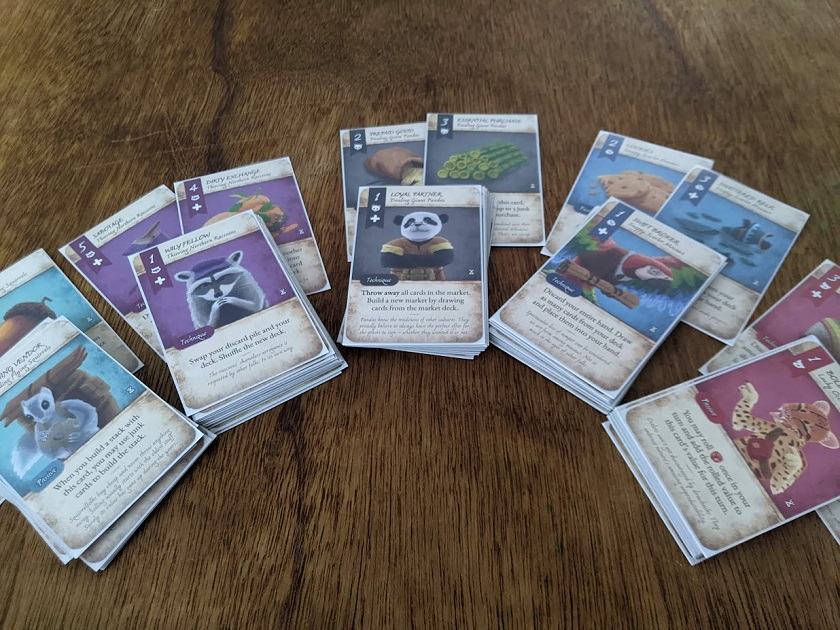
Dale of Merchants
Players: 2-4
Playing Time: 30 minutes
Designer: Sami Laakso
Publisher: Snowdale Design
Dale of Merchants throws caution to the wind by introducing several exciting new mechanics to the deck-building genre. These new mechanics produce more interesting decisions and trade-offs, while the theme and personality of the different card types are phenomenal.
Pros
- Cards and abilities are full of personality
- Tough to choose when to create a stack and when to save your card for an ability
- Tense feeling of being in a race, seeing your opponents sprinting towards the finish
- Lots of variability with the different animal types, only increased with expansions
Cons
- Some of the animal types are more interesting than the others creating games that feel different but aren’t as enjoyable
I grew up in the golden era of massively multiplayer online games. Where the biggest name on the block was World of Warcraft. Sadly, it ruined the industry for many, because it was so good every game would be compared to it. Dominion did the same for deck-building and has gone unchallenged for a long time. However, Dale of Merchants is a new worthy challenger. But can it take the throne?
If the competition was only on terms of theme, Dale of Merchants would win hands down. It’s as though Sam Laakso found his inspiration by exploring Morrowind, and seeing a Kajit vendor for the first time.
However, it’s a lot deeper than putting a funny hat on a raccoon. Each of the races in Dale of Merchants has its unique personality. This is so ingrained into the game that you’ll notice this personality come out in both the art and gameplay.
In starting a game of Dale of Merchants you’ll mix a number of these different animal decks. The cards within these decks are numbered from one to five, with increasingly powerful abilities attached.
This allows you to determine how you want to play the game. For example, if you want more randomness and chaos, add in the Ocelots, if you want a more structured game then add the Macaws instead.
Once you’ve personalized your market deck, give each player the starting card from each animal type, and then enough junk for them to make a deck of ten cards.
Players then take turns, buying cards from the marketplace, using actions on cards, or trying to win the game by building stacks to add to their stall. The first player with eight different stacks wins the game.

Stack-rificial gameplay
Creating stacks in Dale of Merchants is no easy task. Well, the first stack is… and maybe the second. But it gets harder, as each stack must be built by using only animals of a single type, and the sum value of these cards must equal the stack number.
For instance, the first stack needs a single card with a value of one. The second stack requires either two value one cards from the same species, or a value two card.
This gets progressively harder to put together as you attempt to build eight stacks. Not only because you need more cards, but because you lose cards put into the stack.
This turns your deck into a sliding puzzle. Where you’re constantly gaining, and losing cards, and figuring out which ones to hold onto and which to jettison creates fascinating strategic and tactical decisions.
Additionally, you start to feel a rhythm as your deck expands and contracts. With this rhythm, comes strategic opportunities. Do you want to collect a lot of cards first, and use their abilities to help you create stacks? Or do you want to start creating stacks as fast as possible?
Because at the of the day, Dale of Merchants is a racing game, where you can only build one stack per turn. So when someone gets out to a lead, you feel the pressure of it. Sometimes enough to change your strategy completely.
Unlike Dominion, which is all about building a perfect deck. Dale of Merchants doesn’t care about your deck at all, it just wants stacks. You could have the ugliest, square-wheeled deck in existence, but if you get to eight stacks first that’s all that matters.

A new voice in deck-building
Another unfamiliar change is hand management, as you don’t discard your hand at the end of every turn. Instead, you keep your unused cards and draw cards until you reach your hand limit. As such, you need to develop ways to burn through your cards to refresh your hand. Thankfully, any cards bought from the market are added straight into your hand.
Again, this brings new tactical decisions to the fold and clouds your judgment on otherwise straightforward decisions.
I criticised Clank! A Deck-Building Adventure Game because it only partly felt like a deck-builder. If you went in wanting to deck-build you would have been disappointed.
Well, today you can call me Anakin Skywalker because THIS is deck-building. Dale of Merchants brings a new innovative voice to deck-building, managing to capture multiple levels of strategic planning and tactical decisions delivered in a delightfully friendly package.
To answer my own question though – is it enough to knock off Dominion? That depends. In terms of theme, tactical decisions, and interactivity between players; Dale of Merchants is the victor. But in terms of that slow, methodical deck-building Dominion is known for. Well, it remains unchallenged. This is why we love board games though, as two designers and games take on the same mechanic to produce two excellent but wildly different games.

Similar Games You Might Like

Peacemakers: Horrors of War Review – Winning by Doing Absolutely Nothing
Disarm soldiers, redirect marches, and soothe furious armies before the battlefield turns into a bloodbath. A clever pacifist co-op where you never swing a sword.

Tyrants Of The Underdark Review – A Banger In A Budget Box
Forget the paper-thin D&D theme, this is a masterclass in hybrid design. A fierce, high-conflict battle that gives losers a genuine back-door path to victory.

Curious Cargo Review – A Brilliant Puzzle with a Terrible Glassdoor Rating
Building the ultimate shipping line gets tricky when your trucks refuse to move. A brilliant spatial puzzle buried beneath convoluted scoring.
A score tells you if it’s good, but the leaderboard tells you if it’s worth the shelf space.

 Loading ...


My favourite deck-builders are the ones that add a little something to the mix. Tyrants of the Underdark, Valley of the Kings, that sort of thing.
I played Dominion a couple of times and never really took to it. Partially, I think, because I had already played Ascension and others that had a variable market. The static market just seemed stale to me.
But I do want to get this one to the table soon. A friend has it and we’ll get to it one of these days.
Great post!
I think I need to give those two a go sometime. I found with dominion being able to see your deck grow and combo as you want rather than succumb to the random market is great. However, it’s the repeated plays that make it the beast that it is though. As people change their I decks, and you make adjustments as well and seeing how people adapt to the new strategies is why I like it, and something you can’t do with a random market.
I can see that. And I have played other games with the non-random market too (though Trains also has the board too). I can see the appeal, but it doesn’t have the same appeal as the random market does for me.
Valley of the Kings is awesome! Definitely worth checking out.
Now just need to find it in Australia :p