Disclaimer: Parks was provided for free by Keymaster Games, although the writing and opinions of this article are my own.
Parks
Players: 1-5
Playing Time: 30-60 minutes
Designer: Henry Audubon
Publisher: Keymaster Games
Parks treats you to the national parks of America from the safety of your tabletop. Its easy-to-learn gameplay (and beautiful art and components) make it a perfect game for new board gamers.
Pros
- A great gateway board game with beautiful components and artwork
- Able to add and remove different stops along the route to change the game each play
- Blocking and landing on action spaces play an important role
Cons
- Too light to satisfy “serious” board gamers
- Can be a little mean when it comes to blocking other players
Love our reviews? Buying through our links earns us a small commission at zero extra cost to you, helping us table the next big release! Full disclosure here.
In Space-Biff’s fantastic review of Parks, a board game about collecting American national parks, he comments he enjoyed it the most when he started collecting only the parks he’d visited.
A wonderful idea.
So I gave it a try and lost without a single point. Now, this could be because I’m from Australia, and all the parks are in America. But the more likely cause is that I’m a self-deprecating shut-in.
Like Tokaido, Parks is a game of moving forward linearly across a line of action spaces. Imagine a hiking trail on a park map, with multiple lookouts and sightseeing spots connected by a single line. On your turn, you move one of your two hikers any distance along this path. Activating the spot that they stop on, in most instances, will give you resources, canteen cards, or the camera token.
The only restrictions around this movement are that you can’t move backward, or land in a space someone else is on. Although, once per round, you can get around this second rule by using your campfire.
When you reach the end of the trail, you can spend your resources to buy gear that provides you with buffs. Or collect park cards, which is the main way to gain points. Beyond this, there are secret goals for each player, random round effects, and a trail that grows every round.

Hidden in the depths
Parks is an easy game to pick up as the key concept is simple. Move one of your hikers along the track, and perform the action it lands on.
Reductively Parks is about blocking the other players from getting the action spots they need. All the while, collecting the resources you require as well. So picking and choosing when to use your campfire is a critical strategic maneuver, as you can only use it once per round.
In an otherwise relaxing game about visiting national parks, this type of depth was unexpected. But not unwelcomed. It’s this depth that makes Parks such a fun board game.
Beyond blocking, you must also weigh up your hiking speed. Ideally, you want to move as slowly as possible, collecting the maximum amount of resources. However, you can only convert these resources into points after you’ve finished your hike. So while you’re dillydallying on the trail trying to be efficient, you also need to keep an eye on the marketplace. Because it’s first come first serve, and you can easily lose the park you’ve been planning to get.
After the end of a round, you randomly add additional tiles to the trail. This lengthens the hike, and the amount of turns per round, while also blowing the game wide open. The new tiles often come with powerful game-changing abilities, where you’ll need to think on your feet and change your plans on the fly.
For example, the Waterfall which lets you copy an action or the Lookout where you can collect an additional park. Both are powerful effects, that you will need to play around with.
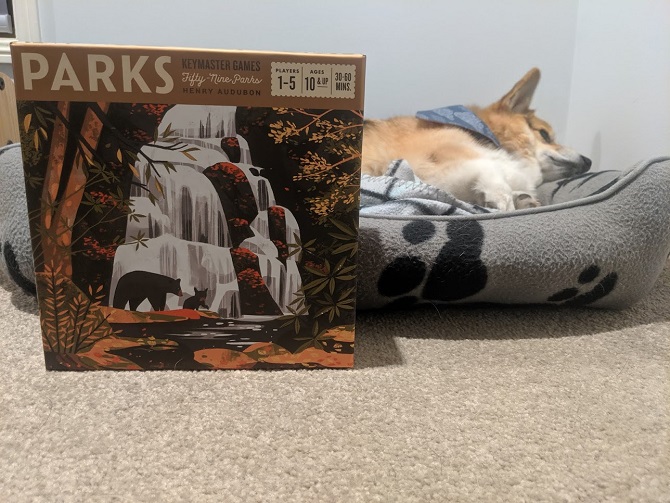
Twokaido
Outside of collecting parks, there are two other ways to score points. The first is via a secret objective handed out at the start of the game. The second way is via the camera token.
Activated by landing on the Vista location, you can take a photo – worth 1 point – for any two resources and then get the camera token. However, if you already own the camera, the photo only costs one resource, and you can take an extra photo if you hold onto it for the rest of the round. This King of the Hill mini-game adds an ounce more complexity but a lot more fun player interactivity.
Circling back to Space-Biff’s review, he concludes that Parks is formulaic and bland. I can see his point, the most innovative mechanic is adding a second hiker to Tokaido. However, I disagree with his conclusion. While it won’t plunge you into the same depths as say Merchants of the Dark Road, it’s still an engaging board game.
Putting the depth discussion aside, Parks is a beautiful board game. The phenomenal artwork is but part of the overall package. The insert, the metal starting token, the pastel colour pieces, everything is produced with a high level of care.
Then the gameplay is on par with any modern gateway game. The turns are snappy, the rules are straightforward, and there’s plenty of variability within the trail tiles. Parks was everything I wanted Tokaido to be, and one of the most enjoyable games I’ve played this year.
Similar Games You Might Like

Photosynthesis Review – Pretty Trees and the Scripted Struggle for Sunlight
Growing a massive forest canopy sounds serene until the sun moves and blocks your all of your income. A tight, rigid spatial race that stalls on repeat plays.

Arboretum Review – A Botanical Bloodbath
Barking up the wrong tree will cost you everything. A clever, high-tension tableau-builder that turns a cozy park stroll into a midnight mugging.

Bärenpark Review – Please Don’t Call Me A Koala Bear
Fit oddly shaped bear enclosures onto your park board to earn points and look cool doing it. A fun and furry family puzzle as long as you don’t mind a bit of setup.
A score tells you if it’s good, but the leaderboard tells you if it’s worth the shelf space.

 Loading ...