Bärenpark
Players: 2-4
Playing Time: 30-45 minutes
Designer: Phil Walker-Harding
Publisher: Lookout Games
From the satisfying placement puzzle to the sometimes-goofy drawings of bears, building a zoo in Bärenpark is an absolute joy. It’s just a shame about the setup time.
Pros
- Organising your park is a satisfying experience
- Bears are cute, and collecting them in your park feels fun
- A great family-friendly game that you can pull out on most occasions
Cons
- Koalas are not bears!
- Hard to tell how well you’re doing at a glance
- Takes a while to setup, while playing is relatively quick
- Low interactivity with heads-down gameplay
Love our reviews? Buying through our links earns us a small commission at zero extra cost to you, helping us table the next big release! Full disclosure here.
Bärenpark puts you in the role of Mad King Ludwig who now wants to open a zoo. However, in typical Mad King fashion, this zoo will only have three types of bears and a marsupial that you’ll call a bear. Despite a very catchy Australian song pleading you not to.
Play begins with you owning a barren park, and your goal is to make it a bear-in-park. You’ll do this by taking turns picking up bear enclosure tiles from a central display and placing them onto your park board.
Now, whoever built these enclosures studied in the Tetris-University of Fine Architecture as none of them are sensibly shaped. So you must maneuver these tiles around your board to fill up all of the squares, as well as cover specific spaces.
Covering up a wheelbarrow space, lets you grab a baby green tile. These tiles don’t provide you any points, but they’re great at filling in odd gaps within your park. Something you’ll come across quite quickly in the mid-game.
Covering a cement truck space, allows you to grab bottom-tier bears such as polar bears and koalas. Meanwhile, the good bears (sun bears and pandas) are reserved for when you cover up an excavator space. These premium ursine species are worth more points but are also a lot harder to place neatly within your park.
The last special space you can cover up has three construction workers standing around doing nothing. This is an unfair description. It’s one construction worker working, with two others managing him. Anyway, by covering up this space, you get to add another park board to your zoo.
The final icon you’ll find on each of your park boards is the pit. It can only be filled with a bear statue, and you only get one of those once you’ve filled in every other space on the board.
Once you have four bear statues, then all other players get one last turn. Then everyone adds up their points from tiles placed and statues earned to find out the winner.
Good old-fashioned family fun
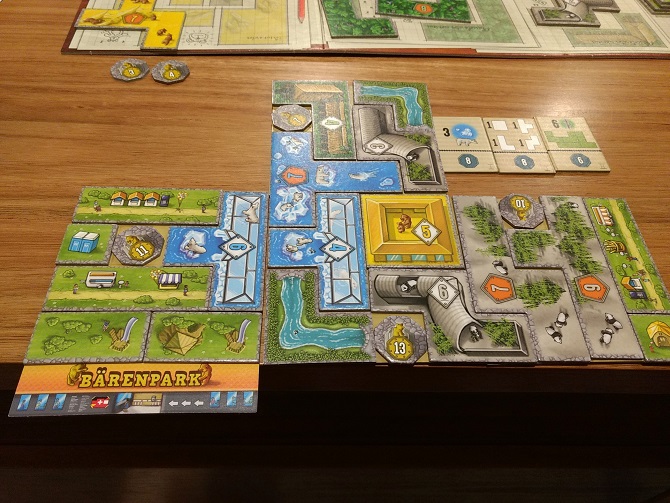
Outside of the wonderful theme of building safe and happy habitats for bears, the wonder of Bärenpark is in putting together these uniquely shaped enclosures in the best way possible. There’s a lot of creativity in coming up with the right combination of enclosures to fill a park board.
When you get it right though, you’re rewarded with the satisfaction of putting in the last piece. The bear statue. This is akin to you placing the last piece of a puzzle or flossing out the small piece of chicken that’s been bothering you since lunchtime. There’s a sense of relief and satisfaction that comes with this action beyond just gaining the points.
From a strategic perspective, Bärenpark boils down to how quickly and efficiently you can build a zoo. The first player to build enclosures of a certain type gains more points than those following. Likewise, the sooner you erect a bear statue the more points you get as well. This is also true of the advanced mode which introduces objectives. Whoever completes these objectives first, gains more points than those completing them later.
So you need to assess which of these races you want to win and focus on winning them. Rather than spreading yourself too thin and ending up with few points across the board.
As such, Bärenpark doesn’t match wits with some of the better strategic board games released. But that’s not its focus, which is more on good old-fashioned family fun. Turns are quick, as are decisions, so you’re always active and the game rarely stagnates or slows down.
Additionally, by the end, you feel like an artist when you look down at your beautiful bear park. It’s a great feeling. But also leads to fun conversations as people describe their parks.
See everyone, we have pandas and koala exhibits right as you walk in. Never mind that there’s only one portapotty and not enough paths for everyone to walk around.
Sharing what happened and how you ended up with the mess before you is enjoyable. If not a reminder that you shouldn’t quit your day job.
Setup is a bear
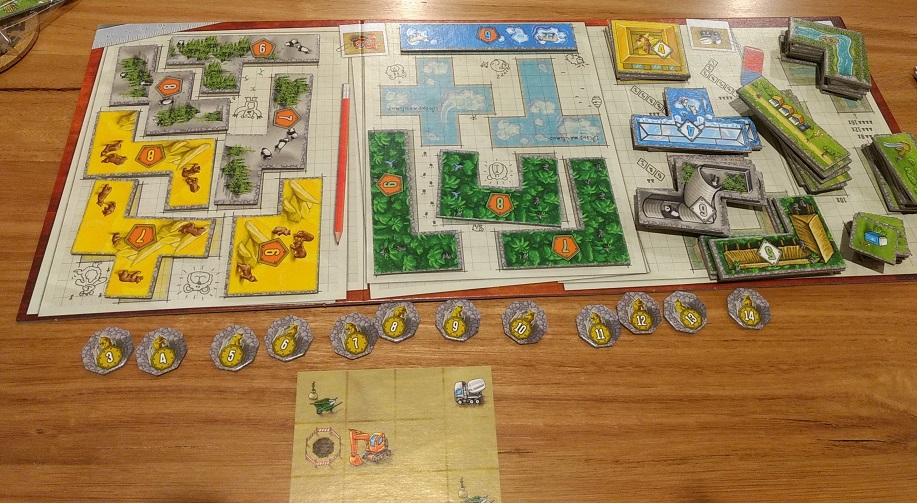
While the gameplay of Bärenpark is fun and family-friendly, setting up the board game is not. Collecting and organising all of the pieces so they sit neatly on the market board takes longer than it should. Specifically, when you don’t have the same number of players in each game and have to add or remove components. This adds a significant amount of time to an already rough game setup.
This wouldn’t be worth a mention, except the setup time outweighs the playtime. It’s like being a roller coaster that spends more than half the time click-clacking up a hill instead of doing high-speed corners and loop-de-loops.
In terms of gameplay, there are a few downsides, probably the biggest though is the trap for new players. Bärenpark runs on momentum, you get tiles, you place these tiles on icons, and then you get more tiles. However, on your first park board, there’s a large enough distance between icons that you can place tiles so that they cover nothing.
Given that you’re racing for bear enclosures, bear statues, and objectives, having to pass due to poor early tile placement will leave you in a position of playing catch-up for the rest of the game.
Another thing to note about Bärenpark is that it’s a very individual game. You play with your head down thinking about your park and what tiles could work and where they could go. As a result, you’re not interacting with the other players at the table.
It’s also difficult to get a beat on what other players are planning or what their score is. This lends Bärenpark towards being a family-friendly game. But as a strategic gamer, I found it difficult to figure out my best move.
Further to this, the last few turns of Bärenpark lose the sharpness and creativity found at the start. During your initial turns, you have all of the zoo to grow and build on. But as the game progresses your opportunity for tile placement shrinks. So by the end, you’ve already got your tiles sorted and are just waiting on other players before you can fill in your gaps.
This can be frustrating, as you play within your own world you already know what you’re going to do on your next couple of turns. Having to stop and start waiting for other players who have no impact on your turns does get annoying.
A game for Goldilocks
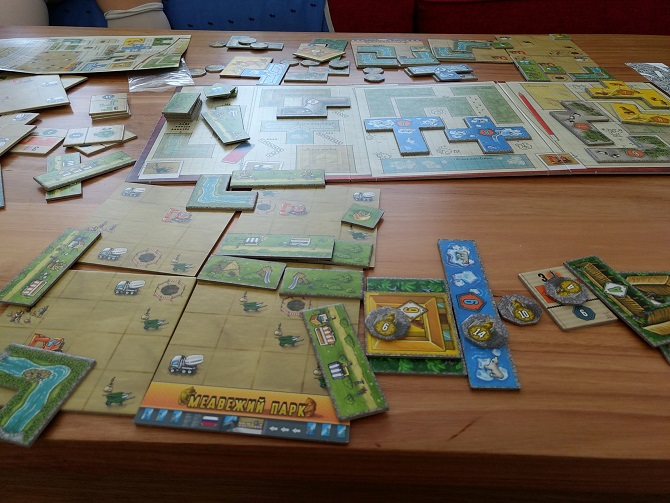
Bärenpark is an easily approachable game. The rules are few and simple to understand, as is the scoring system. On top of that, who doesn’t want to make comfy houses for pandas and polar bears?
The artwork lends itself to this approachability by being goofy and fun. With lots of interesting details within the pictures, they’re great to look at while you’re waiting for your next turn.
So if you’re looking for a board game to bring out with the family or with people who don’t play that often, then Bärenpark is a fantastic option. Being able to shoot the breeze while building bear houses is a good reason to get a board game.
However, board gamers who’ve survived the harsh winters of Agricola and lived to tell the tale might find Bärenpark missing something.
At least I did.
After playing numerous times I still couldn’t put my finger on it though. Whether it was the setup-to-playtime ratio, the lack of player interaction, how difficult it was to know if your strategy was any good or some combination of all three.
Whatever it was, it was enough to put me off playing it as much as I wanted.
Similar Games You Might Like

Arcane Academy Review – Eric Lang’s Magic Miniature-Free Marvel
Back to school, and your desk is already a total mess of exhaustion tokens. A clever, family-weight engine game that hits hard in under an hour.

Bargain Quest Review – No Refunds in this Fantasy Walmart
Fleece rubes with shiny gear in your shop window before sending them into the dungeon to get eaten. A hilarious theme weighed down by endless phase bookkeeping.

Word Domination Review – For When Your Only Word is “Yeet”
Spelling big words gets tricky when you’re desperate to lock down three E’s at once. A competitive spin on Scrabble prone to long turns.
A score tells you if it’s good, but the leaderboard tells you if it’s worth the shelf space.

 Loading ...