
Hanamikoji
Players: 2
Playing Time: 15 minutes
Designer: Kota Nakayama
Publisher: Quick Simple Fun Games
With only four actions per round, few games match the intensity of Hanamikoji. Winning takes a lot of deep thought as you must make each of your actions really count.
Pros
- Gorgeous card artwork for a rather abstract game
- With only four actions every decision is tense and impactful
- After the first round, the game gets even better!
- Outwit your opponent through cunning trades and secret Geishas
- Comes in a small, travel-sized box
Cons
- Not a game you can relax with, or form any meditative rhythm
- Due to the depth of your decisions, you can become susceptible to analysis paralysis
Love our reviews? Buying through our links earns us a small commission at zero extra cost to you, helping us table the next big release! Full disclosure here.
Hanamikoji (also known as Jixia Academy) is a two-player card game that is small in size, and on components, but massive in terms of decision space. It puts you, a Japanese restaurant owner, against a rival restaurant vying for the attention of seven geisha.
Note: This review was based on the original release of Hanamikoji. At some point, the publisher re-released this game under the title Jixia Academy. While the gameplay is the same, it features different artwork.
While the theme amounts to a more expensive version of luring kids into a van with candy. It does Hanamikoji a disservice to focus on it. Not because the artwork isn’t absolutely gorgeous, or the theme itself isn’t worth talking about. But because the gameplay doesn’t tie itself to the theme.
In reality, this is an abstract game where the gameplay is so phenomenal it could be about winning over dung beetles by offering different types of poo, and I’d still give this a raving review.
How to play
Remove one gift card from the deck and then deal six cards to each player. These gift cards have both a number and colour corresponding to one of the seven geisha, and can only be given to geisha with the same combination.
Players take turns using these gifts to blackmail the geishas by doing one of four actions. These actions will let you score cards, put gifts towards a geisha, discard cards, or remove gifts from the game. You can only perform each action once, and the round is over after both players complete all four.
The actions:
- Secret – Save one card from your hand face down, scoring it at the end of a round
- Trade-Off – Discard two cards from your hand face down
- Gift – Offer your opponent three cards, they score one, while you score the other two
- Competition – You offer two pairs of cards, your opponent scores one pair and you score the other
At the end of a round, the player who scored the most gifts against a Geisha wins her favour. Moving her token towards the player who won. If players have the same amount of points, the geisha remains unphased and her token stays where it is.
You win if you have four Geisha tokens. However, each geisha has a number of charm points, and if you win over Geisha with a total of 11 or more charm points. You win regardless of whether the other player has four geisha or not.
If neither player has won, then a new round begins. Only this time the geisha’s tokens are not reset to the middle and stay with their respective restaurateurs.
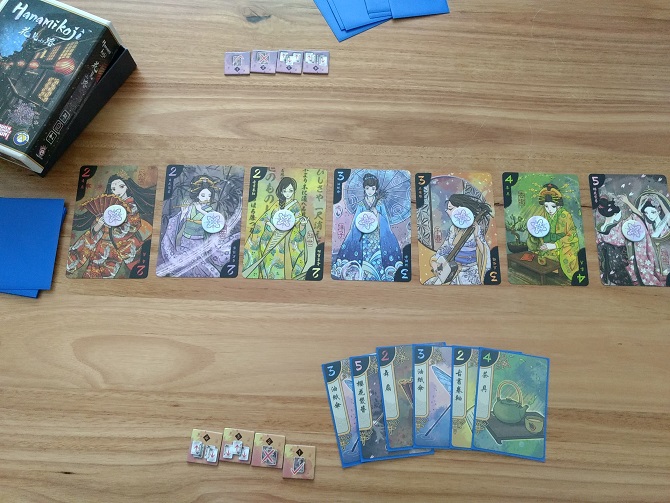
A sharp, well-crafted knife
This is a MacGyver game. If designer Kota Nakayama was trapped with 21 cards, and some cardboard tokens. Not only would he escape, but he would also create an incredibly well-designed card game in the process.
There’s an immediate and sustaining tension throughout Hanamikoji. With only four moves, each must be executed to perfection to win. Making this difficult is the ‘I split, you choose’ mechanics. These create heartbreaking choices where no matter your choice, you’re ceding ground to your opponent.
While Hanamikoji may only have four actions, when you use an action is equally as important as what action to use. This is because each action uses several gift cards in your hand.
So, with each passing turn, you have fewer cards to play with but get a better understanding of the board state. Leaving you with a choice to make early trades with a lot of options in hand without much information, or waiting until you know your opponent is plotting but then not having so many options.
Another point for consideration is the two victory conditions: 11 charm points, or four geisha. You might think it’s a safe bet to just go for the geisha worth the most points, but these geisha also require more cards to win them over. So investing in these geisha, make the others easier to be won over.
You can see that despite there not being too many actions within Hanamikoji, the amount of thought required is monstrous. Deliciously so.
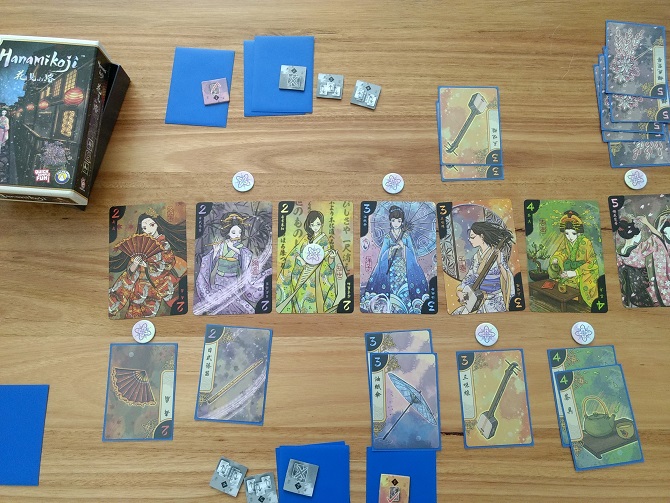
Beautiful artwork, zero theme
Hanamikoji is like a sharp and well-crafted knife, it knows its purpose and excels at doing it. Meaning, that if you’re not into deep-thinking games, you’re not going to enjoy it. It’s missing the joviality you can find in other games like Galaxy Trucker, or Cockroach Poker. It’s more like an unfaithful mathematician – a very calculated affair.
Then, as I mentioned in the intro, there is no theme to Hanamikoji. Or, at least no evocative theme. The game is abstract. While I appreciated the beautiful artwork, you could cut and paste just about any theme onto this game and you wouldn’t have to change the mechanics.
However, there is one oddity with this theme, and that’s the geisha number four’s obi (traditional Japanese sash). It’s tied at the front, and according to Memoirs of a Geisha and Google, this is usually reserved for prostitutes and the elderly.
You see, a true geisha is helped into their clothes, with a helper tying their obi knot for them. Since number four is not old, this leaves one explanation, and I don’t think your kids are going to like it.
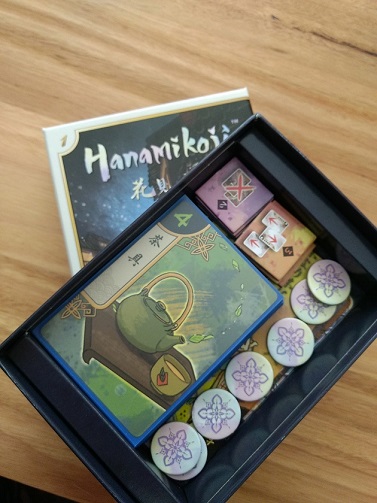
Better every round
Hanamikoji is one of my favourite two-player games, a genre that hasn’t received too much attention. While it’s great as is, it gets better in the second round. Where each geisha you’ve won previously doesn’t need so much to entice them. It ramps up the strategy of the game to levels previously unseen and brings in mind games.
However, as it stands Hanamikoji is a clown car of a board game. It looks tiny on the outside, small box, and minimum components. But once you start playing you find an immeasurable wealth of decision space.
On top of that, it’s got fantastic artwork, and the rules are easily understandable and quick to explain. For such a short-playing game, that also tests the limits of your strategic thinking, this is unheard of. This is why I love Hanamikoji and it’s one of my all-time favourites.
Similar Games You Might Like

Raptor Review – Prehistoric Thrills and the Problem with Modern Science
Tranquilise runaway dinos before they chew through your research team. A clever two-player hunt where luck-heavy card play pulls all the strings.

Tides of Madness Review – 18 Cards to Drive You Crazy
A little madness goes a long way. A brain-twisting 18-card drafting duel whose snappy momentum slams into a wall during end-of-round scoring.

Claustrophobia 1643 Review – A Game That Takes Up More Table Space Than an All-You-Can-Eat Sushi Buffet
Sprinting for the exit gets brutal as injuries drain your hero’s action dice. A punishing dungeon crawler that eats up your entire table.
A score tells you if it’s good, but the leaderboard tells you if it’s worth the shelf space.

 Loading ...

Excellent review! But you make it sound so seedy. LOL
I totally agree with every point. Maybe I don’t need to write a review now…
Hate it when that happens. Though I wouldn’t worry about it, the more people talking about Hanamikoji the better. 😀
I agree!!!
Great review David!
I am sure you will be happy to read that Hanamikoji now has its digital version. Please check out http://www.happymeeple.com
The game comes with an full interactive tutorial (3 minutes), 12 bots (various level), animations, sound/music and the usual online play, chat, ranking system. Exactly like the other games of the platform (like Lost Cities another 2-player favorite).
Have fun and keep up the good work!
Thank Nick, glad you liked it. I took a look at Happy Meeple, seems really well done. Will be checking out Lost Cities on there sometime soon!
Glad you liked it. Did you get a chance to try Lost Cities and/or the other games?
Oh yes, turns out I’m horrible at it. 🙁 However, this is a great way to learn games, I wonder if any companies would be interested in hiring you guys to do tutorials.
Great game, I’d recommend Ravens of Thri Sahashri for another great 2 player game from Japan that is pretty easy to get
Oh nice. I just checked it out and looks good. I’m a huge fan of Japanese games!
Thanks for the recommendation.
Enjoyed your review. I’ve actually seen this title come up multiple times as I’ve been searching for two player games. The art and simplicity is a big draw for me for this game. Likely to pick it up now.
Thanks man! Fugitive and Schotten Totten are also good ones to check out.