Claustrophobia 1643
Players: 2
Playing Time: 45-120 minutes
Designers: Croc, Laurent Pouchain
Publisher: Monolith
Claustrophobia 1643 is a fun dungeon builder held back by its lavish production. Rules, of which there are plenty, are difficult to find when needed, and huge dungeon tiles barely fit on my tabletop. Something no other game struggles with.
Pros
- More thinky and strategic than most dungeon builders (which rely on dice)
- Fleshed-out theme for those who want to dive into the setting and learn more about New Jerusalem
- Creates a tense atmosphere with its punishing gameplay and scary-looking monsters
- Asymmetric two-player game, with both sides struggling with different resources and objectives
Cons
- A struggle to find rulings when needed due to poor player aids and rulebook
- Will struggle to fit onto most tables
- The religious theme may put some players offside
- As the human player gets more injured, it may become more frustrating for them to play
- Difficult to find a version of the game to purchase
In university, I took one class on marketing and learned about different pricing strategies. Mass market cars, for instance, are cheap to make and cheap to buy. You gain profit through the volume of sales. Meanwhile, exclusive cars are expensive to make but have higher margins. You don’t have to sell as many, and because of this, they become more than a car. They become an experience of exclusivity; a status symbol. Claustrophobia 1643 is an exclusive car.
The first thing you need to do when you open up Claustrophobia 1643. Even before taking out the beautiful models and components. Is to read the two-page introduction about New Jerusalem and the Underworld.
This is a heavily thematic game, and if you’re not into the setting, the religious overtones, or just generally scared of demons and monsters. Then this is not a game for you.
However, if you are, dive right into the world of Claustrophobia 1643. A scenario-driven asymmetric two-player dungeon crawler, where each scenario is loosely connected to the one prior. And each plays out like Niel Marshall’s The Descent.

Combining story and strategy
While a lot of dungeon crawlers devolve into two teams throwing dice at one another. Claustrophobia 1643 opts for a more strategic approach. Focusing more on movement, spawning monsters and putting characters in place to block these from happening. As the infernal player can’t spawn monsters in any space with humans.
The implications of this create interesting strategic decisions. For example, whenever you find a new entrance you have to choose between leaving someone behind to stop the monsters from spawning. Or keep your team together to have a better chance of fighting them off?
It’s a tough decision, and one you’ll face often, and the consequence of getting it wrong means one of your characters is dead. Or worse, injured.
Why is that worse? Well, the human player begins their turn by rolling as many six-sided dice as warriors currently alive. Each of these dice is then assigned to one of the six numbered action slots on each warrior’s board. For example, one on the die goes into the first slot.
This determines the character’s stats for the round.
However, when a warrior is injured, one of these action slots is blocked. Then when a dice is assigned to that blocked spot, the warrior is exhausted. And for that round, get no movement, no attack, and only three defence.
Meaning if they aren’t dead yet, they soon will be.
While these mechanics add a lot of strategy to the game, I found the more strategic play annoying more than interesting. The blocking nature felt counterproductive to escaping the tunnels that we found ourselves in.
The strong should fear the weak
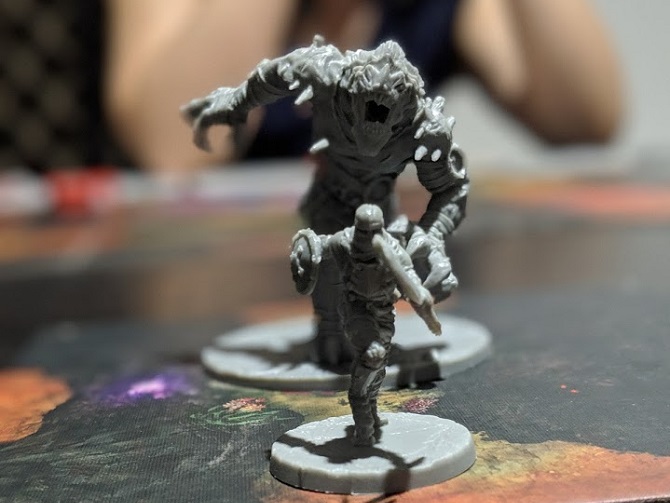
Because of this damage system, the humans start strong, sprinting towards their objective, rolling dice and doing as they please. But, as the infernal player puts troglodytes on the board, they begin to slow.
Maybe scoring one hit here, one hit there.
Now, the human player can’t perform as many actions.
Then they get hit again.
Now, the human player has even less.
This cycle of having your strength siphoned from you is suffocating and plays into the theme of dark underground caves. Edging your way through tight corridors not meant for walking.
The frustrating side of this mechanic is that the human player will often reach fail states early. When it’s obvious they aren’t going to make it but must play on until their character’s insides and outsides. Without the tension of the will they make it, or not, Claustrophobia 1643 isn’t that interesting. No game is.
As the infernal player, your turns are like the waves of the ocean. You can go turns without spawning anything and then turns where you wash ashore a Christmas carol of demonic underlings.
On the third day of Christmas, my true love gave to me
Three trog-lo-dytes
Two hell-hounds
And a demon who’s going to kill me.
In direct contrast to the human player, you get more powerful as the game goes on. Each turn you get more opportunity to put monsters on the board. Until, hopefully, you crush the human player and win the game.

No room to play
As expected the components of Claustrophobia 1643 are gorgeous. However, they also take up more table space than if I – an 85kg, 6-foot male – laid down on my table, with an all-you-could-eat sushi buffet scattered around me.
It is actually insane, the dungeon tiles take up so much space that they become a liability to the gameplay. We had to stop frequently to shift different dungeon pieces so that we could continue.
Another component issue is the overuse of iconography. As it stands, there are 29 different icons for you to remember, or forget. So you’re more likely going to be staring at the rulebook rather than your opponent’s ugly mug.
Though maybe it’s a good thing.
Compounding this problem is the lack of player information, helper cards, and key information that’s only found in the rulebook. For instance, how much it costs to summon each type of monster.
So where does this leave me?
Monolith only created 10,000 copies of this game, and that’s all there’s ever going to be. While the exclusivity of the game makes it feel like a treasured possession. The gameplay didn’t sit well with either me or my wife. Along with glaringly simple design issues, Claustrophobia 1643 is lucky there are no other two-player dungeon crawlers. Because compared to other board games, it left a lot to be desired.
Similar Games You Might Like

Gloomhaven: Jaws of the Lion Review – All of the Strategy None of the Shelf Space
Blow up dungeon walls and clear scenarios straight out of a spiral-bound book. A streamlined tactical crawl that kills off quarterbacking.

Vagrantsong Review – Saving Souls on the Spookiest Train in Gaming
The old-timey cartoon look lures you in, but brutal token draws will break your heart. A stylish, swingy campaign filled with haunting lore.

Arcadia Quest: Inferno Review – When Tabletop Hype Turns Toxic
Chuck buckets of dice to slay underworld bosses and hunt down rival heroes. A dungeon brawler that can be ruined by spiteful table politics.
A score tells you if it’s good, but the leaderboard tells you if it’s worth the shelf space.

 Loading ...