Raptor
Players: 2
Playing Time: 30 minutes
Designers: Bruno Faidutti, Bruno Cathala
Publisher: Matagot
Raptor is uplifted by its amazing theme of man vs dinosaurs. However, while the gameplay was fast, fun, and snappy, it felt unbalanced and dated compared with more modern board games.
Pros
- Getting to say “clever girl” a lot
- Combination of card play and map movement
- Asymmetrical gameplay
- Plenty of tools to win the game
Cons
- Scientists always had the upper hand
- Luck plays a large part in winning and losing
- Design feels dated
Love our reviews? Buying through our links earns us a small commission at zero extra cost to you, helping us table the next big release! Full disclosure here.
There’s a famous moment in Jurassic Park. A trained hunter hides in the bushes, silently aiming his rifle at a raptor. As he’s about to fire, he hears something nearby. Turning to his side, another raptor surprises him from the bushes. He manages to utter ‘clever girl’ before being brutally eaten alive.
Designers Bruno Cathala and Bruno Faidutti have recreated this ‘clever girl’ moment in the two-player board game, Raptor. With one player taking control of a mother raptor and her babies, and the other player, a group of scientists wanting to capture and research these dinos.
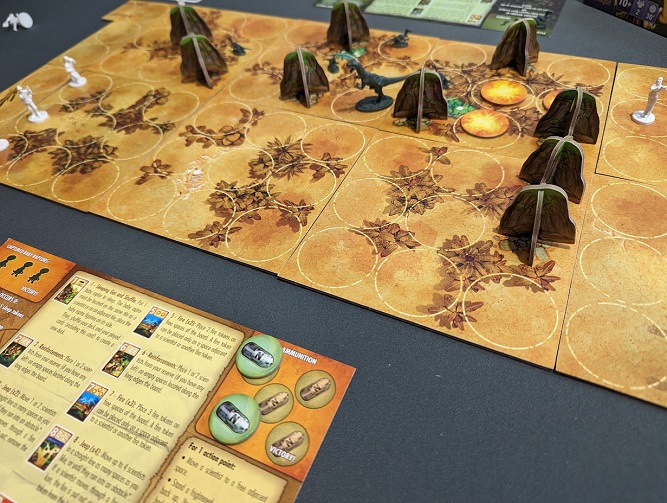
Throughout Raptor, you’ll be moving scientists or raptors across the game board trying to either capture the babies or guard them as they make their escape. However, each round starts with you picking one card from a hand of three.
These cards have both a value and effect. The player who selects the lowest-valued card gets to use the card’s effect, while the other player takes actions equal to the difference between the cards. For instance, there’s a value-two scientist card with the effect of adding more scientists to the board. If you played this, and I played a value-five card. Then you would add your scientists, while I get to take three actions.
As to what actions you can take, well, that depends on whether you’re the prehistoric pack animals or the walking, talking lab coats.
If you’re the former, you control both the babies and their parental guardian. The mother raptor can move long distances in a single action, kill scientists, put out fires, and awaken sleeping babies. The younglings aren’t so powerful, as they can only move one space per action, and escape.
On the other side of the board, scientists are also slow to move around. However, they protect themselves by shooting the mother from a distance. The babies require more care, and can only be tranquilized or captured if there’s a scientist in an adjacent space.
Upon capturing three babies, or shooting the mother raptor so full of tranquillizer it reenacts Will Ferrell’s scene from Old School. They win. Otherwise, team raptor wins if three babies escape from one of four corners of the map or all of the scientists are dead.

Raptors vs Scientists
While the theory of the card play in Raptor is rock solid, the balance of the cards is anything but. Ideally, you want a trade-off between low-value powerful effect cards and high-value weak effect cards. So that you’re constantly yo-yo-ing between choosing the effect and choosing the value.
In Raptor, it’s the high-value cards that also have the most powerful effects.
Because you usually play a high-value card to get a lot of actions. Getting these powerful effects instead feels like a consolation, rather than something you’re actively pursuing. With all of the strength in these high-valued cards, you’re also heavily disincentivised from playing low-value cards at all.
Further to this, between doing the actions or doing the effect, the actions are a lot more powerful. The card effects are situational at best, and useless at worst. Meanwhile, the actions are straightforward and put you on the path to victory.
With this being the case, my best option was to almost always play the highest card I could. Meaning, with a few situational exceptions, selecting a card became automatic and didn’t require any input from me.
This is such a shame because there are moments of brilliance throughout this phase. Where you pause and attempt to figure out what your opponent’s going to play next. But because of the balance issues with the cards, these moments are rare and this initial phase is not as fun or interesting as it should be.
Thankfully, it’s only half of the game, and it’s still fun (although not as much fun as it could have been). Mainly because it is driven by a lot of luck. With a hand of only three cards, it’s easy to get good and bad draws. Forcing you to adapt your plans on the game board to what you’ve drawn, rather than some preplanned grand strategy.
This injection of luck puts Raptor closer to Love Letter than something like Santorini. Even though there’s strategy and skill involved, luck can easily tip the scales in favour of inexperienced players. Making the game more accessible, and always giving players hope that they can win.
Grab your lab coat…
The theme of this review so far is that Raptor is fun but not balanced. As true as that is for the cards, it may also be true of the two roles in the game. Out of the seven games of Raptor we played, the raptors lost every time.
This is likely because of the power imbalance of the different sides, and how we played. You see, at the start of the game, mumma raptor can move around the board quickly and decimate the scientific forces. However, if shot only one time, then mamma’s effectiveness is halved. Every other time the mother is shot afterwards, her effectiveness craters even more.
Meanwhile, the scientists only get stronger as more time passes. They can lay fire on the board to slow down the movement of the raptors or flood the board with reinforcements. Leaving them with nowhere to go.
So unless the raptors win early, it’s very difficult to save all of your babies.
Yet, even though the scientists won every game, no game was without hope. Every game reached a crescendo where it seemed like the raptors were going to win. Only for a rogue sleeping dart to hit its target or a crucial reinforcement to join at the perfect time. From that point forward, the scientists would go on to win the game.
Therefore we end this review on a weird note. As you might read this and think Raptor is an unbalanced, unfun mess of a board game. That’s not exactly right. Yes, I think the game is flawed, but we still had fun with it.
I think if we went back to 2015 when Raptor was released, this would be an easy recommendation. Nine years on, and it’s a more nuanced conversation. I think there’s enjoyment to be had with Raptor, but the design feels dated and there are better options in today’s market.
Similar Games You Might Like

Air, Land, & Sea Review – 18 Cards of Tactical Perfection (No Miniatures Required)
Fight for three military zones using a tiny deck of eighteen cards. A high-stakes duel where knowing when to fold saves you vital victory points.

Radlands Review – A Neon-Soaked Duel at Terminal Velocity
It looks like a Mad Max fever dream, but plays like a deliberate, tactical slugfest. A tightly balanced wasteland duel where clever plays win the day.

Mad Love Review – An Eldritch Game That Won’t Ruin Your Relationship
Working without words to dodge madness creates sweet a date-night. A gorgeous memory board game in desperate need of difficulty settings.
A score tells you if it’s good, but the leaderboard tells you if it’s worth the shelf space.

 Loading ...