Furnace
Players: 2-4
Playing Time: 30-60 minutes
Designer: Ivan Lashin
Publisher: Arcane Wonders
Furnace is a game of two halves. The first half, with the auction, is incredibly innovative and provides fascinating choices and interesting decisions. The second half, the engine-building, is rudimentary at best.
Pros
- Auctions! Lose to win, or win to lose. Such an intriguing take on auction mechanics
- Player powers change how you approach the game
- Engine-building can be fun, if unremarkable
- The artwork is amazing and the box cover is beautiful
Cons
- The engine-building is lacklustre in comparison to other games
Love our reviews? Buying through our links earns us a small commission at zero extra cost to you, helping us table the next big release! Full disclosure here.
When I first came across Furnace back in 2021, I was intrigued by its approach to auctions. Where you bid on multi-use cards, and the winner of the auction adds the card to their engine, while the losers are provided resources from the card equal to the amount bid.
Having played Furnace, I can confidently say that this new mechanic is spectacular. It lived up to every anticipation I had. The auctions are fast and full of interesting decisions to make.
After the auctions, comes the production phase.
When you put all of the cards you won in the auction to work. These cards either give you resources or allow you to convert resources into different types, like coal into oil. Eventually, you’re looking for cards that will convert resources into money. Because if the current state of the world has taught us anything. It’s that you need money to win.
After four rounds of auctioning, resolving, and producing, the person with the most money wins.
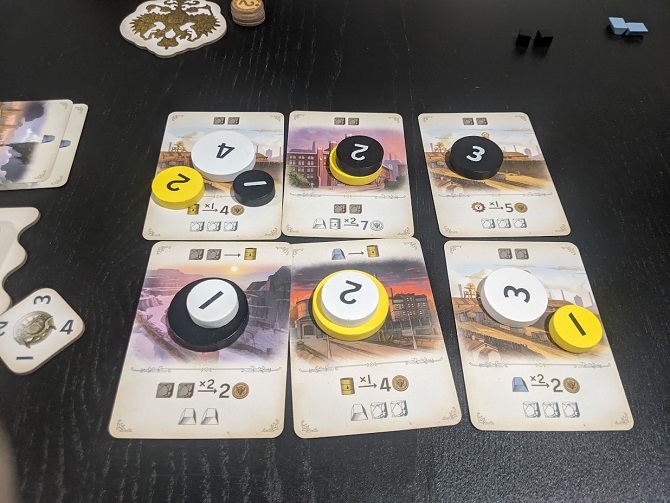
Ready, set, auction!
Despite the whole game of Furnace revolving around the all-mighty dollar, auctions use a different resource altogether. Four discs are labelled from one to four, denoting their purchasing strength. Throughout the auction process, you’ll trade turns putting one of your four discs on a market of cards.
This limited amount of chips makes bidding more strategic than the chaotic auctioning you’d find in Vault Wars or High Society. Because once you’ve bid with a chip, you can’t move it again. Meaning you need to put all your thoughts behind every placement.
The cards you win in Furnace have two functions. First, they provide you with either a resource or convert one resource type into another during the production phase. Secondly, they provide you with several resources when you lose a bid on a card. This amount is equal to what’s shown on the card, multiplied by the chip you lost.
So if you bet your three-chip and lost on a card that gave two coal, you’d gain six coal. Now, I don’t know about you, but that’s a lot of coal. But, is it worth losing your three-chip?
This is the question that Furnace forces you to answer every auction phase. While sometimes it is worth it, other times, you’d rather use your three-chip to get another card in your engine.
Between this choice, and then wondering which cards you should win, when to place your powerful chips, and when to lose an auction. Furnace expands the typical decision space within auction games and is an absolute blast.
Unfortunately, it’s the rest of the game that ultimately lets Furnace down.

Engine building by the numbers
When the production phase starts, the fun of Furnace stops. It turns from this fun, interactive game in the auction phase into an exercise of bean counting. It takes a lot of work to sort out your engine, often you’re performing several conversion actions for small gains.
Then, because these conversions are all straightforward, without any conditionals or combinations. It feels dry and lifeless compared to other engine builders like Jump Drive.
Meanwhile, it also creates this dead zone of interactivity. When everyone is so focused on their engine, they stop interacting with the rest of the table. Both as individuals and the engines they create, nothing impacts the other players. It’s a complete 180 from the auction phase and lasts too long because of the amount of work required to get an outcome.
It’s A Wonderful World, is a similar game that trades auctions for drafting. But unlike Furnace, it realises that the production phase isn’t fun, and blasts through it as fast as possible. Keeping the focus on drafting, and what makes the game enjoyable.

Capitalistic commentary
It’s interesting to apply a 2022 lens to the gorgeous card art in Furnace. Whenever you upgrade a card and flip it over, the artwork shows the factory, oil pump, or whatever, becoming greater than what it was. Either by adding more surrounding buildings, a greater smoke stack, or another oil pump.
In essence, this demonstrates the growth of technology. It simultaneously shows the impact of these inventions, and the industrial revolution, on the environment. Beautiful vistas are replaced by city skylines, and clear skies are now filled with fog. Whether intended or not, I appreciated how this tempered the ‘capitalism is amazing’ messaging found throughout the gameplay.
Otherwise, Furnace is a fine game. Its quick tempo and excellent auctioning will delight many. But the unremarkable second half of the game stops it from living up to its full potential.
Similar Games You Might Like

Ra Review – A Revised Classic Worth Shouting About
Praise the sun god or watch your auction bids go up in smoke. The essential Knizia masterpiece that turns simple probability into pure push-your-luck panic.

Raccoon Tycoon Review – An Anthropomorphic Slog Through the Gilded Age
Corner the market on luxury goods and hoard railroad stock in top-hat style. A sleek economic simulator that drags on far longer than it should.
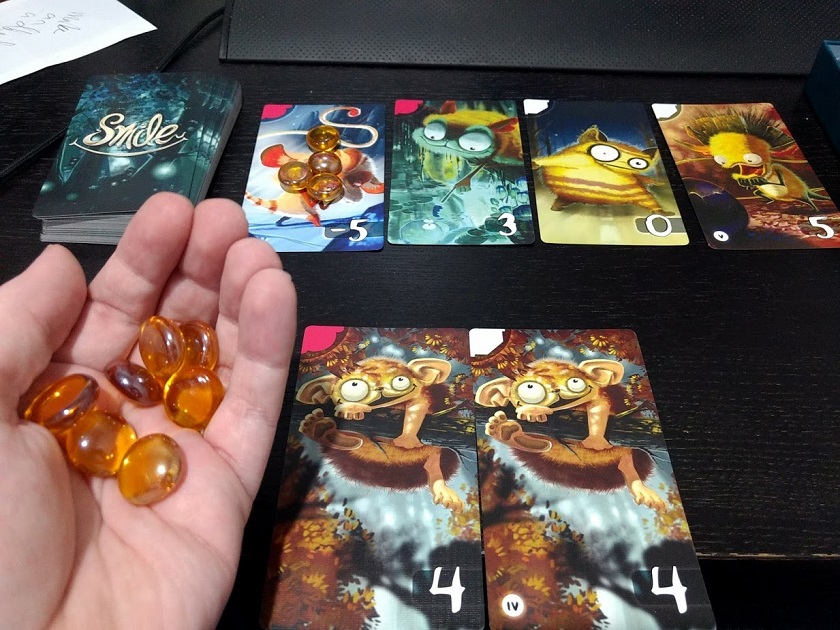
Smile Review – The Ups and Downs of Auctioning Fireflies
Nothing to smile about when you’re out of fireflies. A delightfully mean bidding game where savvy bidding is the only way to survive.
A score tells you if it’s good, but the leaderboard tells you if it’s worth the shelf space.

 Loading ...