Beyond the Sun
Players: 2-4
Playing Time: 60-120 minutes
Designer: Denis K Chan
Publisher: Rio Grande Games
I loved how Beyond the Sun’s tech tree allowed competing players to progress humanity as a whole. But it felt like there weren’t enough systems to make full use of how excellent it was.
Pros
- Having a choice and building a tech tree that fits your playstyle is awesome
- Creating new actions for yourself and others is exciting and rewarding
- When battling other players there’s no risk of losing ships like in other area control games
- Interesting way of gaining resources that make you think
- An ingenious use of dice for population, supply, and spaceships!
Cons
- Not much goes on outside of the tech tree.
- Hard to read the planet cards from the other end of the table
- Games start to feel similar after a few plays
Love our reviews? Buying through our links earns us a small commission at zero extra cost to you, helping us table the next big release! Full disclosure here.
In the Star Wars vs Star Trek debate, I lean towards Star Trek (especially Strange New Worlds). I enjoy the hope, optimism, and aspirational cooperation shown by humanity. The very same things shown in Beyond the Sun.
Despite being a competitive board game where you’re fighting over victory points, objectives, and other board gaming staples. There’s an undercurrent of cooperation. For instance, if you research Wormhole Technology, everyone can learn to use it in the future.
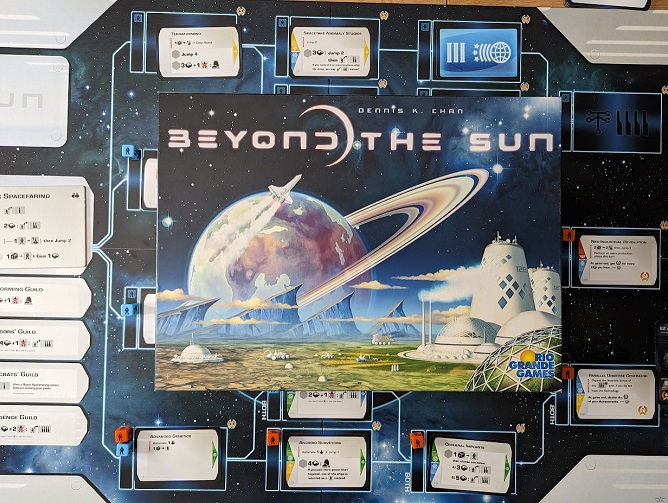
This cooperative/competitive blend is not the only unique feature of Beyond the Sun, because well… The whole board is one giant tech tree.
How to play
The galaxy is a big place and if humanity is to make any kind of splash in the universe, they must work together. Or at least, not against one another.
In Beyond the Sun, players control rival companies researching new technologies, colonising unknown planets, and getting victory points. Through these actions, players complete public objectives, and if enough of these are achieved, the game ends.
Getting into the nitty-gritty, there are two distinct systems at play.
The prominent central board acts as a technology tree for all players, with four levels of technology to research. Starting at the second level, each technology is connected to one in the previous level by a line. Thereby creating a requirement, where you must learn the earlier technology to research the later one.
As you research new technologies, you’ll also activate different event cards. These one-time activities can benefit you, or everyone at the table, or even be a hindrance by adding tax to an action.
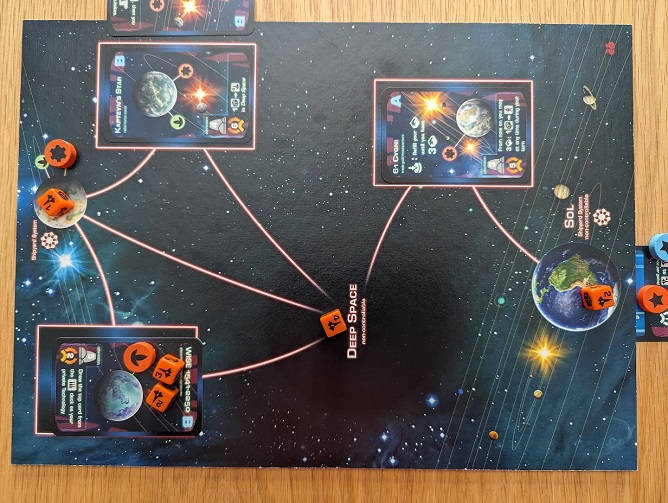
The secondary system is the space board, placed awkwardly to the side of the main board. This is where you can flex your military might. Build and move your ships from planet to planet, gaining control and preparing to colonise them for victory points and other bonuses.
Now you have a high-level feel for the game, when it comes to your turn, you’ll move your single token, or worker, from one action space to another on the central board.
Each action space has an attached action that you perform before producing one of the game’s two resources: population or ore.
Initially, only a few actions are available. However, as you research more technologies, you’ll discover more powerful action spaces. Letting you do more on each turn.
Some of these actions allow you to jump your ships from one planet to the next on the space board. To gain control of a planet, you need the most powerful fleet of spaceships stationed there. By doing so, you gain more resources and prepare the planet for colonisation.
Colonisation is also achieved through actions on the main board. When performed, you move the planet from the space board to next to your player board. You also carry out the colonisation bonus and gain a lot of victory points for bringing this planet under your wing.
Continue to take turns, researching technologies, gaining resources, and colonising planets until three to four objectives are completed (the number depends on the player count). At that point, you count up your victory points to see who wins.
Technology talks
Discovering new technologies in Beyond the Sun is joy manifested.
First, you uncover an event card, with effects ranging from mildly annoying, like a small increase in the cost of certain actions, to changing the game state for all players. Either way, it’s an exciting way to start a turn.
Next, you draw two possible technologies, weigh them up, and add one permanently to the technology tree. Because it affects everyone, and you’ll be able to use it from here on out, there’s a lot of power behind this choice.
Especially when you reach the level three and four technologies. The level four technologies, in particular, provide you with a massive boon and another way to score points.
Now as awesome as this technology tree and research is, there’s not much else going on in Beyond the Sun.
OK, yes, you can research automation which grants you more resources during your production phase. But that’s nowhere near as exciting as the research of new technologies.
Neither is the space board. Where fighting and colonising planets felt bare-bones at best. Again, yes, there are some interesting control and colonisation bonuses to mix things up, but overall the area-control component of Beyond the Sun felt like a distraction.
In fact, I lost every game when I indexed heavily into the military. Despite its heavy reliance on resources, you don’t gain the same amount as you would if you focused purely on research. Quickly putting you behind with no clear path to catch up.
Another reason for these losses is because at its core, Beyond the Sun is a game of efficiency and getting the most out of every move. However, area control is almost the opposite of this. Where you lose a lot of time and actions by moving your units around a map or challenging other players in space.
So what happens when one player focuses on the technology track and the other on space battles? The scales of efficiency swing wildly in one player’s favour.
I’ll let you guess which one.
On the other side of space
We’ve now learnt that the technology tree is the main focus of Beyond the Sun. A fact obvious to anyone who takes one look at the massive board in the centre of the play area.
However, as compelling as the technology tree is, it wouldn’t be half as interesting without the unique resource generation found on your player board.
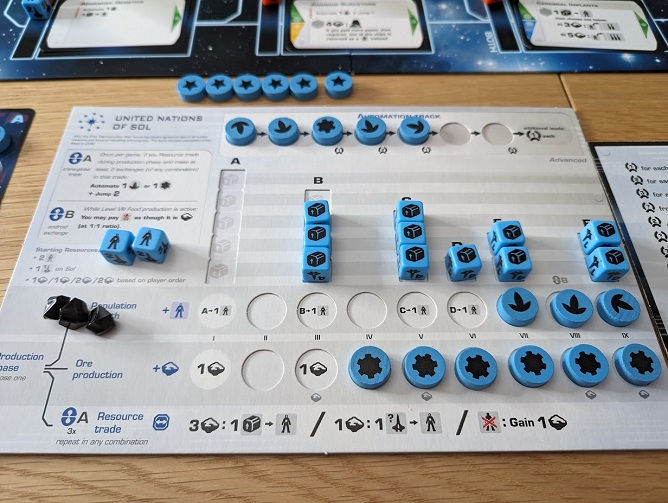
Unlike other games where you simply have a bank to draw resources from, Beyond the Sun opts for several columns of supplies found on your player boards. Under this, you’ll find two rows of tokens, one for population and another for ore.
You remove tokens from these rows through researching automation, controlling or colonising planets. Eventually, you uncover icons that provide you with more population or ore when you produce at the end of your turn.
While that sounds standard, it gets interesting when you realise each icon for population relates to one of the supply columns. So the first icon you uncover provides population from column A, and the second icon provides from column B. Therefore, if you’ve uncovered both icons, you gain one population from columns A and B during production.
As the game goes on, you continually draw from the left column until there’s no more supply left there. Continuing the example above, producing when column A is empty, only nets you population from column B, rather than column A and column B.
I haven’t played a board game with resource management like this before, and it caught me off-guard several times. While I would have columns filled with supply, they were on the right side of the board and unavailable to me.
This created moments where, in any other game, my economy would be ramping up and I would have a player board filled with supplies. Here, I was broke looking for ways to gain more population.
Notably, this was experienced more when playing with the advanced player boards. Because the column lengths were abnormal, different players felt the sting of a declining population at different times.
Now before we wrap up this review, I have one complaint I need to get off my chest. That’s how large the central board is. Maybe it’s my mid-thirties eyesight, but it was difficult to see and read everything within the game.
Players on one side of the table had trouble reading what was on the other side. Given how important everything is to winning, not being able to keep everything in focus gave some players a clear advantage.
Overall, I came away thinking Beyond the Sun was a great game missing something. One stubbie short of a six-pack as we’d say in Australia. The technology tree and resource systems were marvellous, but let down by the serviceable-at-best area control. This means there just wasn’t enough to do within the game.
However, with that said, there is a fairly new expansion that I’m hoping adds the missing piece I need to give Beyond the Sun a higher ranking.
Similar Games You Might Like

Argent: The Consortium Review – Harry Potter and the Quest for the Cushy Corporate Salary
Sling spells to send rival wizard students into the infirmary to hijack board spaces. An outstanding, high-friction worker-placement where hidden judges make you paranoid over every move.

Raiders of the North Sea Review – Sending My Hard-Earned Crew to the Big Viking Farm Upstate
Takes the wind right out of your sails. A clever, fluid worker-placement design spoiled by punishing crew losses and random combat dice.
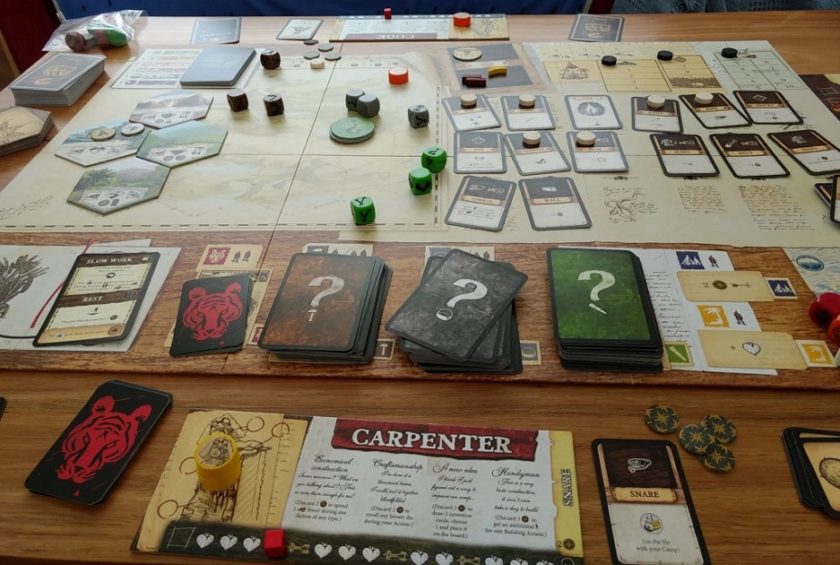
Robinson Crusoe Review – Less Desert Island Adventure, More Depressing Russian Novel
Surviving on an deserted island is depressing when single die rolls ruin an hour of planning. An excellent narrative experience ruined by unfair punishment.
A score tells you if it’s good, but the leaderboard tells you if it’s worth the shelf space.

 Loading ...