
Raiders of the North Sea
Players: 2-4
Playing Time: 60-80 minutes
Designer: Shem Phillips
Publisher: Garphill Games
Raiders of the North Sea would be one of favourite board games if it wasn’t so frustrating! Losing your hard-earned crew on an ill-timed raid takes the wind right out of my sails.
Pros
- Interesting worker placement mechanic of using two action spaces
- Decision space increases throughout the game as new workers are added to the mix
- Great theme that thrives with artwork from Mihajlo Dimitrievski
- Lots of ways to win, as long as you’re still raiding
Cons
- Feels awful to lose your crew during a raid
- Points are distributed by dice roll, making the end result feel random
- The theme may put some people off
Love our reviews? Buying through our links earns us a small commission at zero extra cost to you, helping us table the next big release! Full disclosure here.
Raiders of the North Sea is the chicken tikka masala of board games. Two different cultures combined to produce something flavourful and tasty. Only in this case, we’re talking about traditional European board games that focus on deterministic efficiency and American-style games that rely on theme and chance.
At the heart of Raiders of the North Sea, you’re collecting and spending resources such as iron, gold, and livestock as effectively as possible. However, you’re also a Viking putting together a rag-tag crew of misfits and raiding nearby villages for glory.
Each turn you decide which side of the game you want to engage in. Whether you want to take your crew out raiding or spend time in town trading resources and preparing.
For most of the early game, you’ll potter around the town by placing a worker token from your hand onto an empty village space. Where you place the token, determines what action you take. Some of these actions include recruiting townsfolk to your crew, returning an offering of goods to the chief for glory, and increasing your attack power at the armoury.
After completing your action, you pick up a worker from another space and carry out a second action. In this way, you’re always holding onto one worker token throughout the game.
Once you’ve spent a few turns in town, you’ll want to take your crew out raiding. There are many settlements ripe for the taking, and each has different goods and defensive capabilities. So choosing the right settlement to attack feels almost like choosing new clothes from a Sears catalog.
Upon picking your victims, you’ll roll an attack die and add the attack power of your crew and any bought from the armoury. The higher your attack power, the more damage you do, and the more glory points you’re awarded for your victory.
You’ll also get all of the goods from the village, including any black skulls. These represent your crew falling in battle and joining Valhalla. You know, the Viking version of the big farm upstate. In-game though, picking these up requires you to discard an equal number of members of your crew.
This cycle of going to town, preparing to raid and then pillaging local villages continues until your chief no longer wants any goods, or there are no more fortresses left to raid. At that point, count up all of your glory. Adding points for crewmates in Valhalla, attack points from the armoury, and any leftover resources. Whoever has the most points wins.
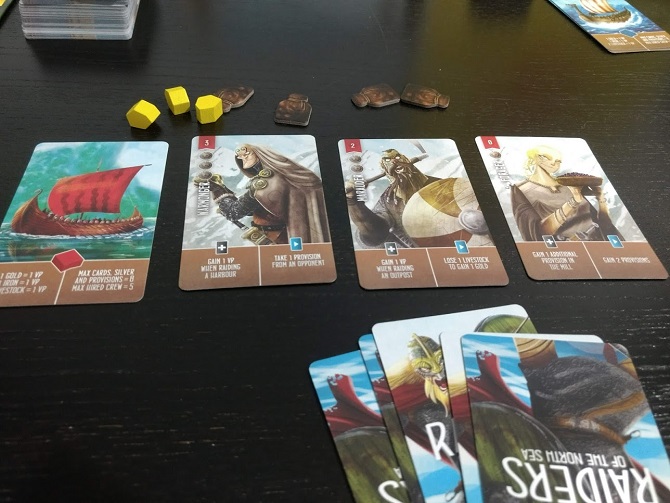
Them’s fighting words
Raiders of the North Sea is one of the most interesting and elegant worker placement games I’ve played, only beaten by my favourite Argent: The Consortium. However, it also feels unfair to play because of several different mechanics.
Chief amongst them is the dice rolling. Whenever you raid a village, part of the action is to roll a die and add that value to your attack power. Villages have multiple defence values, and if your attack power meets or exceeds these values you gain the associated points. For instance, one village has two defence values 8 and 14. So if your attack power is 8 you get 2 points, but if your attack power is 14 you get 4.
As a result, there’s an element of luck to raiding as to whether you get 2 or 4 points. This wouldn’t be an issue in a shorter, lighter game. But in Raiders of the North Sea, it takes a while to build your crew and send them out to sea. It’s a lot of work for a somewhat random result, almost like you working a double shift only for your boss to tell you pay is going to be decided by a roulette wheel.
Throughout the game, these moments of luck compound and by the end, because scores are normally tight, I’m always left wondering if I lost due to poor luck or poor skill.
Now to be fair to Raiders of the North Sea, a lot of games suffer from luck being a deciding factor. Suppose someone gets a good draw or lucks upon a good combination of cards for instance. However, here it’s so pronounced within the design that it’s hard to ignore.
This appears to be a symptom of trying to cross-pollinate these two different design cultures. If you’re putting in the work to do something in the game, then you want a deterministic outcome. However, in keeping with the theme, randomness was introduced.
It’s a similar story to the Valhalla/Valkyrie mechanic. Because It takes so long to generate a worthy crew, losing them all raiding feels terrible. Since you know how long it takes to rebuild. Again, in a lighter, shorter game this would be fine. But here it just takes too darn long to recover.
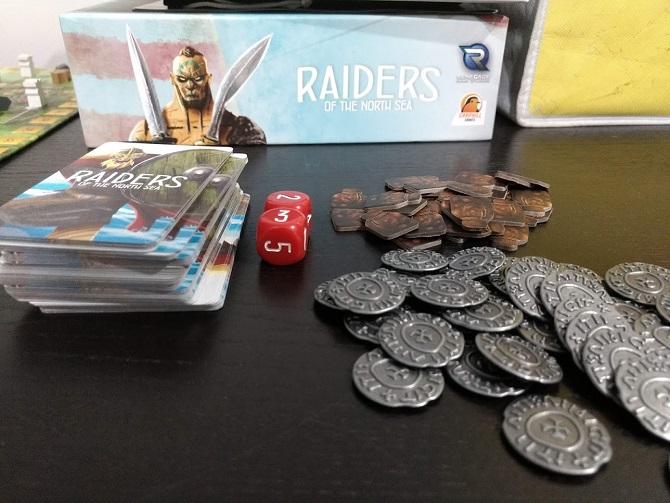
Valhalla is fantastic for victory points
For all its faults, Raiders of the North Sea is still one of the better worker placement games on the market. All due to its fantastic put-down, pick-up gameplay.
In comparison to a traditional worker placement game like Viticulture, where each round starts with you thinking about where all your workers need to go. Thereby creating a chain of placements that’s only interrupted if an opponent blocks you. Raiders of the North Sea only gives you one worker and an ever-changing availability of spaces. Making it darn near impossible to get dragged into the mires of analysis paralysis.
Another benefit to this gameplay is that there’s no cleanup phase where you need to pull back all of your placed workers. Instead, it’s just turn after turn of great board gaming action. For someone who hates bookkeeping as much as me, this is a true highlight.
Then there’s the strategic aspect of this mechanic that comes alive halfway through the game.
As players raid stronger villages, they’ll bring back different coloured workers. These new workers produce different outcomes from the same spaces. Making your choice of put-down, or pick-up a lot harder. Specifically, because you now must choose what’s more important; the worker or the action. A fun decision to make, but not easy in any regard.
Stepping back to look at Raiders of the North Sea from a strategic viewpoint, you’ll see that building up your crew and raiding is central to winning. But so too is figuring out what to do with your spoils. Should you use them to appease the chieftain, or reinvest into your next offensive?
When it comes to the next offensive, the question then becomes which settlement should you raid. Having most of your crew die off and go to Valhalla is fantastic for victory points, but will leave you crippled in the long run. The opposite is true of silver, which is worth no points, but can be used to bolster your position for later on.
All of these decisions are exciting to talk about and make me want to sing the praises of Raiders of the North Sea louder than Thor in the mead hall. Except for the dice rolling and Valkyrie mechanics. These put a real damper on my enjoyment of the game and they greatly distract from an otherwise strategic and well-balanced board game.

Similar Games You Might Like

Fantastic Factories Review – All the Bricks, None of the Instructions
Dropping a tub of colorful building blocks without the assembly guide. A breezy introductory game that lacks the combo magic of big engines.

Mint Works Review – The Chaperone That Shut Down My Engine
Building a tiny economy is great until the seven-point limit abruptly ends the fun. A clever travel toy that cuts off its best ideas.

Dinosaur Island Review – Slap Bands and Boring Board Game Chores
This park is all flash and no bite. A stunning box of neon plastic hides five phases of dull, disconnected housekeeping.
A score tells you if it’s good, but the leaderboard tells you if it’s worth the shelf space.

 Loading ...

Get out of my blog drafts!!! 😛
You’ll see whether I agree with you tomorrow when my review posts. LOL
Though after reading this one, I feel the need to whittle my review down some…
I backed Architects of the West Kingdom, so I can’t wait to get my hands on that one!!!
Haha snooze you lose! Looking forward to reading your hot take.
Super jealous of the Architects backing. I was tempted cause I love the art, but hard to go in when I hadn’t played Raiders yet.