Robinson Crusoe: Adventures on the Cursed Island
Players: 1-4
Playing Time: 60-120 minutes
Designers: Joanna Kijanka, Ignacy Trzewiczek
Publisher: Portal Games
The way Robinson Crusoe: Adventures on the Cursed Island can tell a story is just… wow. Amazing. The rest of the game lets it down, with over-complicated rules and too much bookkeeping. Turning a wonderful story game into a chore.
Pros
- Great selection of actions from exploring to inventing, feels sand boxey
- The threat cards that get sunk into the event deck help the story of your shipwreck
- Plenty of replayability in the different scenarios
Cons
- Too long and too random, you can easily invest an hour into a game for you to draw a card that all but says game over
- The rulebook is tough to get through – even if it’s been improved significantly
- What’s the opposite of streamlined? Because this game is that, lots of moving parts and tedious bookkeeping each round
Love our reviews? Buying through our links earns us a small commission at zero extra cost to you, helping us table the next big release! Full disclosure here.
Saying that Robinson Crusoe: Adventures on the Cursed Island is just a retelling of the book is very limiting. This board game isn’t just that. It’s a framework that allows you to play all sorts of weird and wonderful scenarios.
For this review, we’ll focus on the first scenario: The Castaway. However, in all scenarios, you’re trying to survive on a deserted island. Although this is a mean island, and it just found out you married its high school sweetheart. So prepare for trouble.
To survive in The Castaway, you must build a wood pile and set it alight before the 12th day. Failing to do that, you lose the game. You also lose if anybody, except for the island native Friday, dies. So if he’s the first to go, we say TGIF!
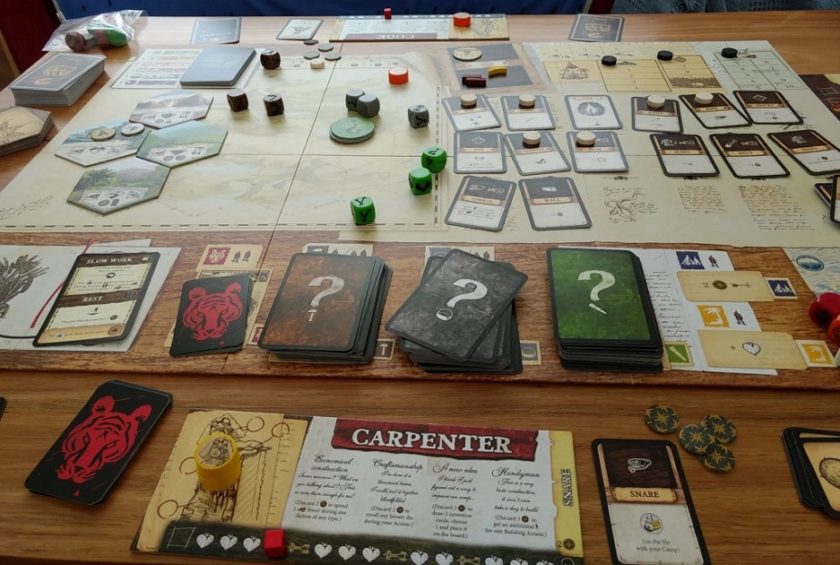
Each round begins with a randomly drawn event in the Event Phase. Immediately carry out the effect on this card and add it to the event queue. While in this queue, the event card gives you a task to complete. After several rounds, if this task remains incomplete, another more disastrous effect gets activated.
With these events comes a little bit of thematic seasoning, that creates a story for both the initial event, as well as the delayed activation. For example, the event might be that a tiger came into your tent and stole two foods. This event is added to the queue, and the task given is to hunt the tiger requiring a level 3 weapon. Finally, the delayed event is that the tiger returns and attacks the characters.
These vignettes of island survival are marvellous at immersing you in the world. So much so, that by the time you finish, you’ll need a volleyball called Wilson.

Lights, camera, action
After the Event phase, the next few phases have you collecting or losing resources like food, wood, and determination tokens. It’s not until the Action Phase that you get to interact with the game.
Now, you get two tokens representing half a day each, and it’s up to you to decide what your character is doing throughout the day. You can spend your two half days on two different tasks, or you can spend a full day on one task.
It’s tempting to spend a half day and get more done. But in doing so you need to roll the action dice. These determine whether you got wounded during the activity, completed it successfully, or went on an adventure. So it’s a mighty big risk.
The actions you can perform include:
- Dealing with an event in the queue
- Hunting beasts for food and fur
- Build inventions, a shelter, a roof, a palisade, or weapons
- Gather resources from a location on the map
- Explore a new section of the map
- Spend time in the camp restoring your morale
- Rest and gain some health back
After you’ve taken your moves, received the boons from your actions. There are two more phases ready to punch you in the stomach. The Weather Phase is first, and in it, you roll dice to see if you’re cold and miserable, or freezing to death and miserable.
Next is the Night Phase, where everyone needs to eat or take two wounds. Further, if you don’t have shelter, take an extra wound. Finally, any perishable food you collect during the day goes rotten and is no longer available next round.
Then a new round begins.
Continue until you’ve won, lost, or forgotten the rules – there are a lot of them!
Borrowing from the survival genre
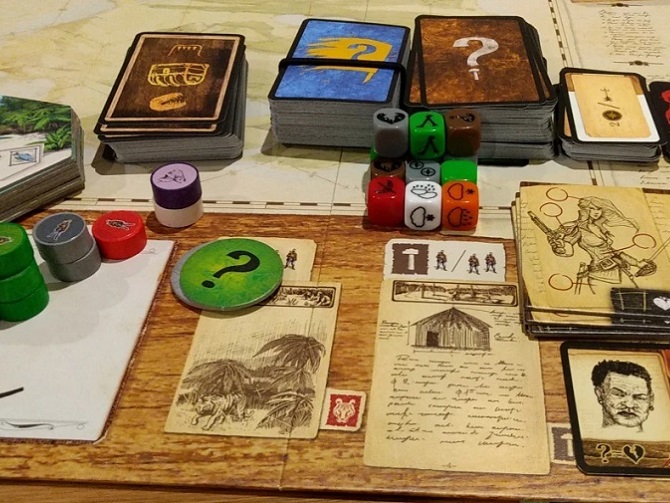
Robinson Crusoe: Adventures on the Cursed Island is nothing if not thematic. From otters eating all the fish in a local waterway to getting a cold and taking a sick day. There’s a story behind everything that happens on the island.
It all starts with the event cards, which offer a story and a choice between dealing with the event, or waiting until something worse happens. This same tradeoff is seen in the Adventure Cards, they sometimes give you a tradeoff of getting something good now – but something awful will happen in the future.
This is a super fascinating mechanic where, like Spirit Island, it lets you know what’s going to happen before it does. Leaving it up to you to decide what you’re going to deal with. This triaging is tough but makes for great discussion and internal conflict. It’s also on brand for a game about survival.
Another genre trope of the survival genre is the feeling of growth, and this is something Robinson Crusoe nails. From washing up on shore with nothing but a shirt on your back, by the end of the game, you’ll have shelter, food, and tools. If everything goes right, and you manage a miracle or two, then in the space of two hours you get to experience a journey from helpless to hopeful.
However, it’s hard to get to this point because on one hand it’s a brutally punishing game, but on the other, it’s deep and thoughtful. With only two actions per turn, you’re limited in what you can do but the options to choose from are plentiful.
Figuring out which actions are the right ones to take, is a thoughtful and deep decision to make.

Anton Chekov eat your heart out
Robinson Crusoe says it’s based on a book of the same name, however, it shares more similarities to old depressing Russian literature. Where bad things happen constantly, and unpredictably, just like in life.
But is gamifying tragedy fun?
Especially in such a long, complex, and thoughtful game as Robinson Crusoe. With its limited actions and resources, you need to be putting deep thought into what you’re doing. However, does it even matter? As when you’re late in the game you’re forced into rolling dice to see if your action is successful, no matter how well you performed.
These action dice are beyond punishing, to the point of being anti-fun. They have no place in the world of modern board game design. You’re already risking a wound or an adventure, so being unsuccessful on top of that is the game kicking you while you’re down.
For an example of how awful it can be, I spent a half day building the Shortcut invention. Thanks to the dice, I failed to build it, took a wound, and drew an adventure card that forced me to remove another invention I built. In a game where everything is so tight, that roll meant my game was over.
Over an hour of investment, gone in the roll of a dice.
These action dice aren’t the end of the punishing mechanics in Robinson Crusoe. The weather dice and the event cards are further random factors that can decimate your hopes of winning.
Now, to be clear, I don’t mind that it’s punishing. But it’s the lack of control that comes with these mechanics that makes the game feel awful to play. Often it feels like no matter what you do, the game is already lost.

Lost in its own complexity
At the top of the review, I talked about how Robinson Crusoe is a framework – a sandbox to play in. And that’s true, while there are multiple scenarios to work through, there’s also a glut of extra rules specifically catering for those scenarios.
As such Robinson Crusoe is the antonym of streamlined, it’s cumbersome to learn, teach, and play. Solely because of all the intricacies you must get your head around, that might never occur.
However, the biggest issue with Robinson Crusoe is the ratio of player involvement to administration and overhead. Of the five phases, you only get to do anything in one. This is unacceptable for a board game in this day and age, and indicative that maybe the tabletop isn’t the right medium to play it.
When you combine this downtime with the extreme levels of punishing randomness. It’s a game where the more I played it, the more frustrating it became. That’s despite the incredibly novel and awesome way it integrates story into gameplay.
In 2012, you could get away with games like this, that distract you with the theme in one hand and punch you with the other. But in 2023, there are too many other games like Sleeping Gods, that fill this niche better.
Similar Games You Might Like

CO2: Second Chance Review – Save the Planet, or Die Trying (Most Likely the Latter)
Balancing global infrastructure gets tricky when a random bag draw doubles atmospheric pollution. A gorgeous puzzle ruined by bad luck.

Forbidden Sky Review – Too Much Rocket Science, Not Enough Adventure
Wire up a giant plastic rocket ship while storm winds blow your crew off the edge. A flat, overly cautious puzzle plagued by quarterbacking.

Spirit Island Review – The Masterpiece That Feels Like Rushing to Work on a Saturday
Losing yourself in your own spirit’s unique strategy leaves zero room to boss anyone else around. A formidable, sprawling co-op that completely redefines the genre.
A score tells you if it’s good, but the leaderboard tells you if it’s worth the shelf space.

 Loading ...

I have only played this game solo but your experience sounds a lot like mine. I enjoyed this game the first few times I played (though set up seems to take a bit). But as I started understanding and diving into the mechanics I realized how luck based this game is and it kinda put a sour taste in my mouth.
I recently dusted it off, played again, and tried two plays. One always playing it safe and second always playing with one pawn at a place. Playing it safe ended in disaster as I just couldn’t do enough. Being riskier was better for game play but you’re right, it came down to dice rolls and I don’t enjoy that for a two hour punishing game.
Great review!
Have you played the Mars version? Thoughts? Does it fix some of your issues?
I haven’t yet. From the reviews I’ve read though it doesn’t sound like it does. Recently I’ve been playing Spirit Island. Now that’s game that solves all of my issues. Highly recommended.
Great review, thoughtful discussion of the mechanics and the experience, and nice to see you return to consider the game several times from different angles. Also amusing.
I find myself wanting to read the book again, and play the game as if I was marooned. What choices would I make, surely it must have been a very hard struggle to survive, but the difficulty in a game impacts the fun. Is this a simulation or a game? Not knowing the game well, I’m wondering whether there are house rules you could adopt to make this stream limed and less punishing, or is that build into the heart of the game and impossible to change?
Thanks again.
Hey HinVan,
Cheers for reading, I know it was a long one – haha! I think it positions itself closer to a simulation than game, however, with a few tweaks and house rules you should be able to tone down the difficulty to a point where you can enjoy yourself. They have a few suggestions in the back of the rules book for this as well.
I’m sure some other people will have some great ideas as well.