Disclaimer: Trials of Maya was provided for free by Department of Lore, although the writing and opinions of this article are my own.
Trials of Maya
Players: 1-4
Playing Time: 60-120 minutes
Designers: Anand Gandhi, Aayush Asthana, Zain Memon, Yash Patel, Ahan Sahoo
Publisher: Department of Lore
Trials of Maya somehow pulls off its ambitious mix of MOBA gameplay and deck construction, and I had a lot of fun with both sides of it. The rulebooks and prototype components need some work, but underneath those frustrations is a game that left me wanting to try more heroes and decks.
Pros
- Card combos are genuinely satisfying when they come together
- The MOBA-style map movement and positioning work surprisingly well
- Heroes feel meaningfully different from one another
- Lots of strategic depth without every decision feeling overwhelming
- Deck construction gives you plenty to tinker with between games
Cons
- Large decks can make getting the cards you need frustrating
- The rulebooks are long, awkwardly organised and hard to reference
- Some rules are buried in unexpected places
- Prototype health tokens and map components were fiddly and easy to knock over
Trials of Maya is live on Gamefound now. You can check out the campaign, follow the project, or back it on their Gamefound page. (Disclosure: This is an affiliate link. If you back the project through it, I may receive a small commission at no extra cost to you.)
If you’re on the same algorithm as me, you’ve probably seen several adverts for Trials of Maya, a new MOBA-esque board game that’s just gone live on Gamefound. I was fortunate enough to receive a prototype from Anand Gandhi and Zain Memon, giving me a first-hand look at the game, its miniatures and everything else packed into its very large box.
What stands out about Trials of Maya is its combination of a MOBA-inspired gameplay loop, complete with heroes, abilities, minions and base destruction, alongside the deck construction, card combos and synergies you’d expect from a game like Magic: The Gathering. It’s an incredibly ambitious project, but does it actually deliver? Let’s find out.
How to play
If you subscribe to simulation theory, Trials of Maya should be very familiar to you. You live inside a computer simulation and take on the roles of legendary heroes throughout time. You are pitted against one another through a number of simulations to see who wins, all in the name of understanding causality.
Really, it’s every power ranker’s fantasy.
Trials of Maya comes with multiple game modes, including Headhunters and a 2 v 2 Siege Mode, but the one we’ll be focusing on in this review is 1 v 1 Siege Mode.
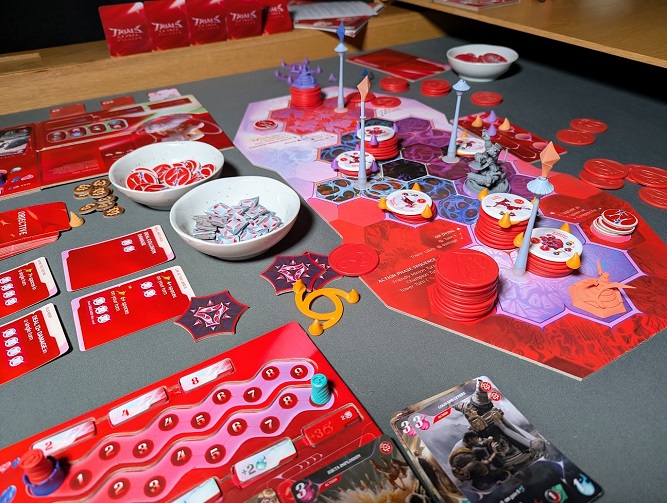
In Siege Mode, the goal is simple: destroy your opponent’s base. Unfortunately, their base is sitting at the other end of the map, so you’ll first have to wade your way through neutral minions and your opponent before you can get into striking distance. You can also damage the enemy base by killing their hero, with each death dealing an increasing amount of damage to their base.
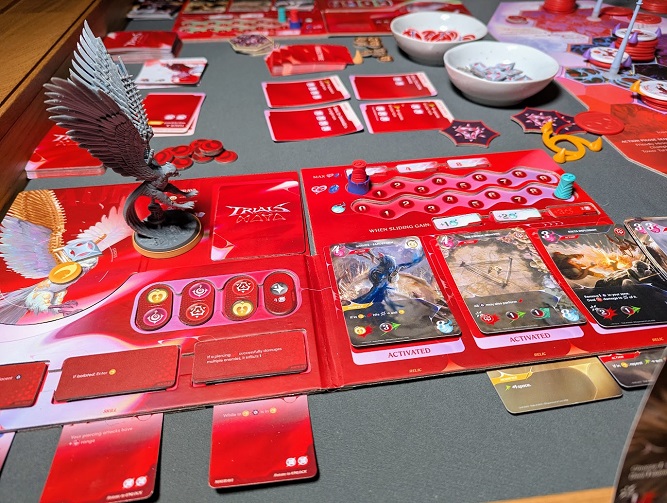
At the start of your turn, you’ll have three cards sitting on your player board. These are the cards you can currently activate. You spend energy to use their actions, which can let you move, attack, defend, draw new cards, or push and pull your enemies around the map.
At the end of your turn, the card furthest to the right is pushed off your board, giving you the amount of energy shown on the card. This means you’re constantly cycling through your cards, and any card you add to your player board sticks around for three turns before you won’t see it again.
In addition to the above basic actions, most cards also have their own special abilities, far too many to list here. Heroes also have a number of unique abilities, mechanics, growth paths and skills, meaning each one plays quite differently.
Using the actions on these cards, you’ll push your way across the map, taking on neutral minions along the way. Every time you deal damage to one, you add its health to your personal supply. You can then spend that supply to create your own minions, which you can control during your turns and use to help your push towards your opponent’s base.
There’s also an experience system that lets you earn XP by completing various feats of strength. Such as moving long distances or dealing a large amount of damage in a single turn. Once you’ve earned enough XP, you can spend it at upgrade stations to increase your health, improve your energy regeneration, unlock hero skills or unlock tags that can power up some of your action cards.
Obviously, this is a very high-level overview, and with a 46-page rulebook, I’ve glossed over more than a few things. But that’s really all you need to know to get the general idea. From here, you take turns using your cards, building up your minions, capturing spawn and upgrade points and pushing your way across the map, all while trying to stop your opponent from doing the same.
Eventually, someone will destroy the enemy base, at which point the simulation ends and the winner can finally type “ez”. While the other player starts rearranging their deck, adding new cards and removing others, building their deck so that they stand a chance next time the simulation begins.
A little bit of magic, a little bit of league
Trials of Maya is a cross between trading card games like Magic: The Gathering and MOBAs like League of Legends and Dota, and it wears its inspirations on its sleeve… which raises the question of whether board games wear shirts.
From the deck construction side, each hero comes with a starting deck, but there’s also a side deck of different cards that can be added to or removed from your character’s deck, as long as you follow the deck construction rules. Cards come in all sorts of flavours too, from standard action cards to spells that can be used instantaneously, and relic cards that can be added to your player board to modify and improve your other cards.
There was a lot of variation in the different types of cards, what they did and how much energy they gave you. So you always have multiple good options for cards to play, making picking the perfect card a particularly difficult decision. There were also clear combinations between cards, allowing you to put together some surprisingly powerful actions. This was a lot of fun and really gave me that feeling of playing a duelling card game, where I wanted to narrate my moves just because of how cool they were.
The downside of this style of card play is that your deck is quite large, and it can feel unreliable as to whether you’ll actually draw the cards you need to pull off your combinations. This is also part of those Magic: The Gathering-style games, where with a large deck, it feels like you’re fighting the randomness as well as your opponent.
In one game, my opponent was constantly drawing cards and had a hand of eight cards to choose from every turn. Meanwhile, my hand was half-full of useless spell cards. So I was basically down to two real options. This gave them the freedom to pick and choose the perfect card, whereas I was left believing in the heart of the cards.
This was the point where, as soon as we finished the game, I immediately started thinking about the strengths and weaknesses of my deck. I dove into that miscellaneous deck and started tinkering with my character for the next game.
But thinking about Trials of Maya as just a deck construction game sells it short. The MOBA aspect of the game is equally, if not more, interesting. There’s a clear tempo running through the game, where you need to know when to attack and when to pull back. Playing to that tempo really gave me that MOBA feeling, as the map swung back and forth in favour of one player or the other.
And this tempo is controlled by the cards you play and how well you control the map. It’s split into different zones, which can impact the cards you play, as well as high and low ground that increases the amount of damage you deal or take. There are also walls and empty spaces that you can’t pass through or attack through. There’s a lot of room to manoeuvre and get yourself an advantage, and positioning can make a huge difference to what you can actually accomplish on your turn.
The other thing straight out of MOBAs is the heroes. Each felt different to play, with their own abilities and paths to level up. Levelling up also felt significant enough that I actually cared about which upgrades I was taking. However, there’s a lot to upgrade, from unlocking tags and skills to adding relics to ability slots, increasing your health and improving your energy generation. So much so that, in our first game, I lost myself in choice paralysis.
But that’s where your strategy starts coming together. What you’re upgrading, which cards you’re playing and how the game is developing all feed into one another. There’s a huge amount of strategic space to play around in, but Trials of Maya does a good job of keeping the actual decisions relatively approachable.
Although, having said that, the rulebook is almost 50 pages long…

The rulebook needs a buff
So, Trials of Maya is good, but if you’re considering backing it, the one thing I would scrutinise is the components. Not the miniatures or the card art, mind you, as both of those were excellent.
Although, I do have some reservations about the card art. Even though the cards look great and do a fantastic job of conveying the action and character of the heroes, they don’t really convey Trials of Maya itself. There’s very little about the simulation or the context for why you’re fighting. There’s a bit of a disconnect there, although it’s certainly not something that’s going to stop you enjoying the game.
The rulebook is a different matter.
First is the length. At 46 pages, it is intimidating. But the strange thing is that it didn’t need to be. The game is actually quite intuitive once you get up and running, but there’s a lot of white space and the layout could be much better. With a more efficient layout, I suspect a lot of those pages could disappear, which would also make the whole thing much easier to reference later on.
Which brings me to another problem we ran into. There isn’t just the Systems Rulebook, there’s also a Game Modes book and a Reference Book. And not every rule in one book is mirrored in the others. This made it really tough to find rule exceptions when they came up. Then, to make matters worse, some rules weren’t even where you expected them to be.
For instance, the character Dangsa has the ability to Jump, and some of his cards reference jumping on a character. However, when you look up Jump in the Reference Book, it doesn’t contain the rules for jumping on characters. It’s only when you look at the Race Traits section elsewhere that you’ll find them. That’s just one example, but we came across more than a few rulings like this.
The other major sticking point was the health tokens under minions, along with the spawn and upgrade points. The health tokens were difficult to stack, meaning that with the slightest bump they’d all fall over and we’d have to restack them. Likewise, the spawn and upgrade points weren’t very sturdy, and we’d frequently knock them over as we played.
Now, these are prototype components, so I would expect them to improve before release. But they’re still worth mentioning because these little frustrations definitely impacted our enjoyment of the game.
Ultimately, Trials of Maya is an incredibly ambitious game that somehow makes its card game and MOBA mechanics work surprisingly well together. There’s a lot going on, and the rulebooks and prototype components need some work, but underneath it all is a genuinely fun game that left me wanting to try different heroes and decks. For something this ambitious, that’s a pretty good sign.
Similar Games You Might Like

Zenith Review – The Best Way to Become a Galactic Sith Lord
Tug-of-war on a cosmic scale. Discard wisely to climb tech trees, build satisfying multi-turn combos, and unite the galaxy under your banner.

Pax Pamir Second Edition Review – A Beautiful Game That’s Hard to Love
Betraying your allies mid-turn for a quick payout is just the cost of doing business. A ruthless, highly political battle where shifting loyalties dictate the winner.

Raptor Review – Prehistoric Thrills and the Problem with Modern Science
Tranquilise runaway dinos before they chew through your research team. A clever two-player hunt where luck-heavy card play pulls all the strings.
A score tells you if it’s good, but the leaderboard tells you if it’s worth the shelf space.

 Loading ...