The LOOP
Players: 1-4
Playing Time: 60 minutes
Designers: Maxime Rambourg, Théo Rivière
Publisher: Pandasaurus Games
The LOOP brings the funk with its art deco vibe and 1990s theme. However, it’s the building of combos and the unpredictability of Dr Faux that makes this game a lot of fun. Planning to have multiple turns in a row by looping is fantastic!
Pros
- Looping and planning for a loop is an awesome mechanic
- The Tower of Terror keeps you guessing as to where the evil doctor will strike next
- Another awesome production by Pandasaurus Games
- Unique gameplay compared to other cooperatives in the genre
Cons
- The Tower of Terror can ruin your day with its randomness
- Because of looping, there can be some downtime at higher player counts
Love our reviews? Buying through our links earns us a small commission at zero extra cost to you, helping us table the next big release! Full disclosure here.
The LOOP is a cooperative board game that tackles the fascinating questions posed to us by time travel media such as Groundhog Day, Steins; Gate, or Looper. That is if you relived yesterday, what would you do differently?
What if you relived the last hour?
What if you relived your last turn?
It’s this last question that designers Maxime Rambourg and Theo Riviere want you to answer in The LOOP. A game where you battle a cosplaying mad scientist, Dr Faux who’s trying to destroy the timeline. He does this by parading around in his sweet drip, but also by creating clones and causing time rifts.
Too many time rifts create a time vortex and too many of those…
Well, it’s the end of the world as we know it.
As a member of the Agency, a specialist group of time travellers whose job it is to protect the timeline, this is bad news. You need to stop Dr Faux’s plans by collecting powerful action cards, completing missions, closing rifts, and looping!

How to turn back time
If you’ve played a deck-builder like Lost Ruins of Arnak, or Clank! A Deck-Building Adventure, you’ll be familiar with the pattern of playing a hand of cards from your deck, performing actions, and then drawing a new hand.
The LOOP sticks to the same formula with one simple twist:
Looping.
After you’ve used a card, it stays in your play area. Then, if your character’s space has energy, you can use that energy to loop. Un-exhausting all cards of the same suit, readying them to be played again.
There’s an indescribable amount of satisfaction in pulling off the perfect loop. While alone each card is powerful, being able to eke out and play one or multiple additional cards is a great reward for the thought required to pull it off.
It gets wilder, and more satisfying when you realise you can pull off multiple loops in the same turn. Thereby playing 6-9 different cards in one turn.
However, to make such a move, you’ll have to do some deep thinking. Movement is dictated by energy on the board and the artifact cards you play. Figuring out when, and how to move in a way that benefits you the most is a rewarding puzzle.
However, the downside is that while you’re plotting your perfect move, across the table is a different story. Waiting for someone (or someones in a four-player game) to work through all the permutations of moves they could do can drag on. And even when they’re performing their actions on the board it’s hard to follow their thinking. Making it feel more like watching a magic trick than playing a board game.
Whereby, you don’t understand how they’re doing what they’re doing, but you sure hope it’s legal.

Taking down Dr Faux
To beat the fabulously dressed but evil Dr Faux, you’ll need to complete four missions. These missions can be as varying as adding 6 energy to a space on the board to chasing Dr Faux around the board and removing 3 time rifts from his space.
Even though there are 7 missions, only two are able to be worked on at once, creating a dynamic path to victory in every game. Compared to say Pandemic Iberia (the best Pandemic) whereby you know your goal from the beginning. These missions make The LOOP feel like a mystery each time you set it up because you never know what you’ll need to do next.
Making matters more volatile, is if a vortex (we’ll cover those later) breaks out in a space with one of your mission tiles – it’s gone. In our plays, we’ve had missions all but completely disappear. While this sounds frustrating, we found it fit perfectly within the theme and tone of the game.
Speaking of theme, whatever they’re smoking over in the Pandasaurus Games HQ would be illegal in Australia. From wildly vivid colour schemes to the ridiculous number of pop-culture references. They had a lot of fun creating The LOOP.
This didn’t connect with me originally, as I almost blacked out from sensory overload, but after a couple of plays, it wore me down and won me over.

The Tower of Terror
Before you get a chance to act, or loop, it’s Dr Faux’s turn. He attacks using a machine resembling a temporal basketball hoop. You drop several red cubes, or time rifts, into it only for those time rifts to be spat out randomly into one of three spaces on the board.
This is where things get dangerous as if any space has four rift cubes – it becomes a vortex. If there are four vortexes around the board or two vortexes in the same era, then Dr Faux and his pimp outfit have destroyed the timeline.
What makes this a challenge is the number of time rifts you’ll be dropping is dependent on the number of clone tokens on the board. More clones equal more time rifts. Meaning, that if you’re playing with me, you’re dropping anywhere between 3 to 6 cubes on a turn.
No mechanic has come close to being this wonderfully anxiety-inducing in a long time. Whereby, even if you’re feeling confident in your position, you’re always one bad attack away from a vortex.
Initially, I thought I’d hate this randomness. But funnily enough, the opposite is true. The uncertainty the tower brings gives The LOOP an edge. Allowing you to hope for good outcomes, and allowing for that hope to be cruelly crushed.
Yet despite this randomness, you rarely feel like the game is one of chance. While you can lose to bad luck, there’s enough safety net that you almost always have a chance to recover before your defeat.

Down, up, more energy
So far, we’ve covered what everyone will remember of The LOOP, the flashy mechanics that will make the highlight real. However, the real hero mechanics of the game aren’t so obvious, but they’re the reason The LOOP is a keeper.
The first of these workhorse mechanics are the restrictions around movement. While movement is a big part of the game, characters can only move one adjacent era for free per turn. To move further you’ll need to rely on the second understated mechanic tying The LOOP together: energy.
Energy is used for moving, looping, and completing some missions. It is the enabler of combos, but also a shared and limited resource. So, if I use the energy on my turn then you won’t be able to on yours. Communicating where you want to place, and where you want to use energy is a big part of your strategy.
Combining these two restrictions on top of already uniquely innovative mechanics, you have a game that might just be the best cooperative game I’ve played since Spirit Island.
Similar Games You Might Like
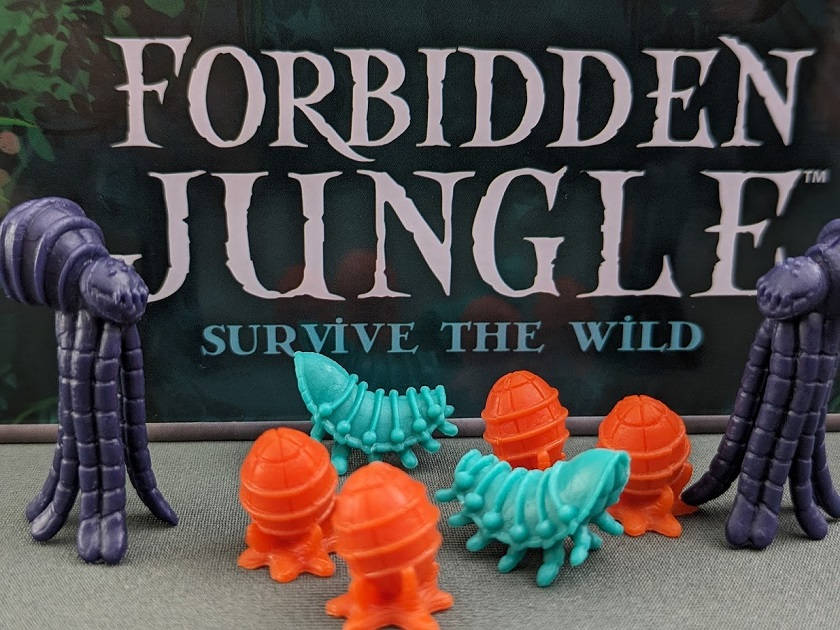
Forbidden Jungle Review – Rediscovering the Joy of a Good Crash Landing
Powering an alien escape portal gets tricky when harmless eggs hatch into flesh-eating adults. A chaotic, shifting survival race that completely redeems the series.

Horizons of Spirit Island Review – Spirit Island on a Shoestring Budget
Trying out a top-tier co-op on the cheap gets tricky when you could just buy the original instead. A solid tutorial, but poor economic value.

World of Warcraft: Wrath of the Lich King Review – Pandemic Without the Panic
Expect a true co-op pressure cooker and you will walk away disappointed. A fine Warcraft adventure that strips away what made Pandemic great.
A score tells you if it’s good, but the leaderboard tells you if it’s worth the shelf space.


 Loading ...