Pandemic Iberia
Players: 2-5
Playing Time: 45 minutes
Designers: Matt Leacock, Jesus Torres Castro
Publisher: Z-Man Games
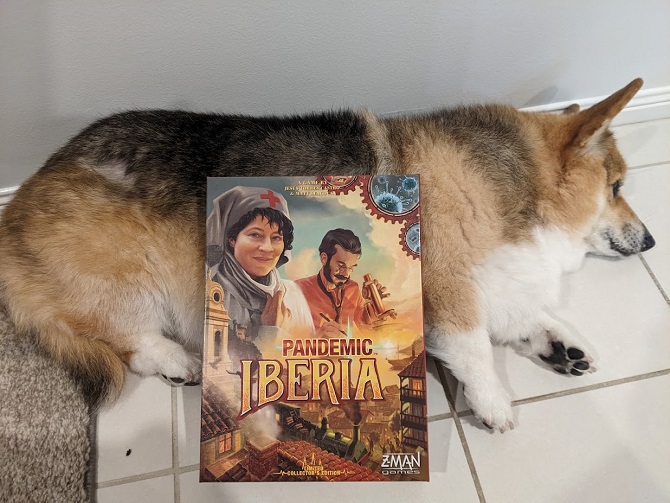
Pandemic Iberia is my favourite iteration of the Pandemic formula. By restricting players’ movement and adding trains, you feel the impact of the train lines you make. The core Pandemic experience is still enjoyable.
Pros
- Build train lines to help you cross the country and help people in need
- Diseases aren’t eradicated, so you must always be on guard
- Purifying the water helps but creates different challenges
- Comes with its own Virulent Strain cards to give you plenty of replayability
- Beautiful-looking components tie into the theme
Cons
- Won’t change your mind if you don’t like the original Pandemic
Love our reviews? Buying through our links earns us a small commission at zero extra cost to you, helping us table the next big release! Full disclosure here.
Released in 2016, Pandemic Iberia was going to be a limited release. At the time this terrified me as I was, and still am, a massive Pandemic fan. I thought there was a chance I wasn’t going to get it. That it would be sold out in every shop to sell it in Australia!
Thankfully, this was irrational thinking, and months after release it was still in stock. Even when it did sell out, they brought it back years later.
It turned out to be that good.
You see, Pandemic opened my mind to cooperative board games, and then Pandemic: On the Brink took an amazing game and made it perfect. Pandemic: In the Lab filled my base box to the brim full of gorgeous components and clever gameplay.
Then Pandemic: State of Emergency came around, and my version of Pandemic was filled with so much stuff that I wrapped the box in rubber bands just to get it to close.
Finally came Pandemic Iberia.
The first expansion to not require the base game to play. Was this game going to continue my love of the brand?
Of course it was.

What’s new in Iberia?
Every new mechanic in Pandemic Iberia stems from the change in location and period. Set in 1848 medicine and travel are only beginning to take shape.
As such plane travel has been removed. Instead, you must trek to the nearest port city and sail from town to town. Or, you can invest in building a railroad track allowing you to travel great distances.
There were no vaccines at the time, and as such you’re no longer able to cure diseases. Meaning a researched disease is still a threat. No longer can you eradicate diseases, and even once researched you’re still restricted to clearing out a single disease cube per action.
It’s not all doom and gloom though, as there are now Purification Tokens that help stop the spread of disease by cleaning the local water supply.
What’s more, Pandemic Iberia has all new roles and events that are more powerful than their base game equivalent.
However, my favourite of these new mechanics is the new railroad system. Without the movement options provided by the original Pandemic, movement in Pandemic Iberia is as stifling as playing a game of Red Light, Green Light.
But once you chain a few of these railroads together you’ll be able to move anywhere on the map in a single action. As long as it’s attached to the railway network. This offers additional strategies for plotting your train track, meanwhile dealing with the ever-growing diseases.
It’s so cool to see your train network grow throughout the game like a flower in bloom. The benefit of fast travel is also a lot of fun. Often by the end, you’ll be able to cross most of the map in a single action!

Preventative vs reactive treatment
Another departure from the original is the way Pandemic Iberia handles diseases. Purification Tokens are a new addition to the game. They’re extremely powerful, at stopping the spread of disease, but they’re also a trap.
Instead of cleaning the location of all disease cubes you might think instead to put down a Purification Token. So while there’s no immediate threat of an outbreak, you have created a ticking timebomb for later.
This is a real shift in gameplay these tokens bring. As they change the way you think about the game from being purely reactive “Oh no, Sydney has 3 disease cubes!” to preventative, “This area is about to lose all its tokens we should get there soon.”
It’s a neat little design difference that changes your approach to solving the Pandemic puzzle.
Additionally, Pandemic Iberia offers two added challenges.
The first is the Influx of Patients challenge. Where each turn a disease cube moves one railroad connection closer to the hospital. This challenge turns your railroad against you. As disease cubes will happily ride them straight into the hospital. Accelerating the eventual outbreak.
The Influx of Patients is a fun twist, and the moving disease cubes make the board feel more alive without adding too much overhead.
However, the real test is when you mix in the Historical Diseases Challenge. This set of four cards turns cute little disease cubes into nightmarish, impossible-to-control diseases. These superpowered Virulent Strains will tear up any plans you make. But that just allows for more planning, thinking, and strategizing.
Which is what makes Pandemic such a great system.

It’s still Pandemic
A lot has changed in Pandemic Iberia but it’s still faithful to Pandemic. You still get the four actions per turn. The epidemic cards still ratchet up the tension throughout the game. Outbreaks are still something you need to look out for. And the game still crescendos into an epic climax.
All the new mechanics add thoughtful, fun, and exciting gameplay opportunities. The redone artwork is stunning to look at and makes the game feel like a special edition. And with everything fitting into one box, setup and teardown is a much cleaner experience.
Therefore, I’ve replaced my rubber-banded version of Pandemic with Pandemic: Iberia. This is hands down my favourite version of the system I’ve played.
Similar Games You Might Like

Horizons of Spirit Island Review – Spirit Island on a Shoestring Budget
Trying out a top-tier co-op on the cheap gets tricky when you could just buy the original instead. A solid tutorial, but poor economic value.

The LOOP Review – Combos So Good They Should Be Illegal
Harness temporal energy to reset your hand and unleash multi-card combos against the mad Dr Faux. A deeply satisfying cooperative challenge that drags a bit at higher player counts.

Forbidden Desert Review – Stumbling to Victory in a Sentient Sandstorm
Clear piling sand, dodge the blazing sun to and rebuild an ancient flying ship. A for-all-ages cooperative game where defeat always looms nearby.
A score tells you if it’s good, but the leaderboard tells you if it’s worth the shelf space.

 Loading ...