
Click Clack Lumberjack
Players: 2-7
Playing Time: 10 minutes
Designer: Justin Oh
Publisher: FoxMind Games
Although Click Clack Lumberjack lets you play Jenga in a new form, it’s a strictly worse version. Taking longer to set up and isn’t as exciting to play.
Pros
- Chopping the tree can be fun at times
Cons
- Long and frustrating setup of the tree
- Whacking the tree bark feels inconsistent and unsatisfying
- Sometimes a player loses early but still has to play with no hope of winning
Love our reviews? Buying through our links earns us a small commission at zero extra cost to you, helping us table the next big release! Full disclosure here.
Click Clack Lumberjack (now known as Tak Tak Jack) is not the first game to attempt to recreate Jenga. Nor will it be the last – I’m looking at you Fuzzies. But it does put a novel spin on the formula. Which starts with building a tree trunk, in the centre of your dining table.
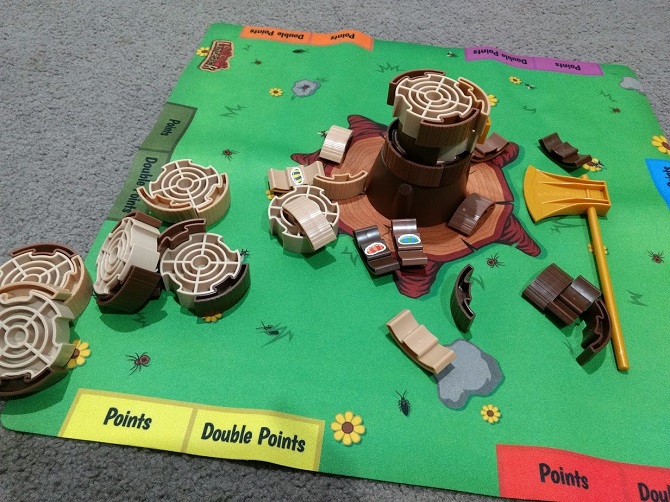
Each part of this trunk must be built separately, by sliding four pieces of bark into a core piece before stacking it on top of the other core pieces previously built. This takes up a lot of time and can be frustrating as pieces of bark are prone to falling out. Making you wonder if it’s not easier planting a tree and waiting for it to grow.
Once the tree is built, the fun begins.
Players then take turns doing their best Paul Bunyan impersonation, by taking two swings of the plastic axe – Tak Tak. With these two swings, you’re trying to knock the bark off the tree without knocking off the core piece they’re attached to.
Each piece of bark knocked off this way scores you one point. If you accidentally knock off a core piece, that’s negative five points.
You keep taking turns like this until the tree is stripped of all its bark. Then you count how many pieces of bark you’ve knocked off, minus the points from any cores you now own, and find out who won the game.

Timber!
There’s a simplicity to Click Clack Lumberjack, where as soon as you put the large plastic tree in the centre of the table, everyone knows how to play. Part of this is conditioning from Jenga, but I like to think the larger part is that as humans we just want to smash stuff.
After setup, the only instructions you need to give are: bark good, core bad. Then you’re off and playing. Making Click Clack Lumberjack a wonderful game to play with kids, or at a party between games of beer pong.
During play, it’s a series of grunts, groans, and tak taks as the drama unfolds. Where one player manages to get a couple of bark pieces on their turn, to the next player edging the bark but receiving nothing.
As players continue to hit the tree and move its trunk around, the tree becomes more unstable than a ball-juggling seal, on a unicycle, in a hurricane. It becomes a matter of time before it all comes crashing down, and as this time gets closer there is this incredible build-up of tension.
When this tension is building, Click Clack Lumberjack is riveting and filled with excitement and drama. But as soon as the tree starts to fall, so do the tension and excitement levels of everyone involved.
The cost of messing up, and earning negative five points, is frustratingly severe. It all but eliminates anyone who does so. It’s also not the end of the game. So there’s this time after someone knocks over half the tree when the game lumbers on in a zombified state. With one player losing all interest, and the rest having to restart on a now stabilised stump.
An axe to grind
When Click Clack Lumberjack originally came out, there wasn’t much competition for dexterity games. A lot of its early popularity was due to the novelty of adding just enough to the Jenga formula to be its own thing.
And, to be fair, the plastic axes are an excellent addition.
By putting something between yourself and the tree you’re kind of trying to topple, you introduce imprecision in the player’s abilities to affect the tree. Leading to fun, whacky moments when players end up doing things they weren’t expecting.
These axes not only add to the already high novelty and toy factor of the game. They also make people curious about playing Click Clack Lumberjack. Again, leaning into that party vibe.
However, despite the interest this game generates, and the improvements to the well-worn design of Jenga. There isn’t enough to overcome the downfalls of both the painful setup and the zombification of the end game.
Similar Games You Might Like
Catacombs Conquest Review – A Tactical Battle for Your Monkey Brain
Watching your mate curse their fat fingers after a missed disc shot never gets old. A portable, tactical flicking duel that delivers easy laughs.
ICECOOL Review – Catnip for Kids and Penguin Physics
Watching four grown adults lean over a mini snooker table never gets old. A wonderful flicking dexterity game where practice creates real skill gaps.

Go Cuckoo Review – Dump Your Eggs Before Child Support Arrives
Don’t put all your eggs in one rickety nest. A manic-looking dexterity game that sets up in seconds and looks great on the table.
A score tells you if it’s good, but the leaderboard tells you if it’s worth the shelf space.

 Loading ...

I like the review format!
But you know I’m biased, since this is more similar to how I do it. 🙂
Haha you’re now an inspiration, how does it feel?
Very weird 🙂 But happy!
What is Flick Em Up Dead of Winter like?
Setup is a pain in the ass, what’s worse is the hour of putting stickers on the plastic figures, and then rules leave some room for interpretation. However, once you get passed all that, it’s actually really fun. The zombie tower mechanic they’ve implemented works really well, along with giving your characters weapons – and how you use those weapons is completely different – makes the game a lot more strategic than you’d think possible for a dexterity game.
However, again, setup is a pain in the ass.
That sounds like Dead of Winter alright – pain to set up but quite fun when you do 🙂 I keep seeing this and keep questioning whether to get it. I’m still fairly solidly on “maybe”.
Seems original…but I can kind of see why you’re wanting to sell it off. It sounds more like a novelty than a full blown game. Is that a fair verdict?
I’m not sure, it’s certainly sold as a full game haha. However, with dexterity games I feel like there’s a upper limit on the amount you can do without using cards or tokens. Also, a lot of people enjoy Click Clack enough – so there is something to it. Maybe it’s my fault for being spoilt for choice. 😛