Power Grid
Players: 2-5
Playing Time: 120 minutes
Designer: Friedemann Friese
Publisher: Rio Grande Games
Power Grid may have a dry theme, and rely too much on accounting. But towards the end of the game, you’re always on the edge of your seat.
Pros
- Fun economic gameplay, with plenty of options and decisions to make
- Rubber-banding mechanics means you’re never out of the game until it’s over
- Can be expanded with different maps, and power plant packs
- Engaging market simulation, with the ebb and flow of different technologies
Cons
- Too much maths! Some people may be put off by so much arithmetic
- With so many options, people susceptible to analysis paralysis should avoid
- The dry theme of creating an electrical grid is a hard sell
Love our reviews? Buying through our links earns us a small commission at zero extra cost to you, helping us table the next big release! Full disclosure here.
By all rights, Power Grid should be boring. When described to me, it sounded like work. When I played it, it felt like work. Yet somehow, someway, it ends up being a lot of fun, if not a little too economical.
As the name suggests, you’re competing with other players to be the leading power company for a country. Requiring you to buy and build power plants, infrastructure, and fuel.
Each round has five phases of play, with the order of who goes first flip-flopping between the different phases. This can be confusing and is made worse by a rulebook that makes mashed potatoes out of its rules explanation.
Note: Between the time of writing this review in 2017 and now, Rio Grande Games released Power Grid (Recharged). This new edition may address my concerns about the rulebook.
The first phase of each round is determining player order. After that, the round starts in earnest with players auctioning off power plants from the market. These auctions happen like those from High Society. Where when it gets to your turn, you can either increase the original bid or bow out of the auction entirely.
Once everyone has a power plant, you move on to buying fuel resources for all of the power plants you’ve purchased. With limited resources and ever-increasing prices for fuel, buying resources the right amount can make or break your round. As there are still two more phases for you to throw money at!
The first of these phases is the infrastructure phase. Here you connect different cities to your power grid. First by paying for the connection, then paying for any permits (or bribes) the city requires as well. Furthermore, as more players enter a city, the more expensive it becomes to enter.
Finally, in the last phase of the round, you do all the bookkeeping for the next round. As well as paying out money to all players for the number of cities they’re currently powering.
To power a city, you must have:
- Connected the city to your grid
- A power plant capable of powering the city
- Fuel to power the power plant
The more cities you power, the more cash finds its way into your pockets. Additionally, powering cities is also how you win Power Grid. Whoever can power the most cities, once someone builds in 17 cities or more, wins the game.

Market simulation at its finest
Power Grid has such a fun balance of direct in-your-face interaction through the auctions and indirect interactions such as racing to cities and being the first to complete infrastructure. No matter what you do within Power Grid you are directly affecting other players’ plans and machinations.
As a result, there are no dominant strategies within Power Grid because it’s more about responding to what other players are doing. Rather than coming up with a bulletproof strategy at the start of the game.
One example of this is in one game I played everyone invested heavily in coal. This pushed up the price of coal to the point where it was cheaper to buy other power plants than continually investing in coal. So I quickly switched to uranium powerplants and over a couple of turns, I rocketed into the lead.
This example also shows how effective the market simulation is. Keeping an eye on what power plants players are buying is a must. But then so is making adjustments to your power plant portfolio.
This market speculation is exciting as you’re constantly making judgment calls on what people are going to do. The downside is there’s an overwhelming amount of information to assimilate to make these judgements. For some, this leads to analysis paralysis, because you don’t have enough time to digest all the information. Leaving you to feel if only you just had a couple more minutes, you’d be able to compute a better move.
Speaking of computation, it’s what you’ll spend most of your time in Power Grid doing. As for each round, you need to budget out three phases of spending. Then you have to readjust this budget with every dollar you spend and each speculation you make.
This amount of maths and calculations can quickly put people off. For that reason, Power Grid is one of the few games we allow calculators at the table for, especially towards the end game.
However, this constant crunching of calculations is quite meditative. Everything begins to fall into the background as you focus on the numbers. As such, Power Grid is excellent at getting you into a state of flow.
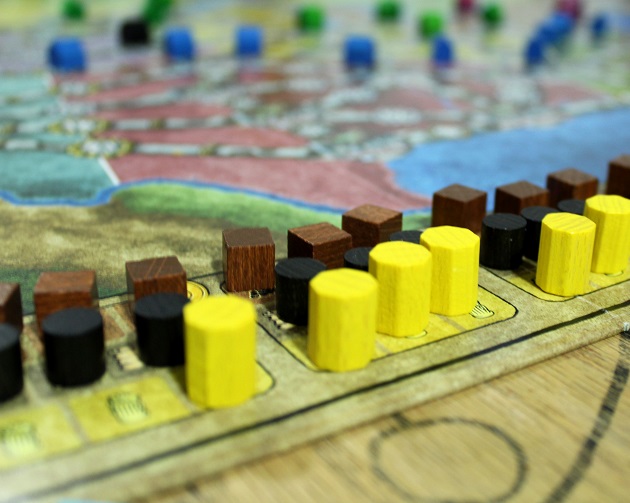
Makes for a crazy last round
Games are almost always close in Power Grid, and that’s by design. By swapping the player order throughout the different phases, it’s the mechanical equivalent of the blue shell from Mario Kart. Where the player in the lead is in the most disadvantaged position.
This makes for a crazy last round, where everyone is in it up until the final power plant is placed. However, after a couple of games, it feels somewhat artificial.
That’s not to say a skilled player will lose to an unskilled player. Quite the opposite, a difference in skill or experience with the game will show itself in the end score as easily as a clown at a funeral. But if players are on a similar level, then the outcome could be swayed by these mechanics.
Yet, even when you don’t play Power Grid to perfection, it’s still a feel-good game. Wherein even if you lose, you’ve gone on a journey, and spread your company across the map. There’s a real feeling of accomplishment seeing your little houses covering the country like it’s got a bout of chicken pox.
Otherwise, Power Grid is ridiculously easy to pick up and play so long as one player knows all the rules. Given the half-rules, half-spaghetti state of the rulebook this is no easy feat. However, once you go through the game once or twice, it all flows. This is because the idea of buying a power plant, connecting it to your grid, and then buying fuel is intuitive and makes sense.
After you get this understanding, you’ll have a lot of fun with Power Grid. As you rack your brains calculating where and when to spend your money. By the end, you will feel drained – but satisfied. Happy you won or deep in thought about your loss.
Similar Games You Might Like

Endless Winter: Paleoamericans Review – Four Simple Actions, One Giant Table Hog
Balancing tools, food, and labor across five distinct sub-boards creates a sprawling strategic puzzle. Just be prepared for the teach.

Raccoon Tycoon: Fat Cat Expansion Review – The Fat Cat Expansion Review – A Box Large Enough for a Real Raccoon
Adds character shields and extra building tiles to widen your scoring options. A solid addition that improves strategy but fails to fix the endless endgame.

Dinosaur Island Review – Slap Bands and Boring Board Game Chores
This park is all flash and no bite. A stunning box of neon plastic hides five phases of dull, disconnected housekeeping.
A score tells you if it’s good, but the leaderboard tells you if it’s worth the shelf space.
Pictures for this article were grabbed from Board Game Geek under the commercial licence. The featured image was taken by @nonnormalizable, the second image was by @garyjames, and the last image was by @aldoojeda.

 Loading ...