
Lewis & Clark: The Expedition
Players: 2-5
Playing Time: 45-120 minutes
Designer: Cédrick Chaboussit
Publisher: Ludonaute
Lewis & Clark: The Expedition is an awesome game that stumbles as it heads towards the finish line. It provides deep gameplay decisions but is plagued by some punishing anti-fun design choices.
Pros
- Seeing your canoes move forward and back through the river fills you with tension
- Excellent theme and captures the history of the adventure
- Great brain-burning gameplay
- Chaining together cards, and having to use cards as payment makes for some fun tough decisions
Cons
- Having to scout and then move feels awful
- Can get trapped when changing terrain
Love our reviews? Buying through our links earns us a small commission at zero extra cost to you, helping us table the next big release! Full disclosure here.
Lewis & Clark: The Expedition is a racing game that starts with simple directions from Thomas Jefferson to explore the western states. That’s all you need to know. Well, that and the first person to take their expedition from St Louis to Fort Clatsop and the Pacific Ocean will go down in history.
The journey begins with a hand of six cards and plays similarly to other hand-building games like Aquatica. Where each turn, you play a card and perform its action. However, once played, the same card can’t be played again until you set up camp.
In Lewis & Clark: The Expedition playing a card is only one option. You can also recruit other explorers, or make deals with the local Indian tribes by sending your companions to powerful action spaces on the board.
While not the main draw, this is an interesting take on worker placement. Whereby you don’t control any dedicated workers. Instead, your workers come and go based on when, and how you play your cards.
But this is all a distraction!
As resources alone won’t get you closer to the Pacific Ocean. In the beginning, you only have one card that moves your expedition forward. Though every turn you get a chance to buy more. Additionally, you can also get rid of your weaker cards for discounts.
After you’ve used all of the cards in your hand, you need to set up camp. This is the only time your expedition truly moves forward. Before then, it’s only your scout that moves ahead. During the camp, the expedition moves to your scout. Except if you’re encumbered by resources, companions, or unused cards. In this case, you reduce your movement. Sometimes not moving at all!

Dynamic and excellent card play
Playing Lewis & Clark in 2023 is a bizarre feeling. Because despite its release a decade ago, the design and mechanics of the board game feel modern and fresh. If released tomorrow, you wouldn’t bat an eye, as it feels so at home with other games released today.
A big reason for that is the dynamic, and excellent card play. During the game, you’re trying to build a hand of cards that works as a production line, giving you resources and then converting them into speed. While not novel, what makes this exciting is how varied, and powerful the cards are.
Of the 54 cards you can buy from the market, all of them could be used for great effect. But usually, only when paired together with others. So creating your perfect hand, and seeing it come together is an absolute joy.
Lewis & Clark gives you a lot of flexibility in this regard. Giving you the option to buy or remove cards every turn. So making your perfect hand of cards is easy to do if it weren’t for the resource cost.
The card play doesn’t stop there either. As whenever you play a card, you must power it with another card, a worker, or a combination of these. While we’ve seen a similar mechanic before in Jump Drive, Lewis & Clark takes it further by allowing you to give your cards additional strength. This means you can spend additional power to use the card ability up to three times.
This drastically changes how you view and use cards. So even though you have the same cards over and over, because of these changing variables, it’s unlikely you’ll play them in the same order, with the same strength.
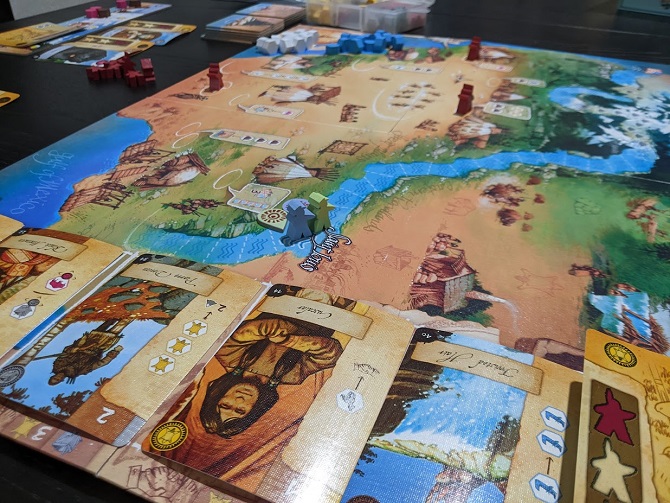
Making a mountain out of a molehill
Where Lewis & Clark: The Expedition comes unstuck is probably where the real-life expedition came unstuck as well: in the mountains. While most of the race track is a wide open river that you can comfortably sail down. There is part of the track that requires you to put your raft away and start climbing on foot.
Although, you can see this coming from the beginning of the game, and if you’re wiser than me you can make sure you’re ready for it. But if you get this water-to-mountain transition wrong, or misjudge your approach, you get punished heavily for it.
Unlike The Quest for Eldorado, another racing game, which allows you to take shortcuts if you have the correct cards, and the long way if you don’t. Lewis & Clark takes design lessons straight from Uwe Rosenberg’s school of feeding your family or they starve. It’s either you have the resources to get over the mountain, or you’re stuck at its base for the rest of the game.
But it gets worse.
Because of the need to camp, your scout not using their full movement to get onto the mountains, and your scout moving backwards based on the speed of your expedition. You can end up in a death spiral. Whereby during your turns you work to get your scout to the mountain, only for it to move backwards upon setting up camp.
Between 2013 and now, there has been an update to the rules regarding this pain in the butt. Now, when your scout would move backwards, it doesn’t. Instead, you get penalised with time tokens. This is a better approach, as it avoids the Sisyphean trap of the mountains, but it’s still not intuitive. Furthermore, the end game suffers and becomes a convoluted count of time tokens.
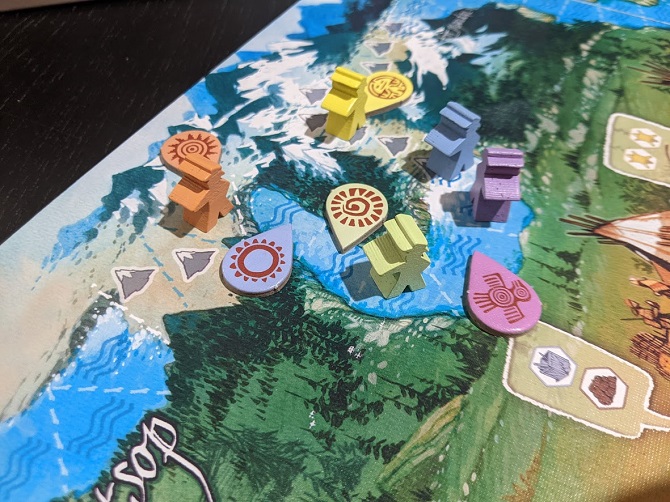
Everyone, everywhere, all at once
Racing games are always so exciting. They put the scoreboard front and centre so that everyone knows who’s winning and losing, and how long is left to go. This creates a tremendous amount of pressure for everyone involved.
Lewis & Clark is no exception. Seeing everyone’s scouts moving, followed by their expeditions upon camping, is a thrilling experience. One where you feel like you can win it, up until someone lands their expedition beyond Fort Clatsop.
A large reason for this excitement is the awesomely expressive card play. But further to the point is how interactive the cards, and worker placement actions are. There’s not a move you can make that doesn’t help, or hinder, your opponents.
Even the simplest of plays, such as using the ‘get resources’ cards, give you a variable amount based on what cards others have already played. So you have to pay attention to everything that’s going on.
As such, Lewis & Clark: The Expedition is an awesome game, it would be one of my favourites. Except, for the poor handling of the mountain ranges, and the bandaid solution of introducing time tokens. This unfortunately severely tarnishes my view of an otherwise excellent board game.
Similar Games You Might Like

Lands of Galzyr Review – Being Dunked into a Milky Cup of Storytelling
Skip the heavy battles and endless rulebooks for an app-driven storybook adventure that delivers cozy charm from start to finish. A narrative-driven campaign where every choice shapes your journey.

Lord of the Rings: Journeys in Middle-Earth Review – Bilbo Deserved Better Than an iPad
Managing your physical hero deck while staring at a tablet screen creates constant friction. A smooth campaign story trapped in an awkward hybrid shell.
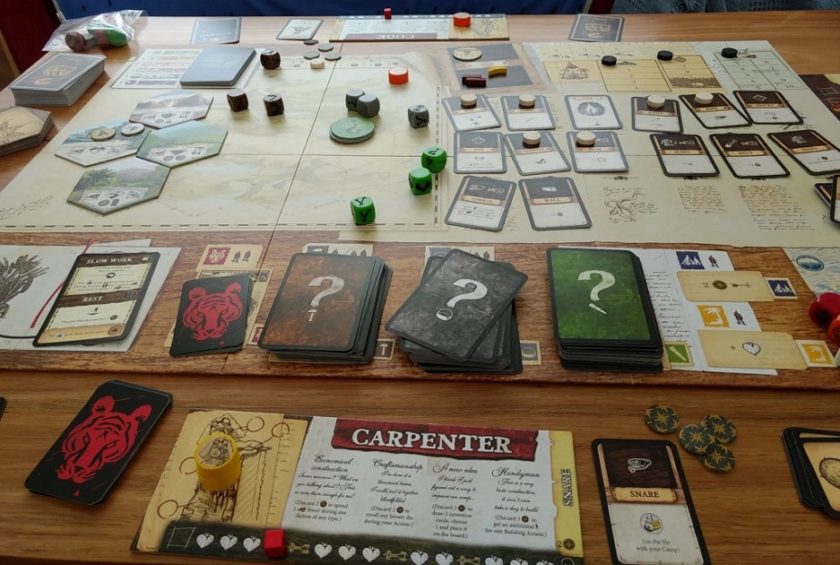
Robinson Crusoe Review – Less Desert Island Adventure, More Depressing Russian Novel
Surviving on an deserted island is depressing when single die rolls ruin an hour of planning. An excellent narrative experience ruined by unfair punishment.
A score tells you if it’s good, but the leaderboard tells you if it’s worth the shelf space.

 Loading ...

I like this game but don’t love it, for the exact same reason you mention. At least mostly. For me, it’s not just the mountains, but how if you don’t play your cards right, you don’t even have to be in the mountains to suddenly go all the way back. I hadn’t heard they tried to fix that, though.
Haha yeah, if you don’t get it right it can be BRUTAL. But I usually found that it was easy enough to only lose a couple of spaces on the scout.
Our first exposure to this was on Board Game Arena. We thought we understood the rules well enough, but ran into scenarios several times where the cards didn’t play quite like we expected. Which was frustrating as that could mean a lot turn or resources. I’d have to have another play through before I really judge it.
Ah yeah, I missed it in the review. But it certainly doesn’t have all the bells and whistles of a modern game. No player aids, and weird iconography. You certainly have to work to learn how to play!