Don’t Get Got
Players: 2-10
Playing Time: 30–1440 minutes
Designers: Zoe Lee, James A. Vaughan
Publisher: Big Potato Games
Playing Don’t Get Got was a wild month of sneaky tricks and unexpected laughs. Risking it all to get away with the perfect mission and not get caught was a thrill I’ll always remember.
Pros
- Pure exhilaration in pulling off the perfect heist.
- The joy of revealing a successful mission and watching your friends’ reactions.
- All missions are low-stakes, lighthearted, and designed for laughs.
- Encourages creativity and gets you thinking outside your comfort zone.
- Works across different settings: game nights, social outings, or even over a longer period.
- Tons of variety with 120 unique missions to keep things fresh.
Cons
- There’s no off button. Once the game starts, it stays active until it’s completed.
- Can distract from or interrupt other activities, which might frustrate more focused players.
- Some missions feel impossible.
- Staying on high alert throughout the game can be mentally draining.
Love our reviews? Buying through our links earns us a small commission at zero extra cost to you, helping us table the next big release! Full disclosure here.
Don’t Get Got is easily one of the strangest board games I’ve ever played. It’s not tied to a table, a single setting, or even a time limit. You play it in the background, while playing other games, hanging out with friends, or even going about your day-to-day life. A game can last an evening, a week, or, in the case of my group, a whole month.
A game this unconventional calls for an equally unconventional review. Instead of diving into mechanics or strategy, I’ll walk you through our month-long experience. From the awkward missteps to the moments of sheer brilliance, I’ll share the highs and lows of Don’t Get Got to help you decide if it’s the right kind of chaos for your table (or wherever else you decide to play).

How to play
Don’t Get Got is the board game equivalent of poking someone’s chest and asking, “What’s that?” only to flick their nose when they look down. It’s a mischievous, silly game where the goal is to play harmless tricks on your friends and get away with it.
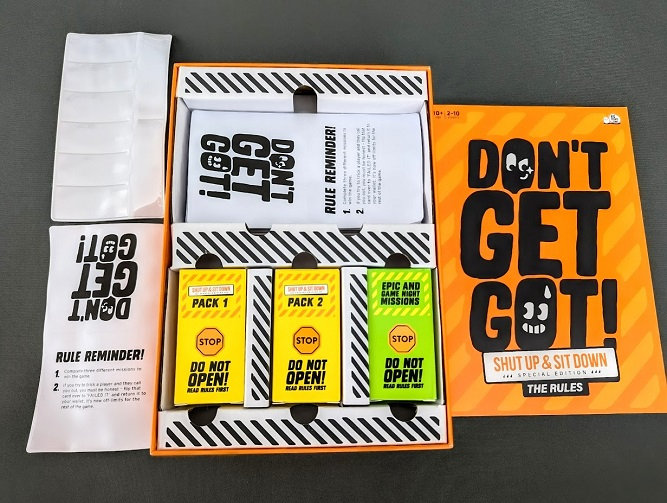
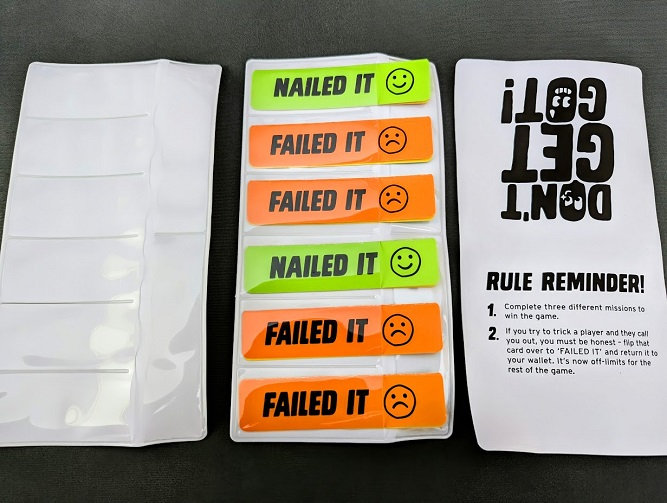
At the start of the game, each player receives a cool little wallet containing six miniature “heists” they need to pull off. These range from simple, funny tasks to sneakily annoying or surprisingly challenging ones, all culminating in the sweet satisfaction of someone Getting Got.
For example, one challenge might be convincing someone to check the tag on your shirt or humming a tune until they hum along. These harmless pranks are designed to elicit that forehead-slapping “Oh no, I fell for it!” moment.
The game includes a whopping 120 unique missions, so there’s plenty of variety. Later in this review, I’ll spoil three of them, but with so many in the box, it’s unlikely to affect your overall experience.
Now, you might be thinking: “What’s stopping someone from completing all their missions right away?” The answer is simple: suspicion.
If another player catches on and asks, “Are you trying to Get me?” before you successfully pull off a mission, your plan falls apart. Cue the voice of Call of Duty’s iconic announcer:
“Mission failed. We’ll get ’em next time.”
When caught, you flip the mission card over as a failure. The first to complete three missions wins, but fail four, and you’re out entirely.

Heist 1: When I die…
After the rules were explained, there was a buzz of nervous excitement. Everyone quietly read through their missions, side-eyed their neighbours, and began plotting their schemes.
Fast forward a few hours to the middle of a Dungeons & Dragons session. The Game Master was delivering some fey-themed exposition, describing how the forest lord’s power was being zapped by some evil and would soon fade entirely.
Seemingly out of nowhere, a player asked, “What happens when you die?”
Keeping in character, the GM replied, “When I die, my power fades from the land, plunging it into ruin.”
The conversation moved on, but as soon as the scene wrapped up, the player grinned and slapped down their mission card: Get a player to say ‘When I die…’
The GM had gotten got.
Everyone laughed and congratulated the successful schemer, but this moment also highlighted one of Don’t Get Got‘s potential to pull focus away from whatever else is at hand. Would that player have asked that question without the game? I can’t say, but it definitely played some part into their thinking of how to respond.
So if you’re in the middle of a more serious activity, like an intense D&D campaign or another more structured game, these interruptions might feel more annoying than amusing. The key to enjoying Don’t Get Got is embracing its chaos as a group.
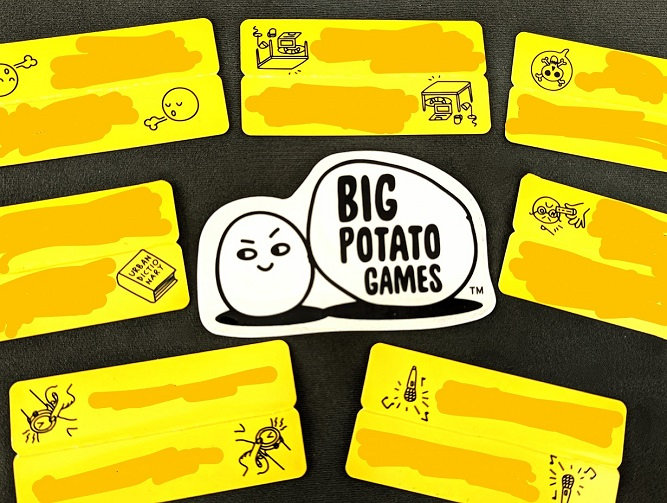
Heist 2: Take your turn already!
We played with the Shut Up & Sit Down edition of Don’t Get Got, which, as expected, includes missions themed around board games.
Now, here’s some crucial context for this next example: my friend (let’s call him Matt) is whip-smart. He processes information faster than a computer. Normally, the only thing keeping him from winning every game we play is his obsession with generating money over victory points.
But during a game of Beyond the Sun, Matt’s lightning-fast decision-making vanished.
His usual five-second turns stretched to ten seconds… then thirty… then five agonising minutes. At one point, he spent ten full minutes staring at the board with the kind of intense focus you’d expect from someone solving a life-or-death Sudoku.
We were all baffled.
Watching Matt struggle to this degree was like seeing a cheetah forget how to run.
What we didn’t know at the time was that one of Matt’s missions was to get another player to say hurry up. But despite his excessive delays, none of us uttered the magic words. Instead, as is Australian tradition, we just hurled a barrage of light-hearted insults at him for wasting our lives.
It wasn’t until after the month finished and we had a winner that Matt revealed his mission, and we all burst out laughing at how obvious it had been in hindsight. But looking back at it now, at the time it was a bit frustrating. Don’t Get Got ended up wasting about half an hour of precious playtime, which, as a working adult, is worth its weight in gold.
This is something you need to accept when playing Don’t Get Got: people will change their behaviours, and it’s usually not for the better. Whether that’s funny or annoying depends entirely on the group’s mood.
Heist 3: Can I have your details?
This was one of my missions: get another player to say their full name including first, middle, and last.
At first, I thought, No way am I pulling this off… or am I?
Heists in Don’t Get Got are 60% planning, 40% timing, and 30% execution (don’t check my math). For this challenge, I brainstormed every scenario where someone might naturally say their full name and how I could set the perfect trap. The real trick? Making it feel organic. You can’t just walk up to someone and ask for their full name, it screams, “I’m trying to Get you.”
Luckily, I had recently updated my passport.
I casually told my friend, let’s call him Bernie, that I needed their full name for an additional (and completely fictitious) passport form. Since Bernie had been a reference for my application, they didn’t think twice. They fell for it hook, line, and sinker.
Despite the simplicity of the setup, the anticipation, excitement, and nerves leading up to this heist were exhilarating. It reminded me of the thrill of a high-risk, all-or-nothing move in a great board game. Or sneaking out as a kid for a midnight raid on my grandad’s shortbread stash (spoiler: it didn’t end well… for me or the shortbread).
What makes Don’t Get Got special is the personal connection to each heist. You’re putting yourself in the line of fire, creating real stakes. For instance, meeting Bernie’s eyes while laying the trap added a layer of tension you don’t often get in traditional games. The social dynamics are what elevate even the simplest missions into memorable, high-stakes moments.
Ultimately, it’s that rush of a plan coming together, combined with the personal stakes, that makes Don’t Get Got so unforgettable. It’s more than a game. It’s an experience that sticks with you.
Get out of your comfort zone
By now, you’ve got a taste of the kinds of missions Don’t Get Got throws at you. But what I haven’t touched on yet is how good this game is at pushing you out of your comfort zone.
Over our month-long playthrough, I found myself investigating how to send anonymous texts, practicing yoga poses, and researching other bizarre things. All in the name of completing my next mission. Surprisingly, this was a lot of fun. Along the way, I picked up a fair amount of now-useless knowledge.
But the highs of pulling off a perfectly executed heist come with a price. While you’re playing, you’re always on edge, constantly alert to the possibility of being someone else’s target. It’s exhausting and can detract from the activity you’re supposed to be enjoying, whether that’s another game, a social gathering, or even just hanging out.
As much fun as I had (and I had a lot) with Don’t Get Got’s missions, I’m not in a hurry to play it again. The thrill of nailing a well-planned heist and the unforgettable memories are undeniable, but it’s not something I’d want to revisit every game night.
That said, if you’re planning a day of board games with a laid-back, jovial atmosphere, Don’t Get Got has the power to transform it into something truly extraordinary. It’s not an everyday game, but when the stars align, it’s an experience you’ll treasure for a long time.
Similar Games You Might Like

Trash Talk Review – A Tactile Trip To The Junk Drawer
Connecting a slinky to the word “Cloud” sounds funny but once your team fails a guess it’s game over. A short, frustrating filler that burns time on setup.

Monikers-er Review – Jeff Bezos, Emu Wars, and the Ultimate Party Game
Injects 330 fresh pop-culture cards and premium foil packaging into the mix. A stand alone entry point for new comers that can be shuffled into the original without issue.

Word Slam Review – High-Speed Shouting for the Whole Table
Slapping down word cards while both teams yell out wild guesses creates pure, chaotic fun. A crowd-pleasing party. game where piggybacking on rival clues is half the strategy.
A score tells you if it’s good, but the leaderboard tells you if it’s worth the shelf space.

 Loading ...