The Estates
Players: 2-5
Playing Time: 40-60 minutes
Designer: Klaus Zoch
Publisher: Capstone Games
The Estates is a clever auction game filled with great highlights, but when you dig under the colourful, chunky wooden components you find it hides a nasty little monster. There’s a lot to love, but the constant dog-piling and petty sabotage eventually wore me down.
Pros
- Clever auction system where the auctioneer can buy out the highest bidder.
- Fantastic closed economy that makes every dollar count.
- Plenty of opportunities for sabotage, backstabbing and petty decisions.
- Simple to teach and play, despite plenty of interesting decisions.
- Chunky wooden components just feel good to play with.
Cons
- Missing out on a company can leave you with very few ways to score.
- Constant dog-piling can make it feel like playing well doesn’t really matter.
- The novelty of watching everyone sabotage each other wears off after a few plays.
- Scores can be brutally punishing, with most players ending up deep in the negatives.
We all know landlords suck, and no board game proves that quite like The Estates. It is a cutthroat game about cashed-up real estate investment firms fighting over new urban development. Designed by Klaus Zoch, this auction game features chunky components, a tricky closed economy, a touch of corruption, and some truly incredible, unfiltered pettiness.
Let’s dig in.
How to play
Everything must go! The Estates is built on this idea where you sit down at the table and every single component in front of you is up for auction. You’ll buy building permits, you’ll buy construction blocks, heck, you’ll even buy the Mayor, all while trying to score points by building and roofing tall towers and closing off the street.
On your turn, you must pick a component to put up for auction. Before you do, though, you have the option to siphon off a million dollars. This takes it straight out of the supply and into your pocket, giving you an extra victory point at the end of the game.
Then it’s time to auction. Put any one component from the market up for grabs. Everyone bids in a single clockwise go-around, and the auctioneer gets a tough choice: either take the highest bidder’s money, or pay that amount themselves to keep the piece.
The pieces up for grabs include:
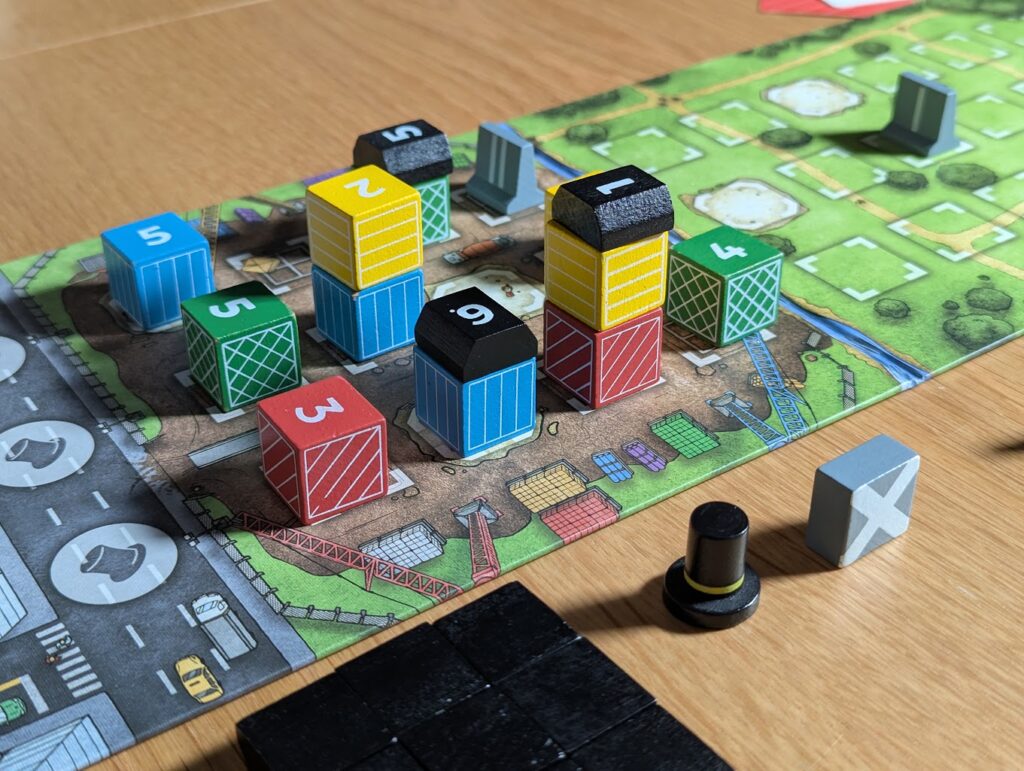
- Numbered building blocks: Once bought, these must be placed immediately. You can start a new building in an empty space on the street, or stack it onto an existing building, provided the number on your block is lower than the block directly beneath it.
- Roofs: These add extra points and cap off a building, marking it as complete.
- The Mayor: A wooden top hat that is the ultimate icon of elegance. Place it in front of one of the three rows to double the points in that entire row.
- Building Permits: Let you increase or decrease the length of a street, making it easier or much harder to finish.
- The Cancel Cube: Lets you immediately remove either the Mayor or a Building Permit from the board.
Now, here is where things get trippy: to actually score points, you need to own one of the coloured construction companies. These are on auction too, sort of. The first player to buy and place a numbered block of a specific colour also claims control of that company. Does this mean you could end up with no companies and zero way to score? Absolutely. So… good luck!
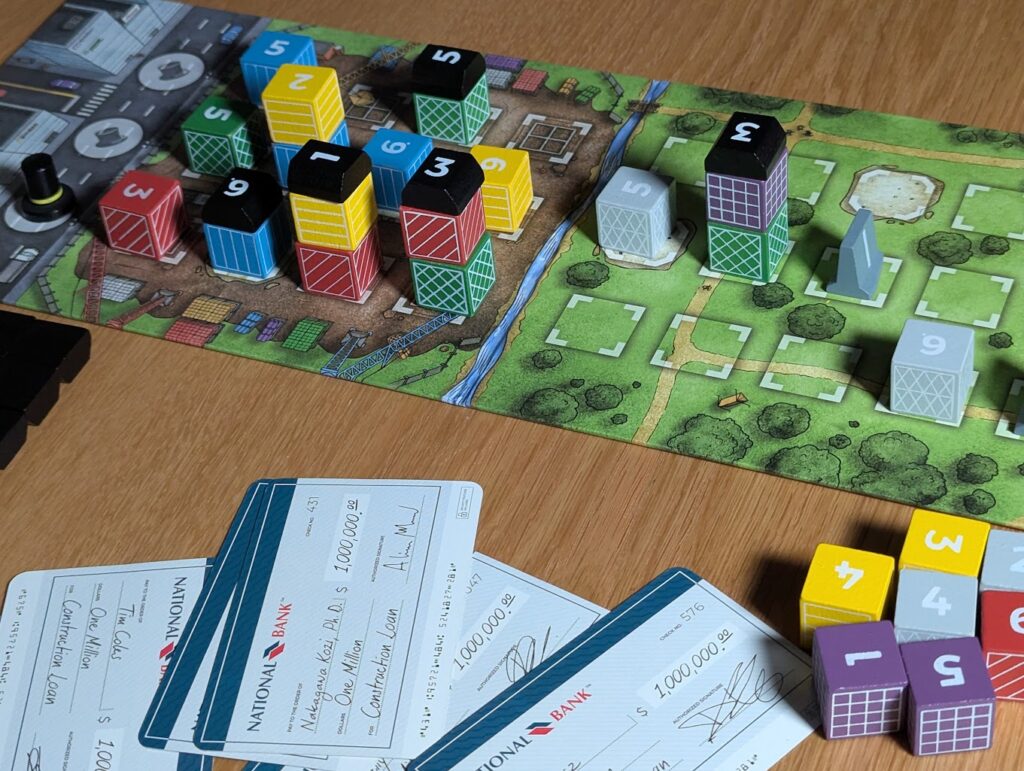
To make matters worse, a completed building only awards points to the player who owns the company of the highest coloured block in that stack. You might have three different coloured blocks in a single tower, but if the top block is red, the red player takes all the points while everyone else calls their accountant to figure out how to negatively gear a total loss.
Or maybe don’t pick up the phone just yet, because the final and most brutal rule is that any buildings sitting in uncompleted rows at the end of the game award negative points instead of positive ones.
The game ends immediately as soon as two of the three rows are completely filled with roofed buildings, which usually means someone is going home with a massive pile of negative points. Alternatively, the game ends when the market runs completely dry, in which case almost everyone is going home in the red.
Once the dust settles, you tally up the numbers on every block and roof you control, subtract the totals from uncompleted rows, and double everything (positive or negative) in the row with the Mayor. Then whoever walks away with the most points is officially the biggest landlord scumbag at the table. Enjoy the crown, you monster.
A Snake in the Ball Pit
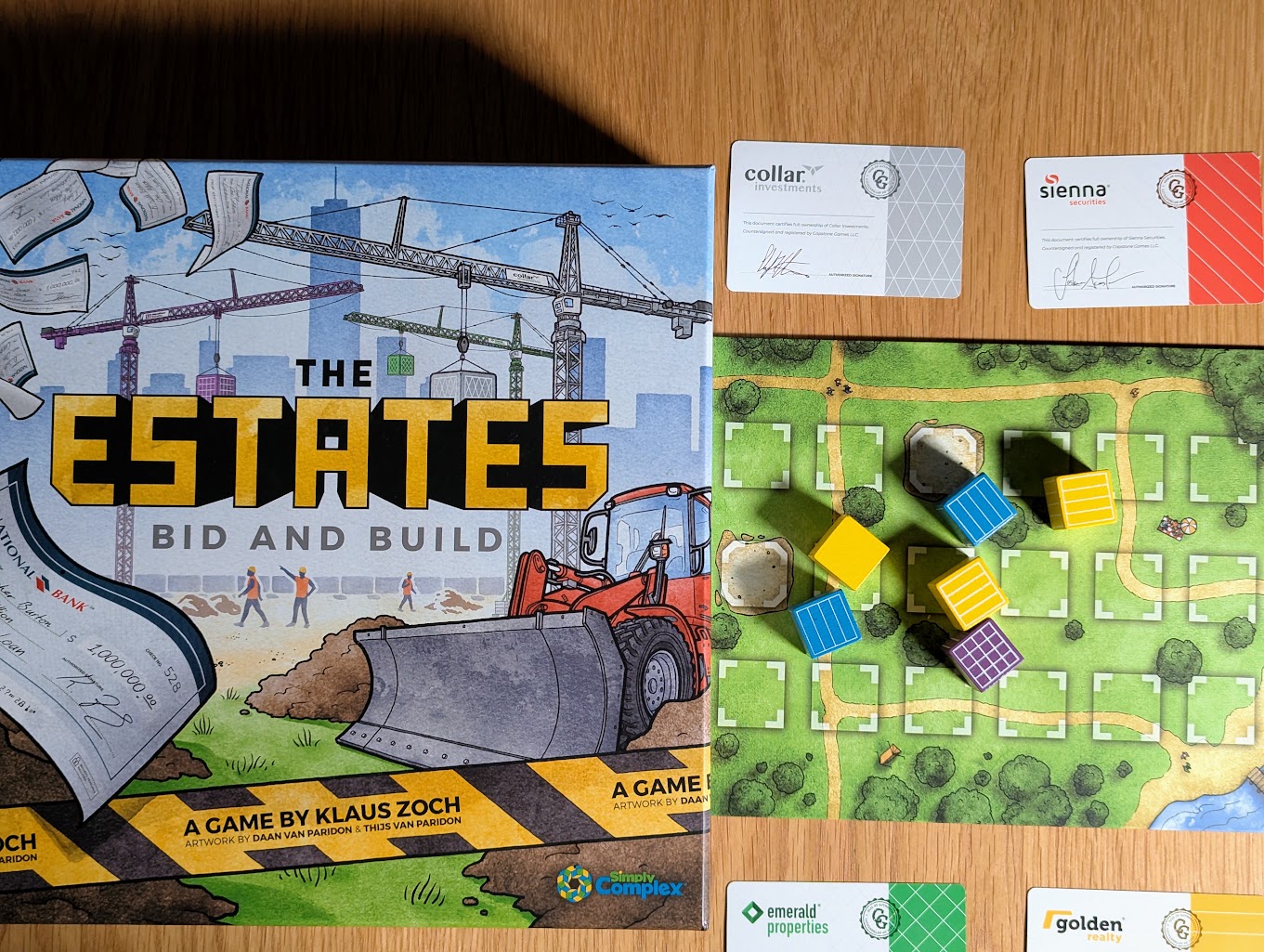
The Estates is a smooth-talking salesman. As with all board games, your first introduction is the cover. In this case, it is colourful and cartoony, and the components you play with are chunky wooden blocks that wouldn’t look out of place on a kindergarten floor. Yet the second you start to play, it reveals itself as the absolute monster of a game it really is.
First is the fact that if you don’t snag a company, well, too bad, so sad. That means there is only one way you are getting points for the rest of the game, and that is by stashing away a million dollars each turn. Still, that doesn’t mean you are out of it. You can still participate, and you can still win by sabotaging the rest of the table. Because oh yes, you can sabotage, and you can sabotage hard.
For instance, if someone is desperate for a piece, just outbid them. Someone built a big, hunking tower? Well, you may as well cap it off with one of your own pieces and steal their points. See someone sitting on a pile of points? Sink their score by dumping their coloured blocks into the row that will never be completed.
Yes, as much as The Estates is about clever auctioneering, it is much more about dog-piling on your rivals and hoping you come out on top. I have had so many games of this where the person with the least impact on the board walked away with the victory on a score of one or two, while everyone else sat at negative twenty.
It is pretty funny the first time it happens. You get that one player looking around the table asking everyone what the hell just happened.
But when it keeps on happening game after game, the punchline doesn’t loses its laughter. So when you actually want to play to win, it feels like you can never play well enough to get ahead of all the pettiness and sabotage at the table, which really rubbed me the wrong way.
It is a damn shame, too, because there are so many great moments and decisions baked into The Estates. I am a huge fan of the one-shot auction, where you only get a single chance to name your price before the table moves on. I especially love the twist here where the auctioneer gets the opportunity to buy out the highest bidder. It turns every auction into a game of dare, where players tempt the auctioneer to steal the piece away just to pad their own wallet.
The tight economy is another thing I really enjoyed, even if it makes it dangerously easy to go bankrupt. And if you do go bust, don’t expect The Estates to go easy on you. There are no government bailouts here. You are effectively sidelined for a few rounds until someone pays you for an auction and you scrape some funds back together.
There is also a great element of competitive cooperation, where players temporarily team up to finish a street, or band together to stop someone else from finishing theirs. That is where the special tokens come in and make those decisions extra spicy.
So yeah, there is a lot going on beneath the surface, even though it is a breeze to teach, learn, and play. My big worry, and the main reason I don’t know if I will play it again, is that “snake in the grass” gameplay. It actively stops you from pulling off the kind of clever plays I love in other games. Make no mistake: this is one of the meanest games I have ever played, sitting right up there with Arboretum.
Similar Games You Might Like
![Modern Art Review – The Most Delightful Way To Fleece Your Friends]()
Modern Art Review – The Most Delightful Way To Fleece Your Friends
A picture is worth a thousand bucks if you can con the table into buying it. Reiner Knizia’s finest auction design is a masterclass in selling the hype.
![High Society Review – Appear Rich, Die Broke, and Win Anyway]()
High Society Review – Appear Rich, Die Broke, and Win Anyway
Bidding high for fame is the right move until you realise the poorest player automatically loses. A satirical financial tightrope of ego and elegance.
![Smile Review – The Ups and Downs of Auctioning Fireflies]()
Smile Review – The Ups and Downs of Auctioning Fireflies
Nothing to smile about when you’re out of fireflies. A delightfully mean bidding game where savvy bidding is the only way to survive.


A score tells you if it’s good, but the leaderboard tells you if it’s worth the shelf space.

 Loading ...