
Tides of Madness
Players: 2
Playing Time: 20 minutes
Designer: Kristian Curla
Publisher: Portal Games
Tides of Madness successfully combines tight-two-player drafting with a push-your-luck mechanic in madness. It’s a wonderful game that will make you, or your partner mad!
Pros
- So much gameplay for 18 cards in a small box
- Creating satisfying combos between all the different scoring opportunities
- Pushing the limits of your sanity all in the name of four victory points
Cons
- Counting points at the end of each round slows down an otherwise quick game
Love our reviews? Buying through our links earns us a small commission at zero extra cost to you, helping us table the next big release! Full disclosure here.
Everyone has their price, what’s yours? A million dollars? The fame of a Hollywood movie star? Respect from your peers and colleagues? Well, what about four victory points?
Tides of Madness is a mano-a-mano eighteen-card drafting game. It’s you vs an opponent in a competition to get the most victory points while withstanding Cthulu’s seduction techniques. Anyone who loses their mind immediately loses.
Each round you start with five cards. From this selection, you draft one card to play and pass the rest to your opponent.
These cards come in one of five suits. If that means nothing to you, think hearts, clubs, spades and diamonds – but more Cthulhu-ier.
Additionally, each card also provides an end-of-round scoring objective. For example, one card might give you 3 points for each suit you don’t have. While another gives you 7 points for having the majority in one suit.
Objectives like these are easy to understand on their own. But once you have three or four different objectives you’ll be drawn into a web of confusion. Surrounded by scoring opportunities on all sides, wondering which one is best.
It’s not all about you though.
Drafting cards away from your opponent is equally important. This is often referred to as hate drafting, and it adds a delicious extra dimension to your decisions.
Once all cards are drafted, the round is over. Write down your total victory points on the scorepad, and prepare for the next round by picking one card to keep and discarding the rest.
In this way, you can build bigger and bigger combos over the rounds. Additionally, this mechanic allows the game to stay interesting over several plays. Since the cards constantly change, what you keep will change too.
Anyway, after three rounds of this, whoever has the most points wins the game.
If this all sounds great so far and you want nothing else. Then check out the prequel game Tides of Time. Because there’s one more wrinkle of Tides of Madness I’ve yet to mention.
It’s in the title.
Madness.
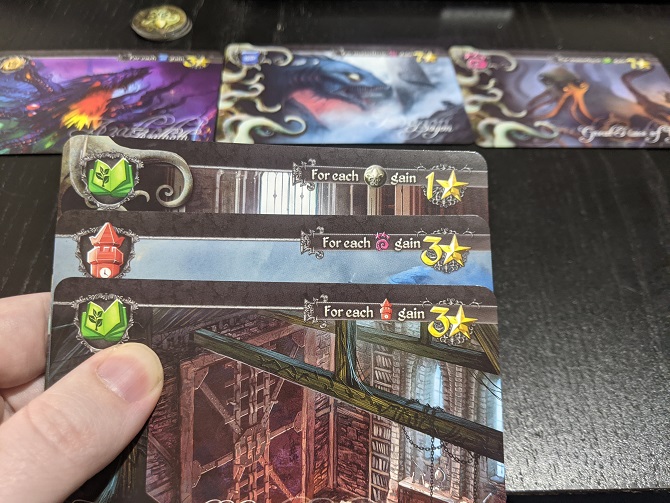
The Big Freaky Spider
In Tides of Madness, eight of the eighteen cards have tentacles wrapping around their suit icon. These cards are more powerful than the others, but drafting one gives you a madness token.
These come into effect at the end of each round during the madness check. If either player has more than eight madness. They lose. No ifs, ands or buts.
So too much madness is bad, but what about a little bit of madness?
Like a strange cackle now and then?
Well, that can be good, very good. During these madness checks, whoever has the most madness gets to either remove one or get four points instead.
Going back to the analogy of all of the scoring objectives creating a web of confusion, then this madness mechanic is the big freaky spider sitting on top.
It distracts you from creating the best combination of cards because you always have to keep an eye on your madness. You don’t want too much. But four points each round is enough to tempt even the sanest of people into going a bit crazy.
Despite being a small game, both in size and number of components. Tides of Madness offers a wealth of thoughtful decisions you need to make. Blending the logical decision of which end-of-round objectives will score the most points, and the non-logical decision of how mad can I get?
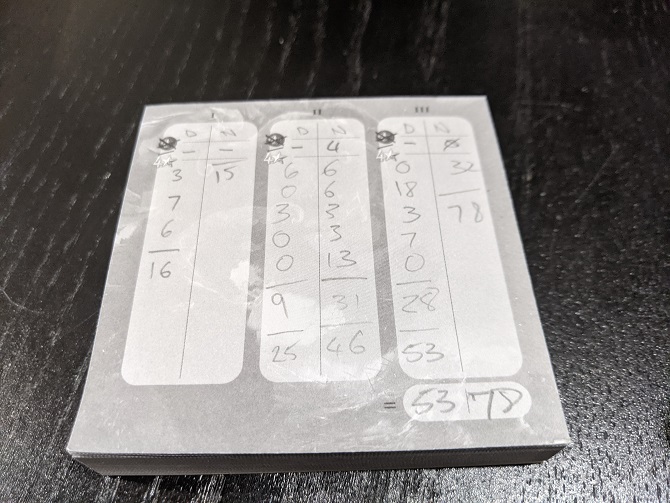
Counting Points Will Always Be dull
The one thing I didn’t like about Tides of Madness was the end-of-round/end-of-game scoring. While the complex web of scoring objectives makes for great in-game decisions. Counting them all at the end of each round is tedious.
It slows down an otherwise quick and snappy board game. It’s as though you’re driving down the highway and a massive Lovecraftian monster stomps across the road. Yes, eventually it’ll pass and you’ll get driving again. But for right now you have to sit in your car staring at your eternal doom.
Overall, this is a minor gripe. One that’s not necessarily directed at Tides of Madness so much as point salad games in general.
Tides of Madness is a good little game that rewards multiple plays. So if you and your partner have fifteen minutes to spare, you can do a lot worse than sacrificing your sanity to the great lord Cthulhu.
Tug of War: More battle line games
Battle line games are a unique brand of head-to-head combat where two players fight over a literal line in the middle of the table. If you enjoyed the back-and-forth tension of Tides of Madness, then these three are well worth checking out.


How does it compare?
A score tells you if it’s good, but the leaderboard tells you if it’s worth the shelf space. See the full board game rankings to see the true pecking order.


 Loading ...

Great review. Thanks Dave!
Thanks Jimmy, feels great to get support from a good friend.