Zenith
Players: 2 or 4
Playing Time: 25-30 minutes
Designers: Grégory Grard, Mathieu Roussel
Publisher: PlayPunk
Zenith blew me away with its familiar yet distinctive take on the battle line formula. The card abilities are excellent, the technology tree adds plenty of depth, and it’s all wrapped up in a polished production that just looks great on the table.
Pros
- Creates constant tension with five simultaneous battles for influence
- Multiple victory conditions mean no lead ever feels completely secure
- Wide variety of card effects keeps every game feeling fresh
- Cards combine into satisfying multi-turn combos without feeling overly convoluted
- Technology tracks offer meaningful progression and distinct strategic paths
Cons
- Large number of unique card effects creates a learning curve.
- Only plays two or four players, so can’t always be brought out at game night
- Cartoony artwork might not land for some
I’m no stranger to battle line games. From Hanamikoji to Air, Land & Sea, I’ve played plenty that revolve around fighting for control of a handful of key locations. But never have I seen one take that concept quite as far as Zenith by Grégory Grard and Mathieu Roussel.
It’s still about competing for influence over a series of central areas. But Zenith takes that simple foundation and piles on different currencies, a leadership mechanic, and a whole-ass technology tree.
Whenever a game adds this much to an otherwise streamlined system, there’s always a question hanging over it. Does it meaningfully expand the experience, or does it just turn a simple idea into a bloated mess?
How to play
In the far-off future, coexistence is a struggle. Like it’s not already.
As an ambassador, your goal is to earn reputation, gain control of the senate, and become the most powerful Sith Lord in the galaxy. Muhahaha… or you can unite the planets under a banner of peace. Your choice.
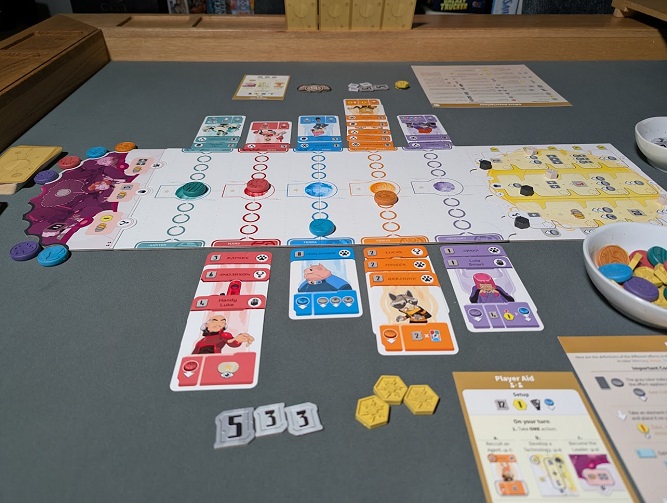
To do that though, you’ll need to collect five influence discs from the different planets to win the game. However, you can take a shortcut to victory by collecting four influence discs from four different planets. Or shorten your path to victory even further by collecting three influence discs from the same planet.
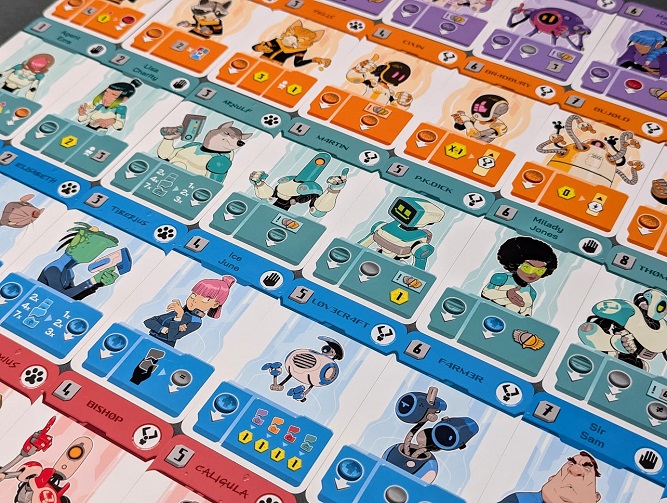
Now the galaxy you’re fighting over consists of five planets, each represented by a different colour. There are also three factions: Humans, Robots, and Animods (cybernetic animals). Every card has its own combination of colour, faction, and special ability.
On your turn, you’ll use those cards to perform one of three actions.
The action you’ll use most often is recruiting an agent. To do so, you’ll play a card from your hand, paying its credit cost and placing it beside the planet that matches its colour. Every card automatically provides one reputation with its associated planet, moving its influence marker one step towards your side of the track. Something you’ll want to do a lot, because if you can move the marker all the way across to your side, you’ll claim that planet’s influence disc and move one step closer to victory.
Of course, every card also comes with its own special ability, and when I say there’s variety here, I mean Milky Way levels of variety. Some cards provide extra reputation, some let you research technologies at a discount, and others allow you to spend previously played cards to gain Zenithium. Many of these effects also come with extra costs or conditions that need to be met before you can get their full benefit.
The second action is researching technology. By discarding a card and spending the required Zenithium, you can advance up one of the three technology tracks. The further up the track you go, the more powerful the research actions become. Better still, you also get to use the research actions from all of the levels below your current level. So while early upgrades are fairly modest, once you’ve climbed three or four levels, the bonuses become powerful enough to completely reshape the game.
The final action isn’t as flashy, but it’s surprisingly useful. You can discard a card to gain a small benefit and take the leadership token, increasing your hand size by one. Since there’s only a single leadership token in play, it regularly changes hands throughout the game. Some cards also become stronger while you’re the leader, giving you another reason to fight for it.
Players continue taking turns until someone earns enough influence discs to claim victory and begin their journey to the Dark Side. Or galactic peace. Again, it’s your choice.
A galactic tug of war
Zenith is tug of war on a galactic scale. Except instead of one rope, you’re fighting over five at once. Every turn becomes a balancing act between strengthening your own position and stopping your opponent from running away with a planet.
The result is an incredibly tense game. Influence markers constantly slide back and forth across the board, and it always feels like you’re on the verge of either winning something important or losing it entirely.
That tension only ramps up once players start claiming influence discs. Thanks to the three different victory conditions, no lead ever feels completely safe. Even if you’re ahead, there’s always the fear that your opponent is just a couple of powerful cards away from sweeping a planet and snatching victory right from under you.
Strip away the cards and Zenith is actually a fairly simple game. Recruit agents, gain reputation, and research technology. Once the cards enter the equation, though, the game explodes into a supernova of possibilities.
The card pool is remarkably varied, with very few repeated effects. Yet despite that variety, almost every card seemed to have a purpose. Individually, they all feel impactful and shake up the board state. Better still, they work together beautifully, making two or three-turn combinations surprisingly easy to put together and incredibly satisfying to execute.
Of course, if you’re building powerful combos, your opponent is doing the same thing. The result is a wonderfully dynamic game where influence markers never sit still, constantly sliding back and forth between players.
No matter how carefully you plan, though, your opponent is eventually going to slip through your defences. With only four cards in hand, it’s unlikely you’ll always have the perfect response. That’s where the leadership token comes in. Not only does claiming it provide a useful bonus, but the increased hand size gives you a much better chance of finding the card you need when you need it.
You’ll need that flexibility, too. Researching technologies and taking leadership actions often requires discarding specific cards, leading to some genuinely painful decisions. More than once I found myself throwing away a card I desperately wanted to play because it was the best move in the long run.
Speaking of technology, the research tracks are a lot of fun to experiment with. Each one has a distinct identity, and while the early upgrades can feel a little underwhelming, the higher levels are where things really take off. Reach the third or fourth tier and suddenly those earlier investments start paying dividends. It creates a satisfying sense of progression and makes investing in a technology path feel worthwhile, assuming the game lasts long enough for you to see it pay off.

The little things that make it glow
Zenith has an interesting relationship with money. Much like Castle Combo, another game from Grégory Grard and Mathieu Roussel, credits don’t just magically appear in your lap. You have to go out and earn them.
While you start the game with a couple of heavy sacks of coins, keeping your economy afloat becomes a fun challenge in its own right. Every credit feels valuable, and when you finally get enough together to play one of the more expensive cards, the payoff is usually worth it.
If there’s one double-edged sword in Zenith, it’s the sheer number of unique card effects. We spent enough time checking the player aids that it’s worth mentioning. Thankfully, the player aids are excellent and do most of the heavy lifting. Even while we were learning what all the cards did, turns stayed quick and the game never lost momentum. It’s not a dealbreaker by any means, but Zenith definitely asks for a few plays before all those card effects become second nature.
While we’re talking about production, I need to mention the artwork. The style is colourful, comic book-inspired, and completely up my alley. So it was a pleasant surprise to discover that all 90 cards feature unique illustrations for my eyeballs to soak in.
I also need to give a shout-out to the tokens. They’re not flashy, but they’re a sizeable step up from the wooden cubes and discs of old. The moulded wooden pieces have plenty of character and are exactly the sort of thing that appeals to a grizzled board game veteran like me.
And that’s Zenith. A wonderfully tense two-player game packed with meaningful decisions, clever card combinations, and multiple paths to victory. Between the tug-of-war for influence, the rewarding technology tracks, and an economy that makes you work for every credit, Zenith constantly gives you interesting problems to solve.
It’s a tight, well-designed game that pushes all the right buttons for me, and one I can’t wait to get back to.
Similar Games You Might Like

Raptor Review – Prehistoric Thrills and the Problem with Modern Science
Tranquilise runaway dinos before they chew through your research team. A clever two-player hunt where luck-heavy card play pulls all the strings.

Claim Review – A Two-Player Duel of Dead Kings and Sewing Socks
The king is dead, leaving two rival factions to battle for the vacant throne. A clever, two-player trick-taker that completely bends traditional card rules.

Radlands Review – A Neon-Soaked Duel at Terminal Velocity
It looks like a Mad Max fever dream, but plays like a deliberate, tactical slugfest. A tightly balanced wasteland duel where clever plays win the day.
A score tells you if it’s good, but the leaderboard tells you if it’s worth the shelf space.

 Loading ...