
Concordia
Players: 2-5
Playing Time: 100 minutes
Designer: Mac Gerdts
Publisher: Rio Grande Games
Concordia did not sit well with me at all. There’s no feedback within the game to tell you what’s a good move, a bad move, or how you’re travelling compared to everyone else. So it’s 100 minutes of feeling lost.
Pros
- Gameplay is simple with diverse strategies to gain victory points
- Feels like a classic Euro game with its art and wooden components
- Fun comes from building out your network and managing your resources
Cons
- Unusual-shaped box that’s hard to store
- No feedback throughout the game telling you how you’re going
- Scoring is complicated and hard to wrap your head around
Love our reviews? Buying through our links earns us a small commission at zero extra cost to you, helping us table the next big release! Full disclosure here.
Instead of David vs Goliath, today you’re reading David taking on a Goliath. That is the game of Concordia. A game that gets praise from a lot of reviewers. Often touted as one of the best games of all time. So let’s see how it fares against my slingshot and sandals.
I am currently typing in a pair of welding gloves because this is the hottest take I have. But…
Concordia did nothing for me.
An empty experience from such a celebrated game, I was so disappointed.
But…
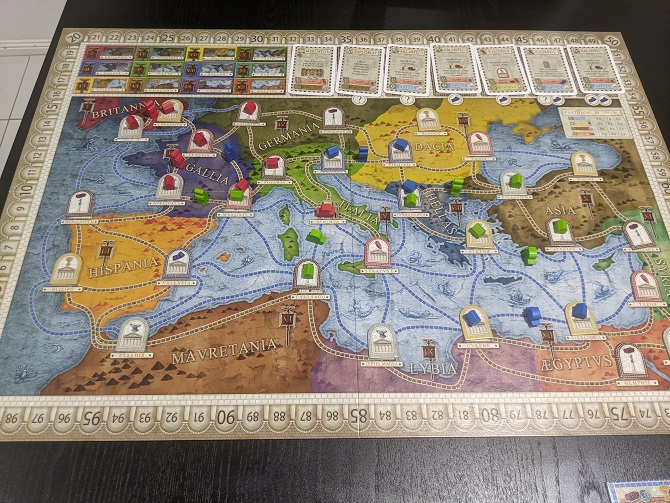
I can see why it’s so liked. As in theory, this should be my type of game. It’s simple to play and teach, and revolves around three things:
- Managing a hand of cards: buying, using, and refreshing cards in your hand.
- Managing the board state: moving pawns around the map and building cities.
- Managing currency: which comes in the form of goods or money.
What did you expect? It’s a Euro game and follows a lot of Euro game staples with its mechanics, and its theme – trading in the Mediterranean. But it’s not as dry as you’d think. It gets a bit salacious over its card effects.
The map is broken down into 12 areas (provinces) made up of several cities. Playing a Prefect card allows you to choose a province, and then all cities in that province generate goods for all players who have a house in those cities. Meaning, if I put a house in a province that has goods that Bob wants to generate, then I also get goods when he plays a province card. Which is great, because I hate that guy.
After generating goods in a province, that province becomes used. That province now generates money. But only if someone plays a Prefect card, and only if they choose money over the goods. If they do, they get all the monies from all of the used provinces, and those provinces refresh. That’s right, the same card used to produce goods is also the one used to give you megabucks. It’s also the same card that makes everyone’s eyes grow a little wider whenever someone produces it and the same card that the table groans when someone recalls all the money. It’s like a really bad game show where you can either win a million dollars… or some bricks.
Yaaaaaaaaaaaay bricks.

The other odd-ball card you can play is the Diplomat, which copies the last card another player played. Giving you access to the same card twice. Like a good joke, the most important part about playing the Diplomat is timing. If someone plays a card that you want another of, brilliant. If not then there’s no point. This creates a sense of urgency when someone plays something good as you can’t be certain when you’ll see it again.
This all sounds great. So why did I bounce so hard off of it?
Well, the theme does it no favours.
But that’s not the issue.
What makes me feel like a kid who got apples instead of chocolate is the scoring. You only score once. Which is both the most boring Bond movie ever, but also a reality in Concordia. And because of that, I never felt like I knew how I was doing throughout my plays. Typically, I enjoy board games that revolve around having a plan, executing that plan, and sitting back to let the serotonin flow over me as I move my marker up the score track. In Concordia, you have a plan, you execute a plan, and instead of serotonin you get a paranoid thought in the back of your brain saying:
Was that a good move?
It’s Anxiety: The Board Game, and I struggled to engage with it. What makes it worse is that scoring isn’t that easy to figure out either. Your hand of cards acts as multipliers of stuff that you have on the board. It’s not as though you can do quick maths to figure it out either. Instead, you have to feel your way through the game, like you’re walking through the dark when there are no walls around – how can you tell if you’re going the right way?
With more plays, I feel most people would be able to get past this and understand what is a good move, and what’s not. But I’m part programmer, I live on instantaneous feedback – I write some code, and does it compile? Does it pass the tests? Concordia is the antithesis of that way of thinking, and therefore I don’t think we’ll ever get along.
Similar Games You Might Like

Ra Review – A Revised Classic Worth Shouting About
Praise the sun god or watch your auction bids go up in smoke. The essential Knizia masterpiece that turns simple probability into pure push-your-luck panic.

Aquatica Review – The Engine-Builder That Ends Too Soon
Slide location cards into your double-layered board to trigger instant resource chains. A clever, fast underwater puzzle cut short by a sudden end.

Power Grid Review – Turning Electrical Infrastructure Into High-Stakes Speculation
Outbid rivals for power plants and buy cheap coal before prices soar. A meditative, maths-heavy market simulation with some severe rubber-banding.
A score tells you if it’s good, but the leaderboard tells you if it’s worth the shelf space.


 Loading ...

I do enjoy Concordia, but it’s kind of bland and I’m never really excited to play it.
When it comes out on digital (I think Acram Games is doing it?) that may change.
But my reaction when it’s suggested is usually “yeah…ok. Sure.”
Yeah I feel that’s my thoughts on it as well. I didn’t have a bad time with the game, just I’d rather play something else haha.
So Dave, what’s the game that makes you go ‘YEAH LET’S DO IT!!”?
I would definitely do that Clank in Space, Time of Crisis, or (if 2-player), 1960: Making of a President
Oh wow, Clank In Space seems the odd medium weight game in the mix. My only recollection of the other two games have been from your blog. Will have to go back and re-read. 8)
I like Concordia but agree it can be hard to tell how well you are playing. I’ve found the best way to mitigate this is to pick one or two card sets to aim for and them do things that match that set. So if you have several cards that give a bonus for having towns in each province, work on getting to each province. This made what I was doing feel more purposeful.
Hi Melanie! Thanks for the comment. This was my strategy going into the game but I think I might just suck haha. Or I got distracted, which is probably more likely. Go for boring new cards, or shiny new cities. I will always pick the later – haha. Glad you enjoyed it though.