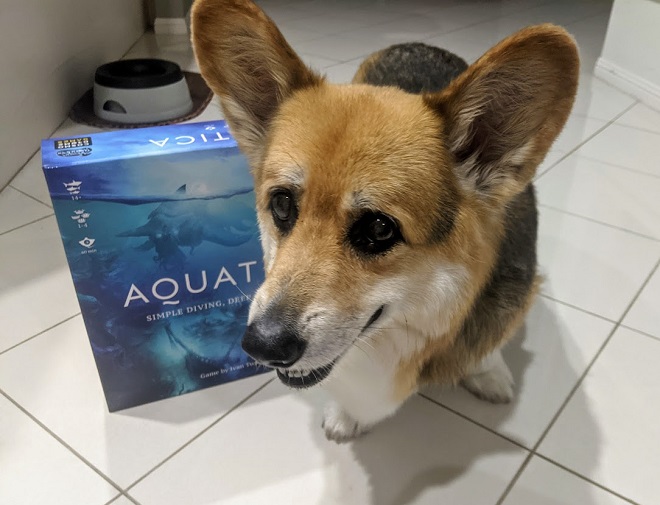
Aquatica
Players: 1-4
Playing Time: 30-60 minutes
Designer: Ivan Tuzovsky
Publisher: Cosmodrome Games
Aquatic is a great little engine-builder with some interesting twists. Unfortunately, the ending comes too quickly, catching you off guard and affecting your experience.
Pros
- A unique one-use economy means you’re always on the hunt for more resources
- Working out if you pay for something through combining resources and mantas
- Dual-layered cardboard player boards help sell the game
- Knowing when to hamstring yourself for objectives
Cons
- Finishes too soon for my liking
- Low interactivity between players makes it hard to catch up
Love our reviews? Buying through our links earns us a small commission at zero extra cost to you, helping us table the next big release! Full disclosure here.
Aquatica takes place in one of the last great unknowns; the ocean. Where over 80 per cent of the ocean is unexplored and unmapped, making it easy to imagine civilisations of creatures hidden in its depths.
In Aquatica, you don’t imagine these civilisations.
You play as them.
Great Kingdoms have spent centuries building their world, raising their kids, constructing their cities and prospering. But now their limited resources are dwindling, and they will have to fight and influence the remaining kingdoms for what’s left.
If you’ve played Concordia, you’ll already be familiar with the gameplay of Aquatica. Everyone begins with the same six starting cards, and each turn you’ll play a card-carrying out its action. Eventually, you’ll play the Matrona card and pick up all the cards you’ve previously played.
Play continues until one person completes 3 of 4 end-game objectives picked randomly during setup.

The Snapchat economy
Throughout Aquatica, you’ll acquire locations through money or force. Once gained, a location goes into your board.
That’s right, into.
Each player board is double-layered cardboard. With space enough for you to slide location cards underneath a top layer.
A location may have several resources, but you can only ever access the top one. But once you use the top resource, the location card gets pushed upwards so it no longer displays. Hopefully giving you access to a new top resource.
These resources are either money, power, or a special ability. They can be used instantaneously and for free on your turn. Stringing combinations of these resources together is how you bring your player board to life.
A good combo will have you sliding cards up your board like an underwater DJ.
The one-and-done use of these locations creates a Snapchat economy where even though there aren’t any filters, all of your resource production is temporary. In all my games, I couldn’t make my engine consistently produce what I needed and instead needed to be on the lookout for new ways to stay afloat.
I found this hunt for the best combination to be enthralling, as I always had many options to consider. Whether it was playing the right card from my hand, waiting for locations to become cheaper, or a clever use of the mantas (which provide some instant resources once a round) there was always something I could do.

What just happened?
The end game objectives are fantastic, and give each play a unique flavour without changing the game drastically. In one game I was conquering locations like Ghengis Khan, while in the next I had to focus heavily on recruiting.
But I think the more interesting part of these objectives, is that in claiming them, you need to surrender a manta ray.
You had to handicap yourself to get closer to victory.
I had a tough, but fun time reconciling this. And who can blame me? You’re saying goodbye to free resources.
To tempt you further into bad decision-making, each objective is worth a lot more to the first player to achieve it. Therefore, you’ll need to temper your greed to win, but knowing when is the time to lose a manta ray is a tough choice. Especially given the explosive pace that Aquatica finishes.
Unlike other engine-building board games, like Ark Nova, which allow you to run your completed engine for a few turns before ending the game. Aquatica finishes right before you put the final touches on your engine, probably even before then.
I found this weird and frustrating. The game allows you to plan out deep multi-turn strategies but then never lets you finish them. Like a fire alarm going off during your meditation, it completely breaks your chain of thought leaving you unsatisfied and asking, “What just happened?”.

An Ending Like The Knowing
Overall I enjoyed Aquatica, it’s a good game but reminded me a lot of Nic Cage’s 2009 movie, The Knowing. Fantastic premise, and execution up until the final minutes of the movie, where everything was ruined by the ending.
It’s the same with Aquatica. Whereby you’re not able to finish your strategy or complete your grand plans, and instead you’ve blinked twice and the game is over. Like the ocean, it left a bad taste in my mouth.
I feel if you’ve had experience with engine-builders before, you’ll feel let down with this ending and would be better off getting something like Jump Drive or Res Arcana. However, if your only experience is Everdell or Wingspan, then Aquatica offers no more rule complexity, but more interesting opportunities for strategy.
Similar Games You Might Like

Fantastic Factories Review – All the Bricks, None of the Instructions
Dropping a tub of colorful building blocks without the assembly guide. A breezy introductory game that lacks the combo magic of big engines.

Splendor Review – The Satisfying Snap of a Perfect Engine
All that glitters is actual victory points. The modern classic engine-building sprint where lightning-fast turns leave zero room for error.

Project L Review – A “Severance” Style Wellness Session for Your Brain
This tetris-inspired puzzle lands every piece in the right place. A tactile engine-builder that makes shape-fitting stupidly addictive.
A score tells you if it’s good, but the leaderboard tells you if it’s worth the shelf space.

 Loading ...