
Medici
Players: 2-6
Playing Time: 60 minutes
Designer: Reiner Knizia
Publisher: Grail Games
Medici is a classic board game that still kicks butt today. Having to weigh up whether you want to be the best merchant, or get the goods you want is sometimes a heartbreaking decision. But even then it’s still a great deal of fun.
Pros
- Using points as currency puts extra tension on each auction
- Auctioneers get some control over what is on offer
- Split decision-making in getting the goods you want vs the best merchant award
- It plays quickly and auctions move at a pace
Cons
- After a few games and some deep thought, you get a good feel for the prices of items
- More calculated than most other auction games
Reiner Knizia has designed over 700 board games, yet on this site, I’ve only reviewed one. Meaning I have a lot of work to do. Coincidentally, that other game is another auction game called High Society.
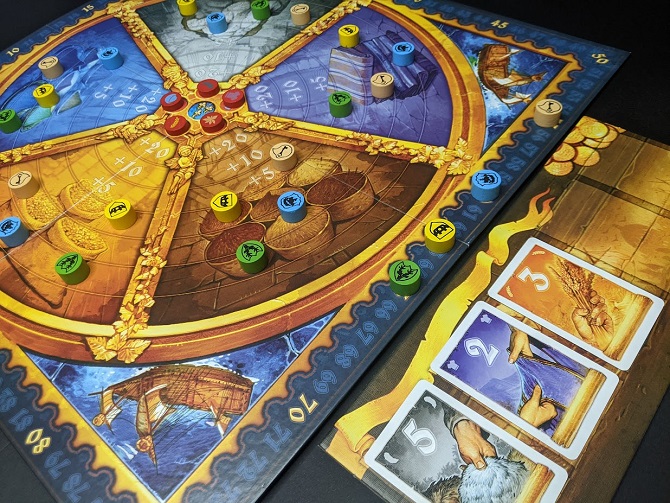
In Medici, you are a travelling merchant loading up your boat with luxury goods, and selling them for florins. These goods have both a type and value and your boat can only hold five of them.
Players take turns starting up auctions by drawing cards from the deck of goods. Then starting with the player next to the auctioneer, everyone gets one chance to bid or pass, ending with the player who drew the cards.
At the end of the round, whoever has the highest total value of items earns a sizable amount of florins. As they are the most successful merchant of the day. For everyone else, this reward falls off a cliff, with the least successful merchants getting nothing. Not even a participation trophy.
However, like the adage, if you want good food, then don’t go to a restaurant with a large menu. The same is true of merchants. After awarding the most successful merchant, you find out who sold the most of each good and award them 10 florins each.
This number of goods won in an auction and then sold, remains round after round. And if anyone manages to sell off six of the same type of good, they gain another 20 florins during this phase.
After three rounds of auctioning and counting goods, the player with the most florins wins.

The twin tightropes
The best board games offer you a tightrope to walk. Forcing you to balance between two needs and identify the correct way to lean, or else you fall off the rope and lose the game.
In Medici, there are two.
The first rope is the cost of every auction. While winning the auction is the goal, you’re giving up florins to do so. The one thing you need to win the game. Therefore you need to balance what you’re losing with what you’re gaining.
This is tough at the best of times, but adding other players makes you wish you had a degree in Freakonomics. Since now it’s not only gain vs loss, you also have to curate your bid to dissuade others from bidding above you. And with only one opportunity to set your price, the margin for error is smaller than Medici’s wooden components.
The second tightrope to walk is the one between being the most valuable merchant at the round’s end or collecting specific types of goods and earning additional points later on. Ideally, you want both. But the frustrating beauty of the auction mechanic in Medici is that you’re never going to get it.
If the auctioneer draws a high-value card you want, they’ll likely draw another one. And it will be rubbish. Then it’s over to you to weigh up whether or not that first card is worth taking it on.
More to the point, because florins are used for auctioning – getting a lot during a round gives you more bidding power for the next round. Giving weight to the immediate cash injection from having the most value, but still, is it worth giving up those florins in the later half of the game?
Out of print?
Medici is a masterclass of clever game design, where although there aren’t many rules, each rule is pulling double – or sometimes – triple duty. Meaning, despite its simplicity, there’s this incredibly profound decision you need to make. There are a lot of calculations surrounding this decision, as you try to walk both tightropes.
Now, the more you play the better you get at this decision. But you also get better at making this decision harder for everyone else – either by drawing more cards, or putting out bad bids and baiting others to go bigger than they should.
As such, it’s a fantastic board game, worthy of appearing on as many top 100 lists as it does. The unfortunate news is that because of a legal altercation between Grail Games and Reiner Knizia, Medici is no longer in print.
However, given the never-ending praise for the game. It’s only a matter of time before someone picks up the mantle and delivers this great game once more.
Similar Games You Might Like

Furnace Review – An Innovative Auction Trapped in a Dull Engine
Losing bids has never been so lucrative. A genius take on auction games that cools off fast once the dry resource sorting begins.

Vault Wars Review – Dead Adventures Don’t Need Their Loot
Going, going, dragged out. A funny fantasy-themed storage auction whose clever bidding mechanics gets lost behind a tedious amount of downtime.
Smile Review – The Ups and Downs of Auctioning Fireflies
Nothing to smile about when you’re out of fireflies. A delightfully mean bidding game where savvy bidding is the only way to survive.
A score tells you if it’s good, but the leaderboard tells you if it’s worth the shelf space.

 Loading ...

It went pretty good, though it’s been so long I don’t really remember it
The app for this was quite good. I don’t know if it’s still available, though. I’ve only played the game on the table once, but I remember really enjoying it.
Absolutely, how did you go with the app? I imagine it would be quite hard on the higher difficulties, with the game’s perfect knowledge and memory. But I spose that’s true of all board game apps.