
Tales of the Arabian Nights
Players: 1-6
Playing Time: 120 minutes
Designers: Anthony J. Gallela, Eric Goldberg, Kevin Maroney, Zev Shlasinger
Publisher: Z-Man Games
Putting its problematic depiction of gender identity aside, Tales of the Arabian Nights is nothing more than a series of disconnected story beats that you must paste together to make any sense.
Pros
- There is fun in the transformations your character undergoes
- Sometimes it tells a cohesive story that you can enjoy
Cons
- No strategy, the game is a series of random outcomes that you can’t control
- The story comes in bite-sized bits and often doesn’t make sense
- Problematic and outdated approach to gender roles
Love our reviews? Buying through our links earns us a small commission at zero extra cost to you, helping us table the next big release! Full disclosure here.
Originally released in 1985, Tales of the Arabian Nights is a roleplaying-lite game that takes players on mystical adventures through the Arabian desert. Sometimes you meet the woman of your dreams, other times you’re jailed for stealing bread, and other times still you are turned into a gorilla by a wandering street magician.
Whatever journey you embark upon, you’ll be competing for Destiny and Story points. The first player to return to Baghdad after collecting enough to meet their goal wins. Although, as a story game, the destination is of less consequence than the journey to get there.
A journey beginning in Baghdad. Each player receives a quest to complete and not enough money to do it. This underpins your character as a motivation for why they’re exploring the world. And it can be as simple as a triumphant return from exile, or as complex as finding a lover for a wealthy merchant.
With this goal in mind, you’ll travel from place to place accumulating wealth, treasure, status, and skills. From increasing your travel speed to opening more options within the narrative, these boons will help you on your journey.
Once you’ve moved to a new area, you’ll draw an encounter card, and then decide on an action to take. Finally, you’ll read, or be read, a passage from the Book of Tales. Outlining the fate in store for your character. During the readthrough, you’ll make choices, take skill checks, find treasure and items, and apply additional effects.
Then it’s all over and onto the next player’s turn.
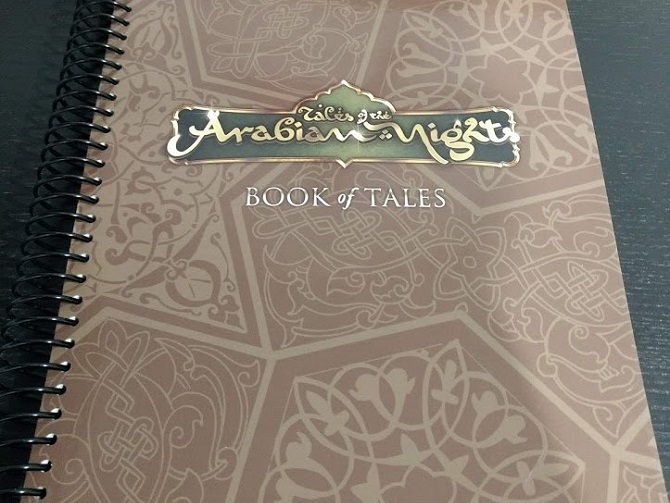
Too random for its own good
The way this Book of Tales works is astonishing, with 2600 different actions, consequences, and circumstances the craftsmanship is phenomenal. It’s no wonder few games have dared replicate the intricate nature of how it works.
Simplified, it boils down to this: the spot you move to is where the event happens, the drawn encounter card is who it’s with, and the action you select is the what and how. Once you combine all these variables, you get the numbered code for the passage to read out.
Right before this though, when picking your action, is the most fun and ridiculous part of the game. For example, you might encounter a Bloodthirsty Barber suspiciously looking like Johnny Depp. Your action must then be one of honouring, attacking, avoiding, aiding, robbing, following, questioning or praying to this mad hair cutter.
While it’s fun to imagine the outcome of each of these actions, in reality, they feel entirely random. Sometimes praying to a drunken thief is the right thing to do because it was actually the king in disguise. However, there’s an equal chance of it being an ambush where a snake charmer uses their snake to poison you. There’s no indication or predictor of what’s going to happen after you use an action, both in narrative and rewards.
So as silly as the story gets sometimes, it’s frustrating for those who want to gain points, as well as those who want to put together a cohesive story. Compared to modern games like Lands of Galzyr or Forbidden Waters which carry plot points throughout their duration. Tales of the Arabian Nights provides a random potluck of encounters, leaving it up to you to make sense of how they connect.
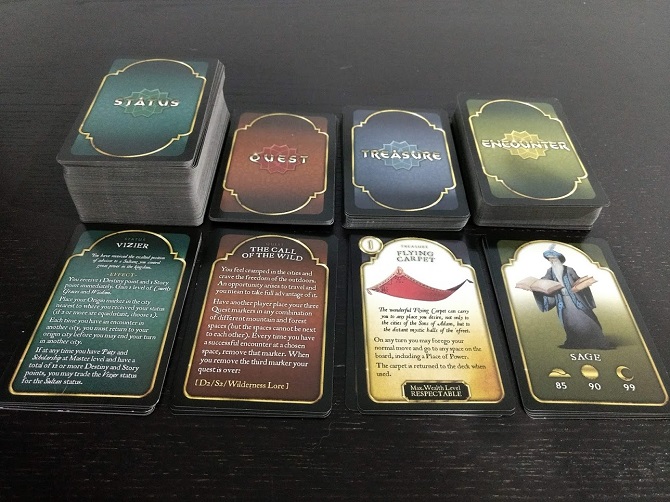
Get Drew Carey on the phone!
During Tales of the Arabian Nights, your character gains skills and keywords that unlock new opportunities within the narrative. This is a cool way to show character progress. However, the skills don’t appear in the book as often as you’d like. So while your character experiences a lot of growth throughout their journey, you may never put that growth to use.
Otherwise, Tales of the Arabian Nights is like Whose Line Is It Anyway, where everything is made up and the points don’t matter. Where winning isn’t the point of the game, having a good time is – and whether you have a good time depends on how much you enjoy the random light-hearted storytelling.
For me, it fell flat, the disjointed nuggets of narrative were more confusing than entertaining. And while the book is executed exquisitely, stripping all forms of strategy and meaningful decisions from the game is too frustrating for me to ignore.
Crafting the Narrative: More story games
Narratives in board games have come a long way since Tales of the Arabian Nights and story beats are no longer a lucky dip. Three examples of this are below with more cohesive and more compelling narratives.


How does it compare?
A score tells you if it’s good, but the leaderboard tells you if it’s worth the shelf space. See the full board game rankings to see the true pecking order.


 Loading ...

I’d agree with that outcome. It’s also a really long game with 6 players, to the point we gave up playing last time we played. That was 4 hours in! Ace review mate.
Cheers Luke! Yeah I’ve had a game where I’ve had to call it early as well. 20 points is just too much!
We found suggestions saying reduce it for 6 players to 10, however even that was too much. We gave up when one player had hit 8!
Wow, I guess you are reading slot and waiting for others to move. Hope you had fun though!