Endless Winter: Paleoamericans
Players: 1-4
Playing Time: 60-120 minutes
Designer: Stan Kordonskiy
Publisher: Fantasia Games
Endless Winter: Paleoamericans is a fun game of diverse systems connected through three central resources. Managing these resources, as well as exploring these systems, is as exhilarating as navigating the icy wilderness itself.
Pros
- Simple yet complex gameplay – there are only four actions!
- Multiple different strategies to follow and ways to build your deck
- Wonderfully produced, and beautiful to look at and play
- All your moves feel both connected and disconnected at the same time
- Sets itself apart from other games in the same genre
Cons
- Learning the rules for all of these systems can be complex
- With the amount of mechanics, the game can feel unfocused
- Requires a lot of table space
Love our reviews? Buying through our links earns us a small commission at zero extra cost to you, helping us table the next big release! Full disclosure here.
Endless Winter: Paleoamericans is a board game where you raise a North American tribe in 10,000 BCE. It’s strange because although there’s an overwhelming amount of systems in play, interacting with these systems boils down to four simple actions.
Each turn, you pick one of the four actions to carry out: initiating new tribe members, developing new culture, migrating to new lands, or going on a hunt. All of these actions have three parts to them. The first part can be performed any number of times, the second part only once, and only the first player to choose the action carries out the third part.
After everyone takes three turns, an eclipse happens. Similar to the reveal turn from Dune: Imperium, players reveal any cards they contributed to the eclipse. Carrying out the eclipse effect on those cards.
Otherwise, these cards are used for their labour value and abilities during your turns. Interacting with the many systems on the board. These systems include:
- Adding stones to the megalith to get points and resources.
- Collecting animals at the hunting grounds gives you points at the end of the game based on how many of the same type you have. You can also hunt them for food.
- Migrating the tribe across the map is an area control minigame that gives points and resources.
- Worshipping sacred stones gives you a large number of conditional points during the eclipse.
- Finally, worshipping the gods on the idol board which contains two tracks for end-game scoring.
Despite the number and complexity of these systems, Endless Winter keeps it simple by only having three different resources: tools, food, and labour. Four different actions, and four ways to get end-game victory points: animals collected, tribespeople buried, leftover resources, and points on cards.

No strategy? No problem
Endless Winter is a similar worker placement deck-building hybrid to both Dune: Imperium, and Lost Ruins of Arnak. This type of board game is having a moment in the sun.
Nevertheless, Endless Winter sets itself apart, by letting the cards you gain supplement your worker placement actions. Instead of determining them.
The saying ‘with great power comes great responsibility‘ is as true for Spiderman as it is for anyone playing Endless Winter. Since there’s no limit to the number of cards you can dedicate to an action, you can have powerful turns where you empty your hand paying for labour. But in doing so, you will limp toward the next eclipse, as that’s the only time you get new cards.
Now, effective budgeting might not sound exciting, but it does create tension between what you need and what you want. This is a staple dilemma found within a lot of board games. However, Endless Winter presents it in such a fascinating way, that only a few others can compete with the interest and deep thought patterns created.
A simple example is the Crafter card, it provides one labour and one additional labour when played with the Develop action. However, if it’s in your hand during your Hunt action, you’ll want to save it for your next Develop action, but you might need to play it to finish your Hunt actions.
So what are you going to do?
This tough but fun thought process is all throughout Endless Winter. Beyond the cards and labour, you have limited food and tools to spend. Splitting these across so many interesting systems means figuring out what you need, and what you want, is the only path to victory.
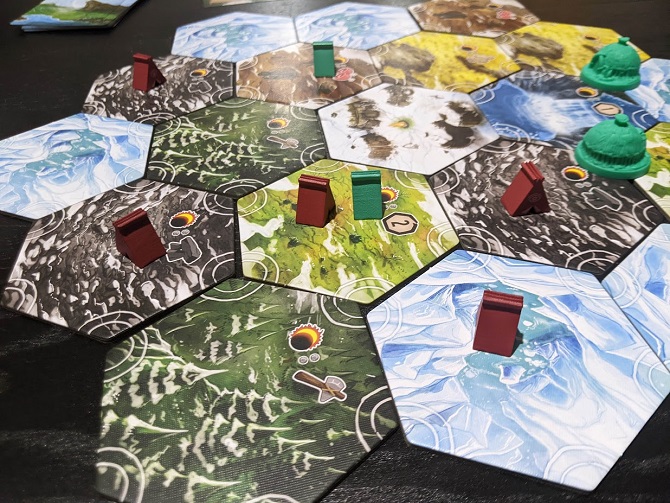
Great game but a horrible teach
I’m not trying to scare anyone off by mentioning how many systems are within Endless Winter. But it certainly is one of the main talking points.
The thing is though, that the systems here aren’t complex or deep. It’s not a Vital Lacerda game like CO2: Second Chance, where every system connects to or relies on another. The only thing connecting these systems is the three resource types you must spend to activate them.
So although a lot is going on, I found it easy to understand and navigate after a couple of rounds. Still, teaching all these systems was a horrible experience. When playing with new players, you have to explain all of these systems for them to have a chance to do well. This is an impossible task to do within the time before your friends’ eyes glaze over.
Once you get over that hurdle though, Endless Winter is bloody terrific.
All of these systems are in some way interactive. Hunting, for example, is a race to get the animals of the type you want. Meanwhile, you can build off of your opponent’s pieces in the megalith. So the board state becomes fluid, fitting into the unique container created by the player’s playstyles.
Along with the random sacred stones and culture cards, you can never go into a game with a single strategy in mind. You need to be agile and ready to adapt to the reality presented before you.
Board games like this have a longer shelf life than most because the odds of the same people playing the same style after a loss are rare. More often, they’ll change things up, and that change will have to be responded to in new and interesting ways.
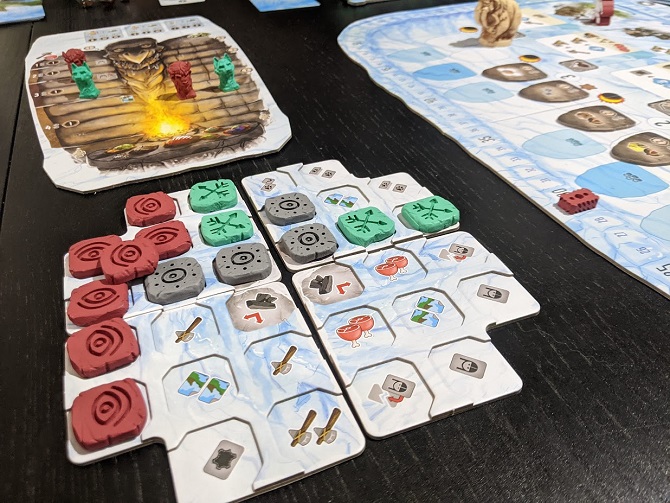
Brace your table, winter is coming
From a production standpoint, Endless Winter is a work of art. Everything from the insert that helps set up the game, to the way the tokens and miniatures look like they’re made from the same material. For example, the minis have a wash over them to make them look like bone, while the monolith tokens look like they’re made of stone. It’s all extremely well done and makes it feel like a premium product.
The only downside to this production is just how big it all is. Between individual player boards, room for the market, plus all of the other systems. Endless Winter takes up a lot of space to play, and I think a lot of people will have trouble finding the space to play it. So make sure to do your research, and have space to play it first.
Overall, there’s so much more to talk about in Endless Winter that isn’t covered, like:
- Deciding whether to hunt animals for food or points.
- Tribes cards all being the same, while culture cards are all unique.
- Constructing your deck, and balancing culture and tribes member cards.
- The two different phases, and planning for the second phase.
- And so much more…
All of these decisions add to a simple yet complex ecosystem of different mechanisms that are just a joy to play with. Endless Winter might not be the game of the year, but it’s definitely in the conversation.
Similar Games You Might Like

Ancient Knowledge Review – Digging Your Own Grave in the Annals of History
Preserving history is a constant struggle as your strongest cards slide off your player board and into oblivion. A shifting puzzle where you race to harness your powers before time runs out.

Lewis & Clark: The Expedition Review – A Journey of Momentum and Misery
Packing heavy supplies speeds up resource craft, but bogs down your scout. A deep deck builder hybrid hampered by punishing mountain choke points.

Raiders of the North Sea Review – Sending My Hard-Earned Crew to the Big Viking Farm Upstate
Takes the wind right out of your sails. A clever, fluid worker-placement design spoiled by punishing crew losses and random combat dice.
A score tells you if it’s good, but the leaderboard tells you if it’s worth the shelf space.

 Loading ...