Fort
Players: 2-4
Playing Time: 20-40 minutes
Designer: Grant Rodiek
Publisher: Leder Games
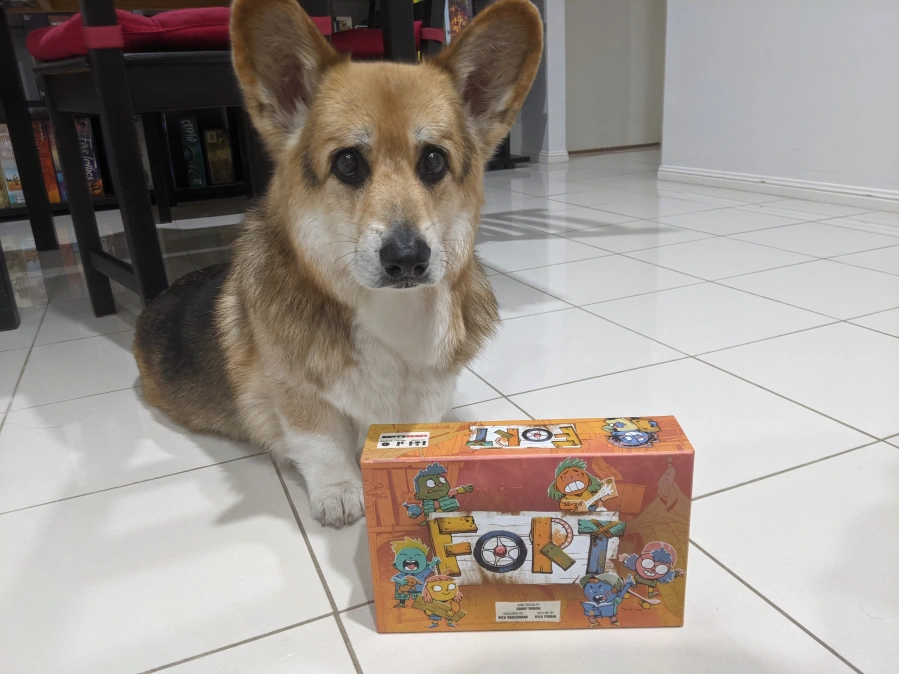
Fort is a deck-building game for people who hate deck-building games. It’s fast, interactive, and requires you to stay agile in your strategy. The awesome theme, artwork, and presentation is just the pepperoni on the pizza.
Pros
- This unique theme was brought to life by the awesome Kyle Ferrin
- Deck-building and deck-destroying in equal measure
- High interaction – especially weird for this genre
- Fun powerups and card combos for you to explore
Cons
- The theme feels disconnected from the gameplay at times
- Just like in real life, you can have all your friends stolen
Love our reviews? Buying through our links earns us a small commission at zero extra cost to you, helping us table the next big release! Full disclosure here.
Fort tries to capture the nostalgic feeling of childhood. Of pizza parties, and no inhibitions. Where you would meet kids at the park, and ask them back to your place, without the police being involved. Wonderful children like Doodles, whose defining trait is a Garfield drawing, or Flipper who is nicknamed after the coin he plays with.
At its heart, it’s a mechanically sound deck-builder. Although… Maybe deck-builder isn’t the right word.
While you’re going through the familiar motions of drawing, playing, recruiting, and discarding. There are notable differences that make Fort stand alone.
For example, cards have both a private action that only you can perform and a public action that all players can perform if they discard a card of the same suit. Then you can empower cards by discarding more cards from your hand of the same suit.
Finally, any cards you don’t discard are placed above your player board; in your yard. Anyone else can take these cards and add them to their deck on their turn.
These mechanics bring a lot of chaos and interactivity to a genre typically known for its stability and long-term thinking. Thanks, Dominion.
Anyway, your goal in Fort is to score the most points. This is typically done by building a deck that thrives on converting pizza and toys into points, or by building your fort and, in doing so, picking up a special ability and end-game objective.
Good luck!

Follow the leader
Fort’s Follow mechanic is similar to games like Broom Service, and Glass Road. After the current player plays their card, everyone else gets the opportunity to discard a card from their hand of the matching suit.
If they do so, they get to use a weaker version of the card. This discarded card goes straight to their discard pile and avoids going to the yard on that player’s next turn.
This keeps you engaged and attentive to what’s being played, even when it’s not your turn. Missed opportunities can cost you a chance to build a fort or at least a whole butt load of pizza.
The inverse of this dilemma also holds. Sometimes you’ll want to play a card, particularly a fort-building card, but choose not to because you know someone else will get a free fort action. At the end of the day, Fort is a race and giving your opponents free actions is letting them slipstream in front of you.
This is yet another dimension that’s both fun and makes Fort stand out from other games within the deck-building genre.
So while you’re constructing, deconstructing, or reconstructing your deck throughout the game. Spare a thought or two to figure out what cards are most likely to appear in other players’ decks.
Getting an extra turn here or there might just be enough to win the game.

Let’s talk strategies
While there’s only one win in Fort, get the most victory points, there are many ways to get them. However, I’m going to boil it down into two major approaches: racing to build your fort before everyone else does or creating an engine to score as many points as possible.
Either way, you’re racing to get your strategy online faster than Munch can devour a chocolate bar.
The problem you’ll face is that since you must offer up cards (and those cards will be grabbed) you’re never able to generate the perfect deck to pursue your strategy. Instead, your decisions must focus on the immediate turn, rather than long-term strategies.
This brings us back to the question: Do you take the risk and send the card to the yard? Or do you play it safe and use it sub-optimally?
The answer to this question is based on player count.
While I was somewhat comfortable putting important cards into the yard when playing two-player. This same thought process came back to bite me when I tried it in a three-player game. Where I lost two important scoring cards which cost me the game.
The fascinating thing about Fort is how it lets you change your strategy on a dime. You rarely have a massive deck of cards to work through, and there are always plenty of options for removing or gaining cards in bulk. This agility allows you to constantly adapt to the situation you find yourself in. This is somewhat unique in the genre, where it’s usually impossible to deviate from your original plan.

Is it a Macaroni Sculpture? Or a badly drawn horse
There’s been a lot of effort in bringing Fort’s theme to life, with Kyle Ferrin’s fantastic artwork creating fully-fledged characters for you to enjoy. Despite this, the theme isn’t fully realised. Understandable, because Fort is a reimagining of an older game, SPQF, which had your more traditional board game theme, and the mechanics don’t always match up 1 to 1.
So there are times when you’ll fall into the theme of the game and try to be the coolest kid on the block. There are also times when you sit back and say: I want Dot as a friend because she gives me the most victory points.
Otherwise, I enjoyed Fort thoroughly. I’ve reviewed similar card games in Red Rising, and London (Second Edition) recently and while they are great fun games, this one is a cut above. The interactivity between players was something I loved and hadn’t seen before. On top of that, it’s a snappy game that works well at many player counts and has a killer theme.
So, I’m really glad for Leder Games’ re-implementation because otherwise, this game would have flown under my radar.
Similar Games You Might Like

Imperium: Classics Review – The 3-Hour “One More Turn” Dilemma
Cycle through unique faction decks to evolve your society from tribal chaos to empire. A deeply strategic history builder that moves at a snail’s pace.

Tanto Cuore Review – Fix Dominion With Your Own Anime Harem Of Maids
Love is a battlefield, and a market. An engaging deck builder that elevates classic Dominion mechanics with sneaky player sabotage. As long as you can get past the theme.

Clank! A Deck-Building Adventure Review – A Brilliant Adventure That Deflates Into a Two-Player Handshake
Sprint through cavernous tunnels to snatch dragon loot before the exit seals. A dungeon dash where you never know if you’re going to make it.
A score tells you if it’s good, but the leaderboard tells you if it’s worth the shelf space.

 Loading ...