Fireball Island: The Curse of Vul-Kar
Players: 2-4
Playing Time: 45-60 minutes
Designers: Rob Daviau, JR Honeycutt, Justin D. Jacobson, Chuck Kennedy, Bruce Lund
Publisher: Restoration Games
Plenty of reviewers and players say Fireball Island: The Curse of Vul-Kar captures the nostalgia of their youth. I didn’t play the original, so I was left with a random and mean board game that made my son teary-eyed.
Pros
- A massive, painted plastic island with a towering volcano that dominates the table. It looks fantastic.
- Flicking marbles at players, watching fireballs wreak havoc, and the uncertainty of cave exits all create chaotic fun.
- Whether it’s dodging fireballs or racing back to the chopper the game is at it’s best when everything feels like a gamble.
- Swapping out dice rolls for movement cards eliminates frustration and gives players some control over their choices.
Cons
- No matter how strategic you try to be, the game’s chaos ensures that randomness plays the biggest role in deciding the winner.
- It tries to modernise the original game but keeps punishing, old-school mechanics that feel out of place in today’s board game market.
- Constant treasure-stealing and punishing knockdowns can make the game frustrating, especially for younger or casual players.
While many board gamers started their hobby in their youth, I was a late bloomer. As such, I’ve only played Monopoly once, never played Mouse Trap by the rules, and the first I heard of Fireball Island was the Kickstarter campaign.
So although some backers were foaming at the mouth thinking about reliving their childhoods. I was only interested in rolling red marbles down the mountainside destroying any players in their path.
Having played Fireball Island several times, I am pleased that the boulder rolling is everything I hoped for. Yet, despite its reinvention, I couldn’t shake the feeling that much of the game design was left in the past as though the designers were afraid of changing too much.
Given Restoration Games’ goal of bringing new life to old games, it raises the question of the board game of Theseus. How much can you replace before it becomes a new game entirely? Where do you sacrifice modern game design so that the feel of the old game remains?

How to play
In Jurassic Park, tourists travel to an island paradise housing dinosaurs like a zoo. Within moments of arrival, everything goes wrong. The dinosaurs get loose from their cages and the protagonists spend the rest of the movie trying to flee the island.
Replace the dinosaurs with a big angry volcano and you have Fireball Island: The Curse of Vul-Kar.
Of course, you’re not one to waste an island paradise. So you’ll need to grab a few snapshots and selfies before the island explodes. Three of them will do the trick. Then rush back to the helicopter, hopefully, while the island is still intact.
Honestly.
Influencer culture is out of control.
Each turn you pick an action card from a hand of two. You then move the amount of spaces on the card before carrying out its ability.
As you move, you’ll pass treasure spaces spread out around the island. Each spot has at least one treasure token to collect. These form part of the scoring, where there are three types of treasure and the more of the same type you pick up, the more points they’re worth at the end of the game.
After you’ve moved, you perform the ability on the card. Some of these include:
- Picking up double treasure
- Rotating palm trees or the volcano
- Or flicking a marble at another player
By far, the most impactful of these action cards are Cataclysm cards.
When playing these cards, you cause Vul-Kar to explode by dropping all available marbles into its top and watching the mayhem unfold as they roll and rattle down the island.
Any players knocked over by these rampaging marbles have their treasure tokens stolen and their character (sometimes) thrown about like a ragdoll. Not a pleasant experience at all.
Beyond all this, there are a few special rules about different spots on the board such as ladders and caves. There’s a special treasure token called the heart of Vul-Kar that’s hard to get and easy to get stolen. And then there are souvenir cards that give you one-time bonuses.
But you get the gist of it.
Once the first person returns to the helicopter with three snapshots, everyone else gets two turns to make it back to the chopper or else their snapshots won’t count. After those two turns, everyone counts their victory points from treasure tokens, snapshots, and souvenir cards to find out who won.

Stuck in the past
Before I dig into this review I want to shout out the production team at Restoration Games because Fireball Island: The Curse of Vul-Kar is one of the most impressive board games I’ve played.
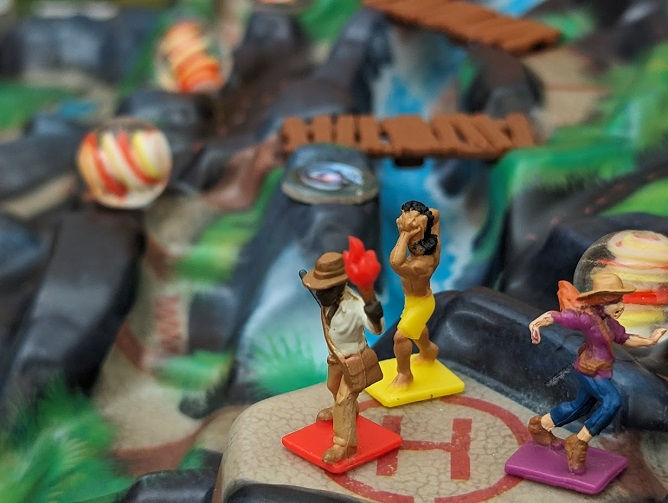
The island is painted, plastic, and huge. Vul-Kar, in particular, casts an intimidating shadow from where it sits above the table. Ready to throw marbles at any unexpecting tourists.
Looks aside, Fireball Island is a lot of fun when it leans into its chaotic nature.
You’re having a great time when you’re lining up an awkward shot of an ember marble into someone’s head, or laughing maniacally as the fireballs you poured into Vul-Kar are knocking over bridges, ladders and other players.
These situations when you’re unsure about the outcome, and the anticipation of what’s going to happen shoot shivers through your veins… which is a fantastic feeling.
There’s no shortage of them either, as Fireball Island is filled with moments of excitement. Such as:
- Entering a cave, where you roll a die to find out where you’re exiting.
- Seeing someone with three snapshots heading to the chopper. Forcing you to figure out if you have enough turns and speed to make it back as well.
- Stopping on a bridge, ladder or anywhere else that’s so close to Vul-Kar’s mouth you can smell sulphur on its breath.
When it feels like what you’re doing is a gamble, Fireball Island is at its best.
So it’s a wonder why the game’s design doesn’t enhance this feeling, instead opting to push against it.
One of the big changes from the original Fireball Island is the removal of the dice movement. You’re now drawing cards with movement values and picking which fits you best on your turn.
This gives you strategic choices where you can decide on routes to take while stopping players from rolling low movement values every turn.
Another strategic choice added was the set-collection scoring. Whereby you gain more points depending on what treasure tokens you collect, rather than how many.
Both systems give you the feeling that you’re making interesting choices that matter.
But that’s all it is; a feeling.
Because the game is so chaotic and random, your choices rarely matter and the outcome of the game is governed by luck.
Did you get hit by that fireball? Are you going the same way as someone else? Will that cave put you in the right spot?
These are the questions that determine the winner and as such the games I played were never close. One player was guaranteed to run away with the game while the rest of us, despite our best efforts, could do naught but watch.
Through the eyes of a six-year-old
Fireball Island: The Curse of Vul-Kar positions itself as a family game to break out and have fun with its silly chaotic gameplay.
So why, oh why, is it so mean?
Knock someone over with a fireball or ember marble. You steal their treasure.
Jump over someone carrying the Heart of Vulkar. You steal their treasure.
Pull the right souvenir card. You guessed it. You steal their treasure.
Granted, my son is new to board games and has trouble controlling his emotions, but every time we played he was in tears because someone stole from him. Or he got badly knocked down setting him a long way back from where he wanted to go.
Fireball Island can be an extremely frustrating game if you’re not in the right mood, or unsure of what you’re getting in for.
It’s interesting that we again find Fireball Island at odds with itself. It wants to be this fun-loving family game but is filled with these ugly moments of nastiness.
Having not played the original, this type of gameplay fits perfectly in the style of those 80s games. Harsh punishments, dealt out unfairly. It’s a big reason why no game of Monopoly ends without a fistfight, and why the board game hobby is still trying to win back people who’ve only played those titles.
At that time, designers were still pioneers in the board game space and didn’t know any better. There also wasn’t anywhere near as much competition. So board gamers took what they were given.
In 2024, this type of gameplay no longer flies. We have so many good family game options on the market like Horrified, That’s Not a Hat and Blue Lagoon that you need to bring your A-game to compete.
And sadly Fireball Island: The Curse of Vul-Kar does not.
Similar Games You Might Like

Harmonies Review – Finding Inner Peace in a 3D Wildlife Sanctuary
Stacking wooden rivers and trees for otter scoring just feels great. A serene set collection game let down by flimsy components in an otherwise fantastic box.

Camel Up (Second Edition) Review – High Stakes, Higher Stacks, and Total Chaos
Watch the whole room lose their minds as an unexpected camel stack hitches a ride backwards. A chaotic, crowd-pleasing derby that rewards bold bets.

Takenoko Review – The Ultimate Gateway Game of Smug, Hungry Pandas
Grow tall bamboo stalks and guide a greedy panda to devour your hard work. A surprisingly tactical family-friendly board game that looks gorgeous on the table.
A score tells you if it’s good, but the leaderboard tells you if it’s worth the shelf space.

 Loading ...