Faraway
Players: 2-6
Playing Time: 15-30 minutes
Designers: Johannes Goupy, Corentin Lebrat
Publisher: Pandasaurus Games
I’m not sure I’ll ever recover from playing Faraway… and I’m not sure I want to. The excellent reverse scoring mechanic combined with sharp drafting gameplay make this card game one of 2024’s best.
Pros
- Play forwards, score backwards, gives Faraway a unique flavour I’ve never played before.
- Offers a lot of decision-making in just eight rounds
- The artwork and style look great and give the game a lot of character.
- The variety in Quests, Wonders, and card combinations ensures every playthrough feels different.
- Small box for easy storage and portability. Perfect for travel or quick game nights.
Cons
- It might bend your brain after an initial play.
- A single misstep in your planning can frustratingly derail your endgame.
- Sometimes the draws (or the drafts) won’t align for your chosen strategy.
Love our reviews? Buying through our links earns us a small commission at zero extra cost to you, helping us table the next big release! Full disclosure here.
Faraway might lure you in with its small box and fantastical artwork but don’t be fooled. This game of drafting a relaxing walk through an exotic paradise is designed to turn your brain into mashed potatoes.
On the surface, it doesn’t seem so antagonistic. You draft cards to create a path of places you visited. It’s only when you reach the end of the game that things get a little topsy-turvy.
Despite you sanely creating your path from left to right, they’re scored backwards, on the return trip. So your last played card is scored first, and so on. This simple switch of direction changes everything you ever knew about strategy and scoring points.
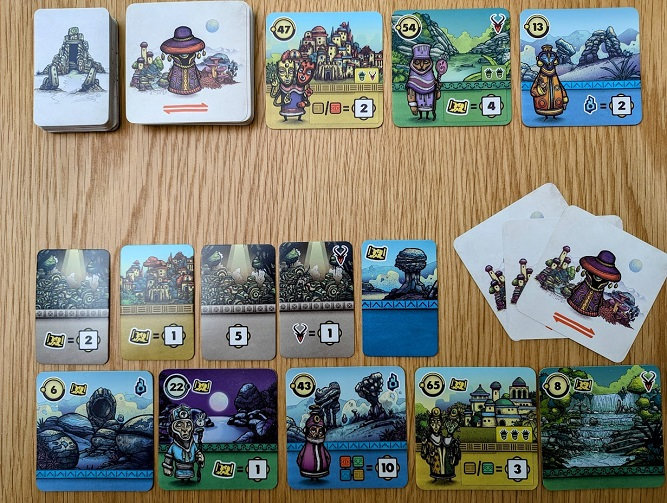
How to play
In Faraway, you go walkabout on a mystical island. You’ll draft and play cards showing areas of the island you explored, the bizarre locals you met and the hidden sanctuaries you uncovered.
Each round starts with everyone playing an island card from their hand of three to the end of their current path. Components of these cards may include:
- An Exploration Duration that determines the order of drafting later in the round.
- A Quest to gain victory points. Some of these come with prerequisites, such as collecting Wonders, which you must unlock before they grant you their points.
- Wonders come in three varieties: mineral, animal or plant. By themselves, they’re useless. But they’re used to unlock Quests or parts of other scoring opportunities.
- You’ll also find Clues on some cards that help you find better, more appropriate sanctuaries.
After everyone plays their island card, Sanctuary cards are handed out to anyone who played a card with a higher Exploration Duration than their previously played card. If this is you, draw as many cards from the sanctuary deck as you have visible Clues (but only keep one).
Sanctuaries offer similar benefits as the other exploration cards but of lesser value. For instance, if a standard card gives you three Wonders, you might only get one from a Sanctuary.
However, they’re powerful in their own right.
Once Sanctuaries have been handed out it’s time to draft. Starting with whoever had the lowest Exploration Duration this round, choose one of the cards available from the market.
Play continues like this until you’ve added the eighth card to your path. At that point, your journey ends and it’s time to return home following the same path you just created. Flip all your cards face down. Then starting with the last card, turn them over one at a time – scoring them as you do.
Now, for the topsy-turvy-ness.
Only face-up cards, and Sanctuaries, count towards your Quests and prerequisites.
This is the moment where Faraway takes a mallet to my mind. I’m not proud to admit it, but so many times it wasn’t until I got through the middle of scoring that I realised the Wonders I counted on were still on face-down cards.
Once everyone is done groaning, mumbling, and scoring their cards, the winner is the player with the most. Hopefully, that’s you!
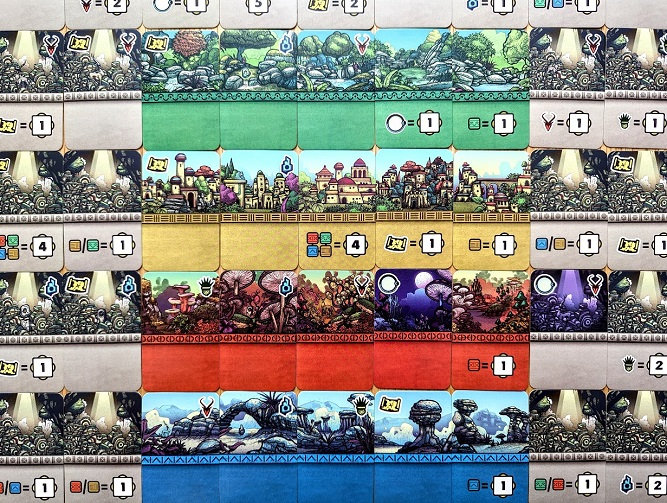
Backwards thinking
It’s weird to call a card game a tongue twister, yet there’s no better description when it comes to Faraway. Because while it’s simple to learn and play, there’s something so counter-intuitive about scoring your cards in reverse.
In most of the drafting or tableau games I’ve played, you pick cards to keep based on what you’ve drawn. For instance, in It’s a Wonderful World your cards are used to gain resources to get more powerful cards in the future.
Faraway is the inverse of this.
Since you’re scoring backward, you want to play your most powerful cards first and supplement them with weaker cards as you go. It’s almost like you take out a loan within your first couple of turns, then try to pay it off as the game progresses.
As a seasoned board gamer, I feel I’m disadvantaged playing Faraway because I’ve been conditioned to play and strategise in one way. This game turns all of that on its head, which I find incredibly exciting because it gives Faraway a unique and memorable feel to play.
But this game is more than its gimmick. The island cards are sharp and tightly designed, sporting a great balance of Quests, Wonders, Clues and prerequisites. With only eight rounds, you often want to play more cards than you can… or rather should.
It also makes the drafting a headache. Even before reaching it, you’re focused on your cards’ Exploration Duration. Not just because a higher value than your last play grants you a Sanctuary, but because it also sets your position in this round’s auction.
As if choosing a card to play wasn’t hard enough!
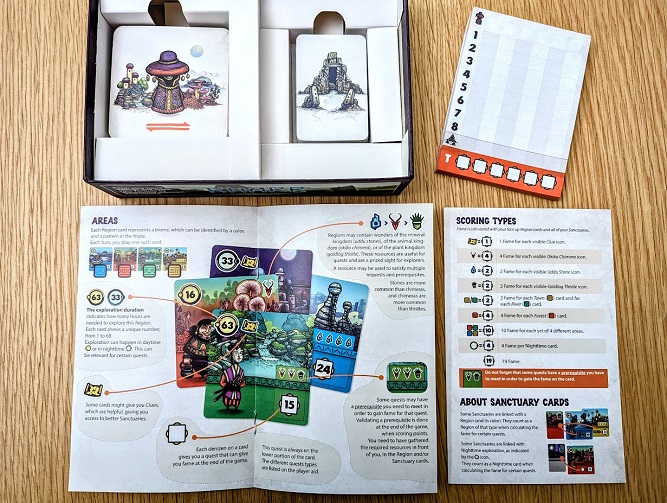
Still full of surprises
There’s also a surprisingly wide variety of ways to score points through Quests and Sanctuaries. Maybe because Faraway makes me feel like I’m constantly five shots deep on a good night out, but I’ve been amazed by the different paths my friends created while playing.
All in all, this is what makes Faraway a fantastic board game. It’s got a gimmick to make it stand out from the crowd, but underneath it’s still smartly designed.
So, although the game lost a bit of its magic after I FINALLY learned to think backwards, it’s still an excellent card game filled with great decisions and punctuated with wonderful art.
Similar Games You Might Like

It’s a Wonderful World Review – The Game That Killed 7 Wonders
Draft cards, plan production sequences, and watch your engine explode. A fast-paced card game where zero-resource starts turn into cube-spawning industrial powerhouses.
Sea Salt & Paper Review – The Origami Card Game Worth The Months Of Heartache
Bank safe points now or risk them on a final bet to score extra. A pocket-sized card game hobbled only by its total lack of a point tracker.

Trekking Through History Review – Revisiting Humanity’s Greatest Hits
Time flies when you’re managing a historical vacation. A slick, gorgeous family game that starts strong but might wear thin for veteran groups.
A score tells you if it’s good, but the leaderboard tells you if it’s worth the shelf space.

 Loading ...