Cryptid
Players: 3-5
Playing Time: 30-50 minutes
Designers: Hal Duncan, Ruth Veevers
Publisher: Osprey Games
Cryptid is a wonderful game of deduction that’s bright, colourful and brimming with deduction possibilities. The only shame is how fragile the game is, relying on players remembering their clues for the game’s duration.
Pros
- An excellent colour palette makes Cryptid pop right off your tabletop
- Turns happen quickly, and the deduction aspect of the game is sublime
- Minimalistic components and rules let the game focus on the awesome deduction at hand
Cons
- Incredibly fragile, with most games falling apart because someone forgets their clue
Love our reviews? Buying through our links earns us a small commission at zero extra cost to you, helping us table the next big release! Full disclosure here.
Have ye heard the tale about the Cryptid board game? It wanders into town at night searching for lost tokens. Collecting them. Adding them to its box, and vanishing into the night.
‘Tis a tale as old as time, and yet no one has seen this board game.
No one, that is, until now.
If you’ve ever felt the need to leave your 9-5 cubicle and hit the wilderness in search of a beast whose existence is wholly documented in blurry photos. This is not the game for you. While that’s the theme of Cryptid, it’s dusted on so lightly that a strong gust of wind would blow it all away.
And that’s OK.
While cryptid hunting would make a fantastic theme for a more complex game. Cryptid is a streamlined and straightforward, family deduction game.

How to play
Each player starts a game of Cryptid with a clue as to the location of a mysterious beast.
This clue could be something like: the creature is on a forest or desert tile, or the creature is within one space of a mountain.
These clues are useless on their own, but when combined with the other clues given they’ll point to one hex on the board. The hex belongs to the creature of legend.
Turns move quickly within Cryptid, as you only have two options for your turn:
- Ask a player if the creature could be on a certain hex.
- Or announce you’ve found the monster in your best Nigel Thornberry voice, and place a disc on the suspected space.
When asking if the creature could be on a hex, the asked player places a wooden disc on the space if they could. If not, they place a cube. Furthermore, if they place a cube, you must also place a cube on the board somewhere.
As play continues more and more of the board is covered in cubes and discs. Eliminating hexes, and pointing out others.
This continues until someone chooses the second option.
From there each player either places a disc on top of your own or a cube. If no one places a cube you’ve found the monster and won the game. Otherwise, you haven’t and instead look like a right fool.
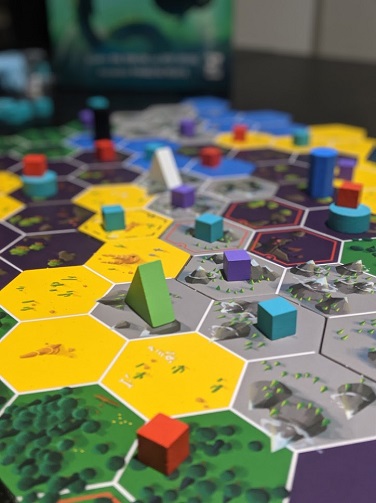
Making the front page of Monster Hunter Monthly
The funny thing about Cryptid is how it makes you covet your clue. Where you want to be the only one who knows it. It turns a straightforward deduction game into a game of intrigue.
When placing tokens on the board, you do it in a way where it satisfies multiple clues. Trying to befuddle the rest of the players. And when asking someone if the monster could be there, the underlying subtext reads: is this your clue?
Even though finding the monster, and making it onto the front page of Monster Hunter Monthly, feels great. Cryptid also allows for minor successes, like finding out someone’s clue.
This makes for a grand parlour scene at the end of every game. Where the winner gets to gloat about how they figured out the mystery. While everyone else also gets to see how close they were, and whether or not they deduced correctly.
Usually, someone will be so close they can’t help but say: if only I did blah I could have won!
Thankfully, and brilliantly, games of Cryptid usually only last between 15-30 minutes. So it’s not a lot of effort to set it up for a rematch, making the game quick, and to the point like Love Letter, rather than the slugfest of reason that is something like Letters from Whitechapel.
Helping speed up this repeat game is the web app which does all the setup for you, and gives everyone their clues. It’s a slick implementation that greatly speeds up setup.

My memory is great until it isn’t
Unfortunately, we found that after three or four games of Cryptid we wanted to pack it away. Not because it’s a bad game, but because there’s a large memory factor to its gameplay. By the time that third or fourth game came around, we were so mentally drained we were indiscernible from zombies.
Often finding ourselves muddling our clues, or having trouble telling what applied to this game and not the games before.
This revealed a real problem with Cryptid.
Nothing ruins this game quicker than someone misremembering their clue. Both for the victor, who finds out their victory was based on lies, or the other players who feel cheated out of their win.
This problem is amplified when playing the advanced version – which will push even the best memories to the test. As with the advanced version, you’re not shortening a list of 24 possible clues, but 48.
Per player.
With four players that’s 141 clues you’re eliminating, and trying to keep your nogging from not spinning off into orbit is a feat unto itself.
Memory issues aside, it’s not a super common problem, but common enough for it to be worth mentioning. Cryptid is an excellent game that distils deduction into its simplistic form, only adding enough mechanics and theme as necessary. It’s easy to digest rules, and small (but addictive) playtime will see you coming back again and again and again.
Similar Games You Might Like

Tragedy Looper Review – Outsmarting the Mastermind One Loop at a Time
Rewind time, reset the board, and use the wreckage of your last failure to unravel the mastermind’s plot. An unmissable deduction game of bluffing and timeline manipulation.

Okey Dokey Review – I REALLY Want to Play Green!
This animal orchestra hits a flat note. A light, adorable card-sorting co-op that loses all replay value once you crack the puzzle.

Lovecraft Letter Review – Even Our Sweet Lord and Saviour Cthulhu Can’t Save This Clunky Sequel
Going insane grants game-ending powers but risks instant elimination on your turn. High-stakes push-your-luck that sacrifices the clean deduction of the original Love Letter.
A score tells you if it’s good, but the leaderboard tells you if it’s worth the shelf space.

 Loading ...