Disclaimer: Cerebria: The Inside World was provided for free by Mindclash Games, although the writing and opinions of this article are my own.
Cerebria: The Inside World
Players: 1-4
Playing Time: 60-120 minutes
Designers: Richard Amann, Viktor Peter, István Pócsi, Frigyes Schőberl, Nick Shaw, Dávid Turczi
Publisher: Mindclash Games
Cerebria: The Inside World is both a great board game and an overly complex one. Putting aside its weird player count requirements, levelling up your character, being part of a team, and fighting for area control is a lot of fun.
Pros
- Wonderful theming like an adult version of the movie Inside Out
- Packed full of tough decisions
- Loved levelling up my character and plotting with my teammates about which skills we should invest in
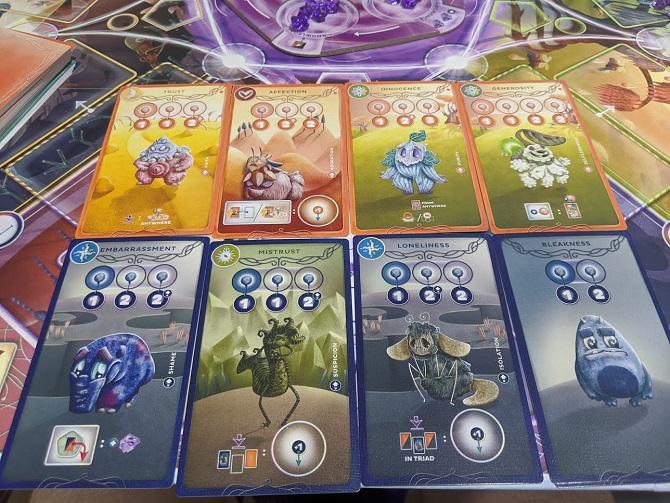
- Plenty of different emotions to play, with each coming with a unique set of cards and player board
Cons
- Complexity for the sake of complexity, ruining an otherwise great game
- So focused on what the rules are rather than how to act and strategise within them
- Since it’s a team game, you need an even amount of players or else it gets weird
Love our reviews? Buying through our links earns us a small commission at zero extra cost to you, helping us table the next big release! Full disclosure here.
It’s impossible to describe Cerebria: The Inside World without mentioning the movie Inside Out. Both cover the topic of emotions battling for control within someone’s brain. But where one targeted young people and families, the other is Cerebria.
It’s damningly complex.
And that’s OK.
Because while I played – or tried to play – Cerebria with the most advanced ruleset. The game allows you to easily add or remove rules to tailor your experience.
We’ll cover more on the complexity later. For now, let’s talk about how you play.
Cerebria is a team-based game taking place within someone’s mind. One team represents joyful thoughts, while the other pessimistic thoughts. While the teams won’t be slugging it out with their fists, they will be competing for objectives.
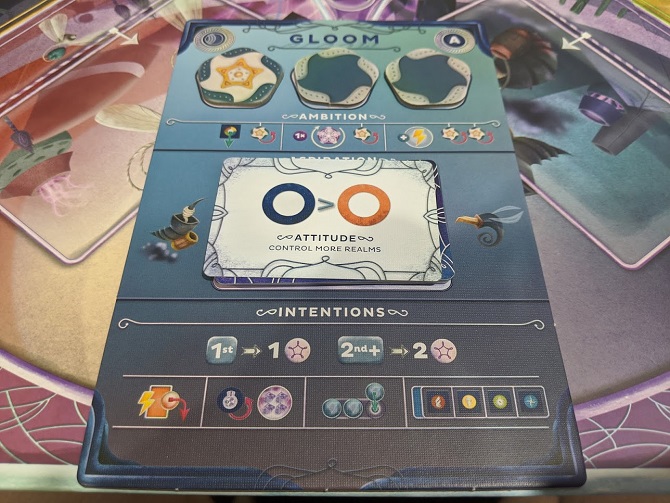
At all times, the teams have two objectives to fight over. A public objective that either team teams can win, and a private objective that only your team can. These objectives are scored several times throughout the game. Within these intervals, if you manage to complete one objective you get to add a minor fragment to the brain, while if you win both you add a major fragment.
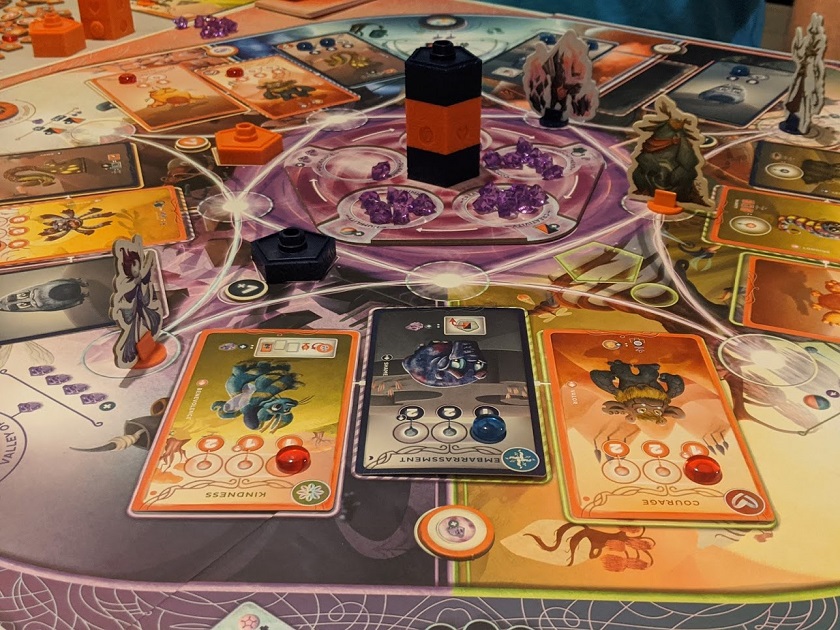
During your turn, you’ll get three actions to influence the brain and put your team in front of these objectives. Usually, they involve controlling different areas of the brain. Done by implanting emotions, adding essence to emotions already implanted, creating fortifications, or removing your opponent’s essence from the board.
That’s not all you’ll be doing though. You’ll also level up your character, use your special ambition actions, and most importantly absorb willpower from the central cortex. Whenever a central cortex is drained of all willpower, then a revelations phase happens and you score the current objectives.
Throughout all of this, almost every action you do has a subsequent bonus attached. For instance, when implanting an emotion, you get a bonus depending on the emotion card. Or when you absorb from the central cortex, depending on the side you absorb from gives you a different advantage.
All of this is within Cerebria’s “basic” mode. The advanced mode gives you 8 characters all with unique powers, allows you to power up emotions, and adds a new move called “Empower” to your arsenal.

How much complexity is too much?
OK, that wasn’t a full rules run-through (for that I recommend Paul Grogan) but it was enough to give you a taste of the overwhelming options available. And before you get the wrong idea, I enjoy complex games. On Mars, and Lisboa are both up there as some of my favourite board games. However, Cerebria gets complexity wrong in multiple ways and ruins an otherwise fantastic board game.
Firstly, there are a lot of minutiae and exceptions to the rules in play. For example, if you implant an emotion in between two areas of the brain, then it counts for both areas. Except, if the other team puts another card between this first card and the centre of the brain area.
In a simpler game, this would be a fascinating rule that adds all sorts of interesting decision-making opportunities. However, in Cerebria, there’s so much you already need to consider and remember, that you’re likely not taking this rule into your thought process. So instead of being an interesting addition, it just becomes noise. A distraction from what you need to accomplish.
This complexity also makes it hard to understand the consequences of your actions. As Boromir famously said, one does not simply take an action in Cerebria without activating a bonus. So instead of doing three actions a turn, you’re doing six. Then for every action you choose, you need to consider the bonus attached. As a result, deciding between two different actions and weighing their outcomes is incredibly difficult.
Again, in a simpler game, these bonuses would open the game up to all sorts of wonderful choices. But here, there’s too much of it going on. To the point where it all starts to feel a bit random.
Although despite the advanced mode complexity being way too much. I enjoyed the way Cerebria allowed you to tailor your experience. As such, we removed rules when it was starting to get too much. Then re-added them when everyone felt comfortable.
In some respects this made Cerebria feel like a campaign game. Where after each game, we would add additional rules that would change the game and keep it fresh.
Complexity aside, the game is awesome
In a world where most heavy board games deal with trains and economics. Cerebria’s theme of battling emotions is a breath of fresh air. So hats off to Mindclash Games for both that, and the brilliant job of integrating it into every piece of art, icon, and word within the game.
Not just that, the fragments you win are these chunky plastic blocks that are used to create a central tower. It’s a novel way to show the score and makes Cerebria look incredible sitting on your table.
However, the most surprising thing about Cerebria is how they’ve managed to make this big, beautiful, complex game so cheap. So often you see heavy games like this being price-prohibitive. It’s fantastic to see one that’s not. Because when you’re not overwhelmed by rules, there is an awesome game to be found.
The choices you make are vast and thought-provoking because of the many ramifications of your actions. If you’re able to straighten out this spaghetti plate of possibilities, you can put together some pretty special turns. Several times throughout my plays, the table broke out into rounds of golf claps because a player pulled off what looked to be the impossible.
It was so cool to see. But the downside of these impossibilities is that you can lose yourself trying to make them a reality. Often taking long turns and extending the playtime of an otherwise relatively quick game.
Cerebria helps with this analysis paralysis by keeping those two objectives at the forefront. Reducing all of your possible options to just the ones that will move you closer to winning. Then if you’re stuck, remember that you’re on a team.
Meaning someone is always on your side, with no ulterior motives. Giving you a person you can bounce ideas off, discuss possibilities and come up with the best move together.
Will your gaming group like it?
The one flaw we haven’t covered yet is the player count. Given it’s a team game, particularly a 2v2 team game, you need four players at the table. At any other player count, the rules get a little weird and try to shoehorn the game into a four-player game.
However, if you have that sorted, then the only thing stopping you from loving Cerebria. And it bears repeating; Cerebria is damningly complex.
Not helped at all by a rulebook that uses thematic cues instead of plain English. Also without an appendix, it is nearly impossible to find a rule you’ve forgotten. Without these tools it makes the complexity stand out.
However, in playing, I saw that complexity as a challenge to conquer. So I enjoyed the journey of learning and was rewarded with some deep gameplay and compelling decisions to make. But everyone else at the table wasn’t as prepared, or interested to make the same journey. Leaving us with a pretty polarised view of Cerebria.
Similar Games You Might Like

Pax Pamir Second Edition Review – A Beautiful Game That’s Hard to Love
Betraying your allies mid-turn for a quick payout is just the cost of doing business. A ruthless, highly political battle where shifting loyalties dictate the winner.

Merchants of the Dark Road Review – The Best Game of 2022 (That I Played in 2021)
Piggybacking on a rival’s dark road delivery feels fantastic until someone freeloads on yours. A crunchy, system-dense economic quest.

Escape Plan Review – A Hefty Price Tag for a Muddled Escape
Sprint between safe houses and dodge police gunshots to stash your loot. A stunning heist that stalls under rulebook clutter.
A score tells you if it’s good, but the leaderboard tells you if it’s worth the shelf space.

 Loading ...

I love Anachrony, and I’ve been pondering Cerebria — I appreciate the review so I can think about it even more. It really does sound like a Vital Lacerda game in many ways, but that is a good thing!
Absolutely. My original draft had something like: this is an American version of a Lacerda game. Where it has the Lacerda feel, but adds so much theme, and direct player interaction.
Still counting down the days for On Mars. 😛
One tiny comment on your glorious review. I always import a OFF of the rules into my computer/tablet so I can do a keyword search on this pesky rules! It is a bear to find a reference without doing that!! Thanks for your thoughts. I have been so drawn to this game based on the theme and art. Thanks for your input to help me in my decision making process. (I love Mindclash games!)
Oh man that’s a great idea.
I also spoke to Mindclash and they’ve put their manual up on an app called Dized. I tried that and, while albeit a little buggy, was amazing to use. You should check it out.
Ugh! I see my auto-correct changed “COPY” to “OFF” in my message above. I guess you got the idea, though! Yeah, I carry many of my complex games’ rules on my tablet. I love being able to quickly find what I am looking for by pulling up the rules on my tablet and do a key-word search. I’m also familiar with Dized though I haven’t subscribed to the service. I did look at it in its infancy. Maybe I should take another look!
Also let us know which way you end up going. For me I’m going to look at getting Anachrony sometime soon…