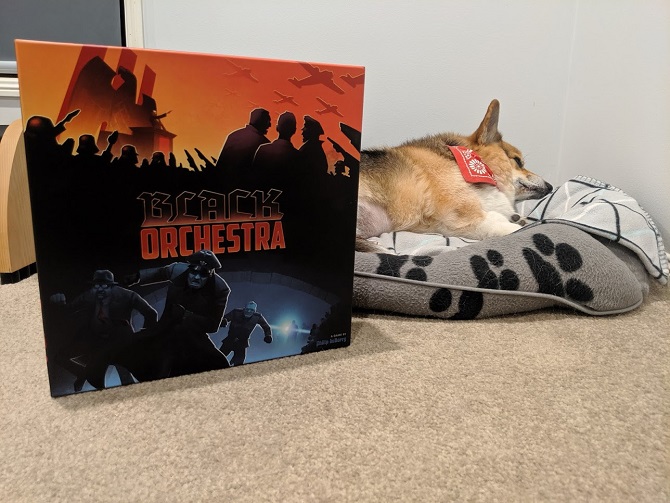
Black Orchestra
Players: 1-5
Playing Time: 90 minutes
Designer: Philip duBarry
Publisher: Starling Games
Black Orchestra covers a fascinating theme that isn’t talked about enough. Although it expertly demonstrates the difficulty of the German people and their resistance, as a board game, you don’t bring it to the table for fun.
Pros
- An interesting perspective of history you don’t often think about (in the West).
- Shows the difficulty of plotting and planning an assassination
- Being caught and put in jail is a real threat and breaks communication between players
- The history on the cards gives you a sense of time and place
- Massive relief when you finally carry out your assassination attempt
- Loved how everything you needed to play was on the board
Cons
- Setting up and missing your assassination attempt because of a dice roll is VERY frustrating
- The theme is not for everyone, and the oppressive tone of the graphic design will scare others off
Love our reviews? Buying through our links earns us a small commission at zero extra cost to you, helping us table the next big release! Full disclosure here.
When it comes to World War 2, we often hear about the Allied heroes storming the beach and taking Germany by force. What we don’t hear about are the German heroes. Those who stood up to the regime while surrounded by friends and family they could no longer trust. Black Orchestra puts you in the shoes of these Germans as they try to assassinate Hitler from within.
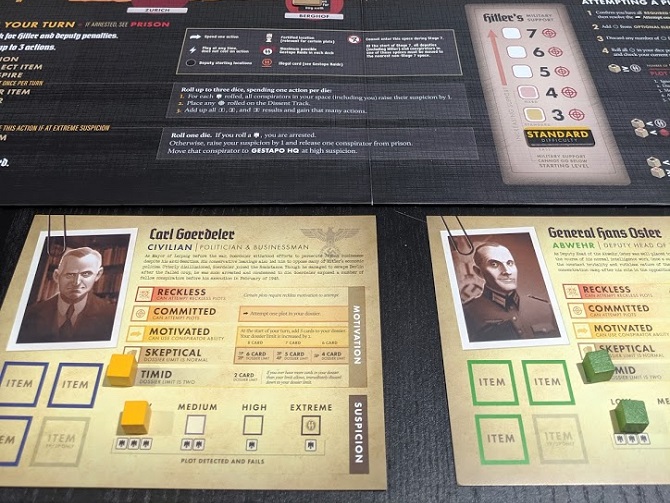
Each of the nine characters in Black Orchestra is a historical figure. Out of these nine, six were executed, two chose suicide rather than execution, and only one survived beyond the war.
That’s the tone Black Orchestra sets, and just knowing the history behind these characters adds a certain gravitas to the board game. Unlike any other I’ve played before.
From a mechanical standpoint, your goal is simple: assassinate Hitler.
But you don’t start with that goal, in Black Orchestra you start as a regular Joe. Angry at the government, but too timid and unmotivated to do anything about it. As the years progress, your motivation to do something grows, but the more agitated you become, the more suspicious you are.
Juggling your levels of motivation and suspicion is a primary concern. While they rise and fall based on the events that unfold, you need high motivation to perform an assassination. On the other hand, if your suspicion gets too high, you might find yourself jailed, or worse.
While balancing these two attributes, you’re also picking up and delivering goods across Europe. Attempting to avoid the German high command, you’re also collecting action cards and assassination plot cards.
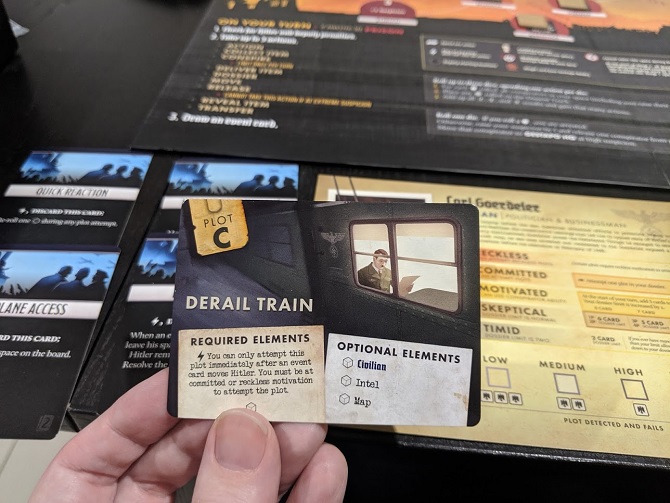
These plots are how you kill Hitler. Although, they’re not so easy to complete. Each lists out specific requirements you need to meet before you can make an attempt on his life. Once fulfilled, however, you get the chance to roll several dice where if you get more crosshairs than Hitler’s military strength – you’ve killed the bastard.
The chances of that happening though are quite low. So you need to do everything you can to make sure you have the best shot. Sometimes that means action cards, other times it’s waiting for the right moment. But usually, it means completing the additional optional requirements on the plot card, with each completed optional requirement rewarding you with an extra die to roll.
Play continues until either Hitler is dead, or you run out of time. Then you can read Wikipedia to find out what happens to your character.
You only get a chance of a chance
Outside of the historical context of Black Orchestra, plots (and how they’re carried out) determine whether or not this game is for you.
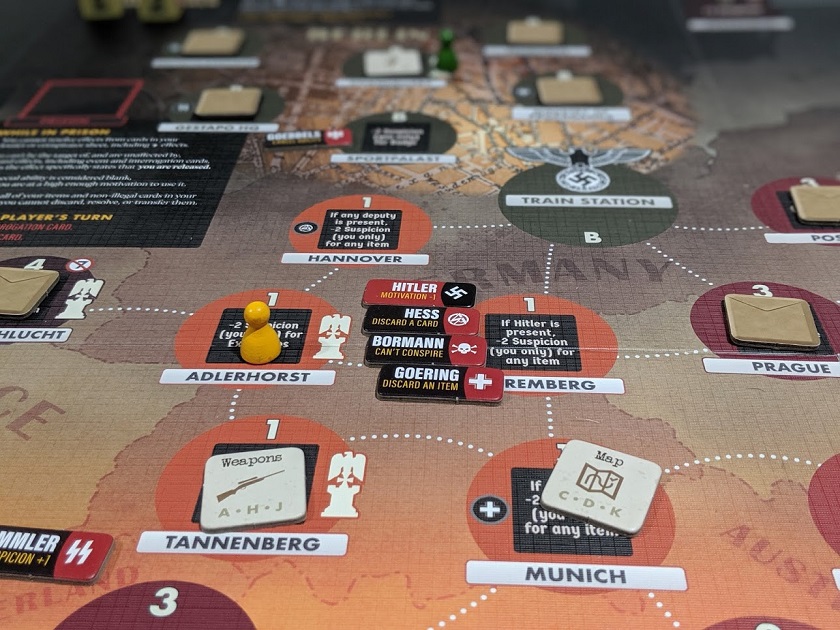
Everything within the game is about building up and pulling off the perfect plot. As part of this, you will visit different places and collect required items, gather action cards and avoid the Gestapo. All the while you will manipulate Hitler and his cronies to be in the right place at the right time.
An example of this is The Lone Gunman plot. To carry this plot out, you must be in the same space as Hitler, with your motivation at its highest. Then your optional elements, include having a weapon, badges, and being a Wehrmacht (each character has a different affiliation).
This is a lot of work and takes multiple turns and coordination to set up.
Then once everything aligns, it all comes down to the roll of the dice.
At that point, whether or not you assassinate an art school dropout is out of your hands. It’s a tense moment, where a lot hinges on crosshairs coming up. However, more often than not, you’re going to whiff the roll. Meaning all that time and effort you spent will be for naught.
Now as frustrating as this is, losing all that work, it successfully demonstrates the difficulty of planning an assassination. And while it takes you minutes to set up a new plot, contextually people spent months if not years putting together plans – only for them to fail.
This is where you have to question why you want to play Black Orchestra. It’s a great tool to learn about the forgotten heroes of World War 2, and how Hitler survived until the end of the war. Yet as a board game, this frustration isn’t something I typically enjoy.
Treats its subject with respect
Black Orchestra isn’t all doom and gloom though, it realises it’s a board game so it offers a bit of levity as well. Not in the theme mind you, but through the mechanics.
One example is the Conspire action. Once per turn, you can gamble on the result of a dice roll. If successful, you gain more actions for that turn, but if unsuccessful, your suspicion increases. It’s a neat bit of your push-your-luck that can give you the extra turns you need, or put you in a perilous position.
Another fascinating mechanic is whenever you’re jailed, instead of a regular turn, you draw a card from the interrogation deck. This card gives you several options, all bad, and you have to choose one to carry out. However, this choice is yours alone, and you can’t discuss it with anyone else at the table.
This creates a powerful feeling of isolation. Especially in juxtaposition to the rest of your time playing Black Orchestra. Where you’re constantly conversing over what plots people have and how best to act on them.
Taking a step away from the gameplay, the colour palette used makes Black Orchestra tonally beautiful. It feels timely, and its use of red and oranges provides you with a heightened sense of danger. Adding to the tension and desperation you feel within the game.
Everything else is tied back to history. All of the event cards use black-and-white photographs to picture events that happened. People and places used are notable figures and locations found within history books. It’s incredibly grounding and taught me a lot about what happened inside Germany during that period.
Continuing to talk presentation, they managed to lay out all the information you need to play on the board and in the cards. This is something I wish more board games would do. Once you’ve learned the game, you never need to go back to the rulebook.
Overall, Black Orchestra is a good game that pushes new ideas into the co-op genre and has one of the most beautiful tones in modern board gaming. It masterfully deals with its tough subject matter, while still managing to be fun – if not frustrating. And that’s the question you must ask yourself when considering Black Orchestra. Do you want to put in all that work to kill Hitler, if it’s all for naught?
Similar Games You Might Like

Pax Pamir Second Edition Review – A Beautiful Game That’s Hard to Love
Betraying your allies mid-turn for a quick payout is just the cost of doing business. A ruthless, highly political battle where shifting loyalties dictate the winner.

Imperium: Classics Review – The 3-Hour “One More Turn” Dilemma
Cycle through unique faction decks to evolve your society from tribal chaos to empire. A deeply strategic history builder that moves at a snail’s pace.

London (Second Edition) Review – An Engine Built to Spontaneously Combust
Running a thriving city block pays massive dividends until you’re forced to tear it down. A unique, cynical tableau builder with no steady income.
A score tells you if it’s good, but the leaderboard tells you if it’s worth the shelf space.

 Loading ...

Interesting summary, David. I’ve heard of this game, but I’ve never really taken a close look at it. I guess I was thinking it was similar to Secret Hitler, but this is a different animal. Thanks for the overview. I’ve been recently playing Sekigahara and Anachrony! Oh! And I won a game of Brass: Birmingham — huzzah!
An absolute different animal! Although I like Secret Hitler as well – and I’m not huge on social deduction.
You’re going to have to tell me how Anachrony is. It’s been on my list. And I’ve been big on a heavy themed euros at the moment.