
Muse
Players: 2-12
Playing Time: 30 minutes
Designer: Jordan Sorenson
Publisher: Quick Simple Fun Games
Muse’s new inspiration cards don’t always land, but when they do, it’s a great game. Capturing similar feelings to some of my favourite games in Dixit and Mysterium.
Pros
- Inspiration cards keep the game fresh every round
- Stunning surreal artwork on the cards
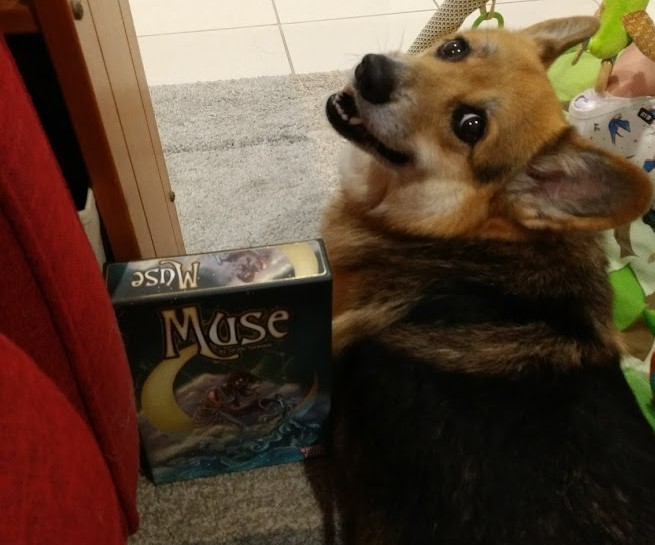
- Comes in a small box, great for transporting around
- A fun party game that keeps your enjoyment at the forefront of its design
Cons
- Doesn’t have the same highs as other party games
- Not all inspiration cards are good or even make sense in the context
- Enjoyability will depend on your group of players
Love our reviews? Buying through our links earns us a small commission at zero extra cost to you, helping us table the next big release! Full disclosure here.
Muse follows in the footsteps of the image association giant Dixit. Where the storyteller must communicate which of the picture cards is theirs. Only this time, they’re restricted in how they give the clue. It might be they have to hum a description, name a building resembling the card, or write a 34-page manifesto on the political nature of northeastern pigeons.
OK, maybe not that last one.
Muse is a team game, where each round teams submit one of their members to be the clue giver. The other team then draws six tarot-sized picture cards called masterpieces, and two regular-sized inspiration cards. They then pick one of each and hand them over to the clue giver.
The masterpiece card is the one they need to get their team to guess. While the inspiration card tells the clue giver how they must give their clue. These might ask the clue giver to name a non-fiction person or a book. But might also get physical as well, like striking a pose, or humming a sound.
Once the clue giver performs their clue, they return the masterpiece card. Then the opposing team, shuffles this card along with the five others, placing them all face-up.
Then it’s over to the clue givers team to guess the card from the clue. If they get it right they claim the card. Otherwise, it’s on to the next team and the next turn. The first team to claim five cards wins.

A solid iteration
Muse iterates upon the Dixit formula, attempting to solve some of the issues with that wonderful party game. Namely, blank page syndrome. When presented with an overabundance of freedom of creativity it’s hard to come up with something. Muse gives players enough direction on how to be creative through the inspiration cards.
The other issue Muse fixes is the burden of creativity. Where instead of one person trying to come up with the clues themselves. Which can be a pretty intimidating experience. Restricting the clue giver to one picture card and an inspiration card makes it a lot easier to come up with the clue.
Meanwhile, Muse keeps the good things from its spiritual predecessor as well. You’ll still burst out into spontaneous laughter when your team gets it wrong, and the clue is so far off-base that it doesn’t make sense. For instance, it’s only by playing Muse that I found out my friend has no idea what a crab sounds like.
Then there are the moments when you think you’ve provided the perfect clue, only to find that it applies to every other card revealed. When that happens, anyone watching you with subtitles would see [groans internally].
These moments are balanced out with moments of victory as well, that don’t embarrass you, and instead make you feel clever. Both as the clue giver, and the ones figuring out the correct card.

Inspiration isn’t all that
Yet the most interesting mechanic introduced is the variety of inspiration cards. These change up the rules of the game each round and keep the game fresh – even after a couple of plays. Because despite seeing the same picture cards over and over again, the clue-giving process changes each time.
That said, not all inspiration cards are created equal.
Depending on the clue giver, forcing them to name a published book, or a recently released movie can be incredibly tough. Especially if they’re not well-versed in that type of media. If the opposing team is playing to win, choose these inspiration cards regardless of the clue givers’ lack of confidence. Then Muse can quickly turn from fun to frustration.
There’s also the inconsistency of enjoyment from these inspiration cards. Where some inspirations are really fun. Great to come up with clues, and great to figure out what the clue giver means. But some feel phoned in, and aren’t as interesting – such as the inspiration requiring a 3 or 6-letter word.
This can be forgiven, not every song on an album is a hit. But it adds up to an experience of high highs and some unexpected lulls. Thankfully here, the misses are infrequent and soon to be forgotten.
However, the most egregious issue with the inspiration cards was that they weren’t always clear about what they meant. They went for brevity rather than clarity when wording the cards. So unfortunately things got heated when I found out a picture of my brother does not constitute a tool.
Muse vs Dixit – which is better?
When it comes to whether I prefer Muse over Dixit, I end up siding with Dixit. The additional direction from Muse’s inspiration cards makes playing easier and keeps the game running smoothly. But it puts the clue-givers into a theoretical box.
So the clues generated aren’t as interesting or engaging.
For example, we’ve had games of Dixit where the clue was ‘My fifth-grade teacher’ or ‘What I like to do when I’m home alone’. In these instances, players’ responses to these clues were as funny as the answer.
Even though Muse misses out on this aspect, it’s still a lot of fun and a great party game. Its small box size makes it a lot easier to port around than most other games. So although my preference is to play Dixit, it’s Muse that finds its way into the bottom of my board game bag.
Surreal Imagery: More Great Looking party games
If you fell in love with the dreamlike vibe of Muse, you’ll find plenty more abstract eye candy right here. These three titles range from a lighthearted, laugh-out-loud night of mind-melding to spooky, beautifully haunting mystery-solving.


How does it compare?
A score tells you if it’s good, but the leaderboard tells you if it’s worth the shelf space. See the full board game rankings to see the true pecking order.


 Loading ...

That is awesome. 🙂 Though the game doesn’t sound that great to me.
Yeah, I think you’d have a better chance liking this one than Dixit, but it’s still a big risk. I’d grab something else. 😛
“Dixit 2: The Dixiting” – BEST.SUMMARY.EVER