Imperium: Classics
Players: 1-4
Playing Time: 60-120 minutes
Designer: Nigel Buckle, Dávid Turczi
Publisher: Osprey Games
Imperium: Classics lets you tell the story of the rise and fall of a civilisation. It’s as much a story game as it is a strategic one. As exciting as that is, it takes too long to play and other games give you the same buzz in a shorter playtime.
Pros
- Rich civilisation building with the cards telling a story
- Engaging gameplay of increasingly complex decisions
- Artstyle by Mihajlo Dimitrievski that compliments the theme
- Rewards multiple playthroughs as you learn about each civilization and their strengths and weaknesses
Cons
- Long playtime exacerbated by the game slowing down in the later stages
- Significant downtime as each player thinks through their turns
- Tough to learn how to play because everything is written into keywords on the cards
- Limited to no player interaction
Love our reviews? Buying through our links earns us a small commission at zero extra cost to you, helping us table the next big release! Full disclosure here.
Every civilization has to start from somewhere. Be it sticks and stones, the invention of steel, or a deck of cards. In Imperium: Classics, you’ll be starting with the latter.
Three decks of cards to be precise.
While mechanically it’s a deck-building game, on a more grandeur scale it’s about civilisation building. At the beginning of the game, you pick one of eight different civilisations and set off to build an empire.
Each civilization has unique cards, including a nation deck, a development deck and a starting deck of cards. These decks are slowly integrated with your starting deck throughout the game giving your deck a distinct flavour.
Meanwhile, you’ll get and spend resources to add cards to your deck from a common marketplace. Then use these cards as either actions or to build a tableau of cards in front of you. All to achieve the most victory points.
While this sounds a bit dry, the main draw of Imperium: Classics is the constant drip-feed of flavour your civilisation provides.
Every card tells a story, every deck a tale.
By the time you’ve finished the game and counted points, you’ll have more than a winner and loser. You’ll have a chronicling of your people’s history. Imperium: Classics creates that sense of history through its mechanics.
In each game, your civilization starts in a barbaric state. But as time passes and you cycle through your draw deck. New technology and culture are seeded into your society until it rises above the chaos and becomes civilized.
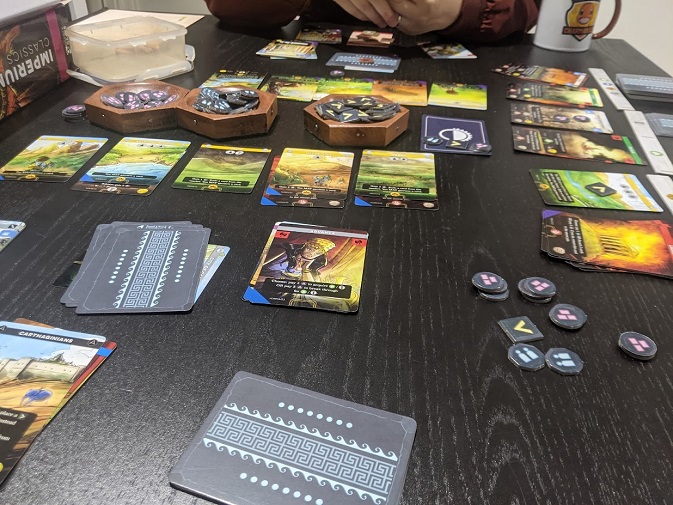
Just one more turn
A two-player game of Imperium: Classics took us somewhere between two and a half to three hours. That’s a long time to be sitting down thinking about your next move. Still, the gameplay is electric while you’re getting your civilization up and running, and plotting what you’re doing next.
It felt like playing Civilization 5 (the video game) where you can foresee upgrades and improvements coming. So, instead of going to sleep at a normal time, you end up on this treadmill of goal setting, planning, and achieving. For that reason, I’ve only played Civ 5 once, but I played for 8 hours straight.
Never again.
Likewise, Imperium: Classics puts you on this same treadmill. Where no matter the time, or whatever priorities are going on. You’ll find yourself saying: one more turn.
Or, one more cycle through your deck, as it’s only when you have no more cards to draw that you can add the powerful nation cards to your deck.
With these drip-fed improvements, there are long stretches of Imperium: Classics where your only focus is the cards in front of you. While there is some interaction between players, like cards that attack opponents, the market, and cards players race for. Most of the game takes place inside your mind.
Especially when you’re playing the more complex civilizations where it takes all your brain power to figure out your next move. As such the game moves slowly. Turns can take a blink of an eye or turn into a whole coffee break.
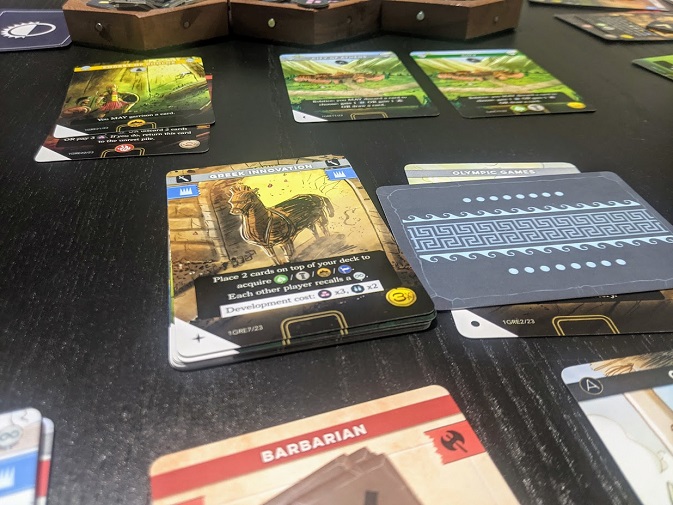
Setting the sun on the Roman empire
As exciting as it is building up your civilization, if history has taught us anything it’s that nothing lasts forever. Naturally, this is true of Imperium: Classics as well, since you get diminishing returns on each improvement. Instead of relishing each new addition to my deck, it was replaced with doldrums as I looked longingly at the end-game condition I was chasing.
Additionally, with the market deck not overflowing with exciting new cards, the onus was put on you to cycle your draw deck to get new national cards.
Compared to the initial excitement felt, when you’re both buying new cards and getting these nation cards. This stagnation took the steam out of what began as an excellent experience.
That said, I played Imperium: Classics five games before this review, and even after those plays I felt like I had just scratched the surface. This isn’t a large bombastic game filled with big plays and large actions, it’s more subtle and introverted.
It’s a game that rewards mastery, and playing it over and over will reveal new strategies that weren’t apparent in the game before. For instance, it wasn’t until my second or third play that I got familiar enough with the nation cards, and other mechanics, and could start to put together decks that synergised with my civilisation.
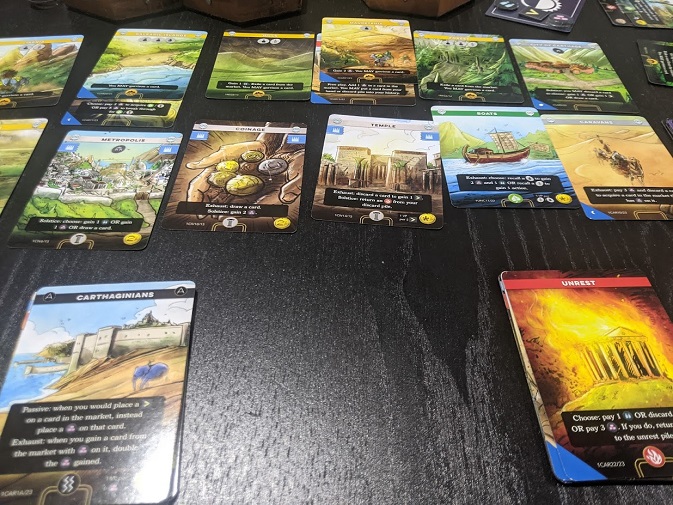
The footnotes of history
The art isn’t for everybody, but I loved the bold style and how it treads the line between too cartoony and too serious. Mihajlo Dimitrievski has done a wonderful job and it works hand in hand with mechanics to provide that historic feel.
While I don’t often mention rule books, this one is an exception because I struggled with picking up Imperium: Classics. It gives a too-brief overview of the major systems and then hides most of the rules behind keywords in the appendix
For example, every game had me digging through the rule book to find the conversion ratio of progress tokens.
Then end-game scoring is a right mess. You’ll need pens, paper, and Charlie Day pointing at a pin-up board to get it right. There are so many ways to score points, you’ll be sorting, and re-sorting through your deck. It’s one of those games where everyone looks at me and says: I give up, you do it.
After such an epic game, this accounting is hardly the climactic finish you want. But then again, it’s also somewhat expected for a deck-building game.
These complaints are easy to ignore when you’re in the thick of Imperium: Classics. If you enjoy deck-builders with meat on their bones and don’t mind a longer playtime, with slower and more calculated play. Then Imperium: Classics is an enjoyable time, if not a very exciting one.
Similar Games You Might Like

Ark Nova Review – Better Than a Pilgrimage to Australia Zoo?
Balancing zoo appeal with conservation leads to incredible tactical depth, even when the card deck plays hardball. A dense, deeply rewarding eurogame that earns its long runtime.

Oath: Chronicles of Empires & Exile Review – Monty Python Meets the French Revolution
Forget the dense and confusing rulebook, you will be talking about this game in the group chat all week. A clunky, unforgettable sandbox for storytelling.

Power Grid Review – Turning Electrical Infrastructure Into High-Stakes Speculation
Outbid rivals for power plants and buy cheap coal before prices soar. A meditative, maths-heavy market simulation with some severe rubber-banding.
A score tells you if it’s good, but the leaderboard tells you if it’s worth the shelf space.

 Loading ...