
High Society
Players: 3-5
Playing Time: 15-30 minutes
Designer: Reiner Knizia
Publisher: Osprey Games
High Society is tightly designed with almost no fluff. Since everyone has the same beginning sum of money, auctions are extremely tight and therefore a whole lot of fun!
Pros
- Balancing winning auctions and having enough money at the end of the game
- The way currency is structured leaves you making bids you’d rather not
- Short play time, rules teach, and portability go hand in hand with the tough decisions you have to make
- Reverse auctions are an interesting twist that keeps you from getting too comfortable
- I wore out my copy from playing too much!
Cons
- Given the randomness of the end game, it can happen all of a sudden which may can put players off
Love our reviews? Buying through our links earns us a small commission at zero extra cost to you, helping us table the next big release! Full disclosure here.
A game of High Society begins with you holding a wad of 11 cards worth 106 thousand dollars. Now, the first thing you’ll want to do is get more money.
Except, that’s the neat part.
You don’t.
See, you’re a socialite with poor impulse control and no idea how to manage money. Instead, your idea of a good investment is to spend it in the most frivolous way possible. Because in High Society, it’s worth more to appear rich than to be rich. So to trade your money for glamour, you’ll need to compete in a series of auctions.
To start an auction you’ll need to draw the top card of the deck, and set the starting bid or pass. Then the next person will have a chance to bid or pass, and so on. This continues until all but one member has passed. That player then wins the card and the fame points associated.
Out of all the forms of auctioning in board games, and there are many, this method is my personal favourite. As it’s quick, but allows for the drama and stakes of the auction to ramp up quickly. Until it climaxes with the inevitable back-and-forth between the final two people. Wherein chasing the victory of the auction blinds them to the money they’re spending.
Once the fourth prestige card (special cards with green backgrounds) is drawn, the game ends immediately.
Before scoring though, you must first remove the poorest player – as they no longer belong in your group. Then the player with the most fame points is the winner.
Drink up, the champagne is on them!
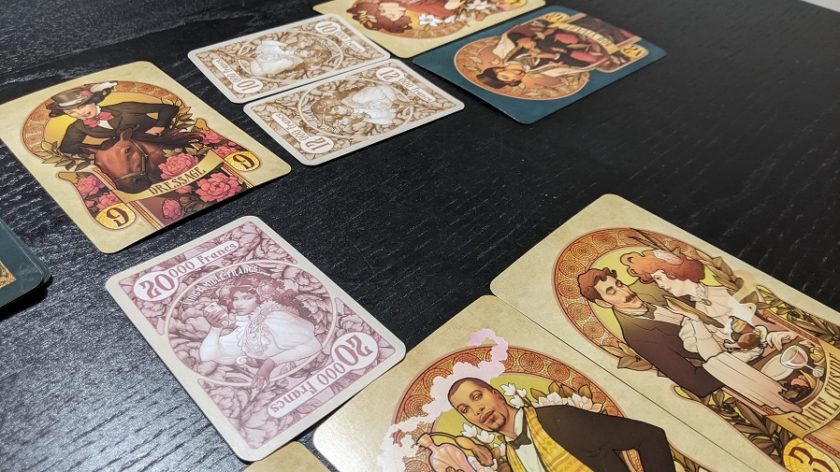
Money is the root of all victory points
High Society has an interesting relationship with money. First, you start the game at your richest point, and from then on, you only lose money by spending it in auctions.
Then although you start with 106 thousand, that amount is broken into the weirdest denominations you’ve ever seen. And there’s no change!
This has massive implications on how you play these auctions, as you need to strategise your spending. Once you put a card towards an auction, you won’t be able to change it later.
For instance, you need to decide how long you should keep your smaller denominations. Holding onto, and deploying them later in the game, can put other players in a tough position.
Like if the current bid was eight thousand, and your previous bid was seven thousand, you could use your two thousand to increase the bid. Whereby if you’re in that same situation but the smallest denomination you have is ten thousand. Then that’s suddenly a lot tougher of a decision.
Remember, the player with the least amount of money at the end of the game is eliminated.
With all cards discarded facedown, you have no idea if you’re the richest or poorest outside of the number of cards each player has remaining. Meaning the entire game you’re tense, and sweating that you’re spending too much.
This, along with the unpredictability of when the game will end, makes High Society an excellent high-stakes board game about taking big risks and getting rewarded, or punished.
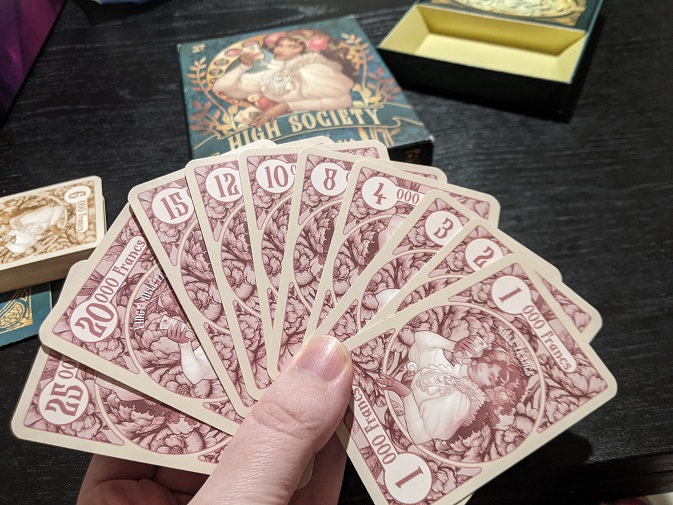
A new favourite card game
What keeps each game of High Society fresh is the prestige cards. Unlike other cards that provide you with straight point values, these modify your score in different ways. Some are good and double your points, others aren’t and can half your points or even get rid of them altogether.
Funnily enough, these negative cards are auctioned off in reverse fashion. The first person to pass keeps their money, and the card and everyone else has to pay their bid.
In a game filled with tough decisions, throwing these curveball prestige cards into the mix is enough to spice it up without drastically changing the game flow.
As it stands, High Society is a brilliant game and easily my favourite small box, and auction game. For a 20-25 minute board game, from start to finish you will be on the edge of your seat wondering whether you should keep bidding or pass. Then at the same time, think about what cards you’ll use to keep bidding.
But perhaps the best thing about High Society is it’s cheap and affordable so that even we chauffeur-less peasants can enjoy it without breaking the bank.
Similar Games You Might Like

Medici Review – The Heartbreaking Tension of the Single Bid
Spend victory points as cash to fill cargo ships with luxury goods. Reiner Knizia’s classic auction game where every winning bid hurts your final score.

Raccoon Tycoon: Fat Cat Expansion Review – The Fat Cat Expansion Review – A Box Large Enough for a Real Raccoon
Adds character shields and extra building tiles to widen your scoring options. A solid addition that improves strategy but fails to fix the endless endgame.

Vault Wars Review – Dead Adventures Don’t Need Their Loot
Going, going, dragged out. A funny fantasy-themed storage auction whose clever bidding mechanics gets lost behind a tedious amount of downtime.
A score tells you if it’s good, but the leaderboard tells you if it’s worth the shelf space.


 Loading ...

Great review. Humorous and informative. I recently acquired the game in a garage sale for a ludicrous 5 dollars and your review hyped me up even more for my first play, which should be coming soon.
Thanks Max! I’m now excited for you. Hope I didn’t overhype it…
Let me know how it goes. 😀
We played three 4P games back to back. The game is surprisingly quick. All of us enjoyed it very much, even the players that are usually lukewarm towards auction games. I personally love the ramping tension as the deck gets thinner and as each buy could make you win or lose on the spot.
Yay! Great to hear. Thanks for the update Max. Did you win?
Not a single time. Got cast out once and was simply beaten by the points the other things.
Haha! Too bad. But it’s the sign of a good game when you lose and still have fun.