Dead by Daylight: The Board Game
Players: 3-5
Playing Time: 30-60 minutes
Designer: D. Brad Talton, Jr.
Publisher: Level 99 Games
Dead by Daylight: The Board Game is an exciting and tactical board game that’s as faithful as it can be to its source material. This is to its detriment as it felt restrained and not as wild as some of Level 99 Games’ other titles.
Pros
- Plenty of heroes and villains to choose from
- Game of cat and mouse and sacrificing players to the powers that be
- Tactical and full of mind games
- Great looking miniatures
- Faithful to the computer game that it’s based on
Cons
- Weird player count issues, as it’s best played with three or five players
- The map is a bit too dark and blase
- If you’re on the hook, there’s not much to do
Love our reviews? Buying through our links earns us a small commission at zero extra cost to you, helping us table the next big release! Full disclosure here.
Being a big weenie, I don’t play horror games. Dead By Daylight is no exception. Yet, I’ve watched my fair share of the game through my friend’s stream, and the bizarre announcement of Nick Cage joining the game. So while I have a little investment in the IP, most of my excitement comes from the publisher.
Level 99 Games produces many of my favourite board games, including Empyreal: Spells & Steam and Argent: The Consortium. So going into Dead By Daylight: The Board Game I was confident we were going to get a good game. But I still harboured doubts. Would this IP stifle the creativity of the design team I’ve come to love?
That’s what we’re here to find out.
How to play
Dead By Daylight: The Board Game is a one-versus-many game. Up to four players play as survivors trying to escape a location by powering four generators and finding an exit. Meanwhile, the evilest player at the table assumes the role of a supernatural killer aiming to sacrifice these survivors. Making sure no one gets out alive.
By in large, survivors and the killer play the same. But there are differences, starting in the movement selection phase that kicks off each round. Here, the killer selects two movements, while the survivors select only one each.
Once all movements are locked in, the survivors are first to act.
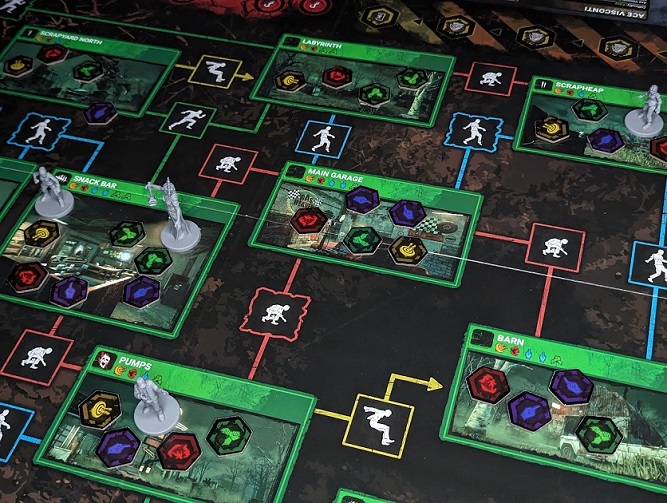
They take turns revealing their selection and performing the movement. Available movements include sprint, crouch, sneak, and vault. Each of these aligns with the different connecting lines on the map. For example, moving your character along a yellow line requires you to play your Vault card.
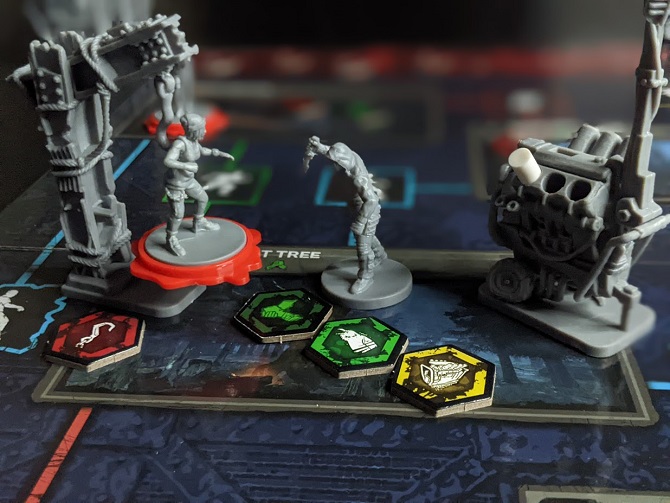
Whenever your character enters a new location, they do a quick scan around the room and discover a new prop. These are objects that you can interact with after completing your movement. Different objects provide different effects. For instance, interacting with a crow gives you extra movement, while interacting with generators moves you one step closer to escaping.
After all the survivors have moved, it’s the killer’s turn. They move, discover, and interact in the same way. Although their interactions are completely different. Additionally, they can wound survivors in their space, and then sacrifice wounded survivors, placing them on hooks, in later turns. Nudging them ever closer to a bloody victory.
It has its hooks in me
From the many hours of watching my friend stream Dead By Daylight, it appears the board game nails the same vibe. From the overpowered killer with supernatural powers to the survivors using hit-and-run tactics on generators and sacrificial poles.
As the killer, you get that same feeling of moving the couch and watching the survivors scatter like cockroaches. Figuring out where these cockroaches are going though, that’s the fun part.
Dead By Daylight knows this, and keeps the mind games front and centre within its design. Players have a simple rock-paper-scissors decision to make when it comes to movement. Giving the killer an edge with a second turn, and special abilities.
This system should be familiar to anyone who’s played BattleCon, a board game from the same designer. As that similarly has the same simple this-beats-that mechanism at its core. However, both games layer so much additional information on top of this simple decision, that it becomes not so simple.
For example, in Dead By Daylight you’re always torn between capturing survivors (or avoiding the killer) and breaking the generators (or powering the generators). Having these competing priorities always makes the decision interesting.
But beyond that, you also need to think about what else you can do.
What powers or perks do you have available?
What props are on what squares? And which ones are your best options?
One of the excellent things about Dead By Daylight: The Board Game is my answers to these questions changed the more I played. Initially, the meta at our table was to rush the generators and power them as quickly as possible. However, that quickly became the story of four moths attracted to the light of a bug catcher.
In future games, we focused more on the survival aspect, using the crows and the lockers to hide and misdirect our movements. At this point, the game opened up and again that simple decision of which card to pick became excitingly complex.
Faithful to a fault
Now, as much as the board game captures its source material, it’s also held back by maintaining its faithfulness. One example is the player count. Where if there aren’t four survivors within Dead By Daylight: The Board Game, you make up the difference regardless.
So in a two-player game, one person pilots all four different survivors at once. As you can imagine, this is as overwhelming as trying to drive all four screens in multiplayer Mario Kart.
Meanwhile, whenever someone is sacrificed in a five-player game, their turn is missed while they’re on the hook. Then when they return, they’re wounded and still an easy target to be re-sacrificed and sidelined from the game again.
Therefore, having three or four players is the perfect player count. At three, players get two survivors each, allowing them to still play while one is hooked. At four, the unassigned survivor can be controlled by a sacrificed player.
This is just one example of the effect of the IP. Another is the look and feel of the main board, which suffers because it tries to capture the dark and dingy feel of Dead By Daylight. It succeeds, but to put it plainly, it’s boring. Yes, from a usability standpoint, it’s got everything it needs.
However, there’s so much empty space on the board. Additionally, the different locations look like screenshots from Dead By Daylight. As such, it doesn’t feel like a cohesive map. Or like you’re travelling from one location to the next. One second you’re inside the Main Garage, the next you’re in the Barn.
For any other publisher, this wouldn’t be worth a mention. Coming from Level 99 Games though, it’s a surprise. Most of their board games are bright, colourful, and full of details.
Their games also allow for big bombastic turns where you can change the flow of the game on a dime. Making sure you can’t predict the winner until the game is packed away. Having this level of surprise throughout the game is why I enjoy their games so much.
Yet in Dead by Daylight: The Board Game that element of surprise is missing. Especially the survivor’s perks that are either too expensive or too situational. But even the more expressive killers felt dull in comparison to previous games in their catalogue.
How you know it’s from Level 99 Games
Outside of the fact it’s got a colon in the middle of its title. You know this is a Level 99 Games production from the sheer amount of board game in the box.
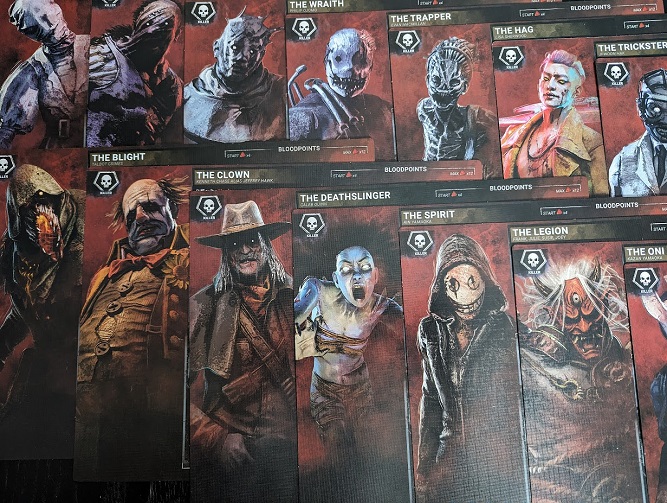
In the base game, you get seven survivors, six killers, and two maps to play with. While the survivors aren’t that interesting to interchange, each new killer changes the game significantly. Having six in the box from the get-go is a serious amount of variability.
Now, being the Level 99 Games sycophant I am, I got the collector’s edition. That comes with 17 survivors, 16 killers, and 4 maps. That’s just an absurd amount of variety.
Of course, with this variety comes variance.
In our first play, we used Legion as the killer and the survivors ran rings around them. However, in the very next game, we changed the killer to the Doctor. Then it was the survivors who didn’t stand a chance.
Going back to the collector’s edition, I do hope whoever created the box for this version stubs their toe, or accidentally hits their funny bone a little too hard. As this is the longest, most awkward-to-store, and most awkward-to-transport board game box in existence. Seriously, when your box is longer than Mechs vs Minions, alarm bells should be ringing.
Putting that aside, Dead By Daylight is one of the best-licenced board games on the market. Although it is flawed – around the player count and people losing their turns – it translates the video game exceptionally well.
Yet, it’s not just for the fans. Its simple core mechanic of picking a movement card puts it on the lighter side of medium-weight. Then as you become comfortable with the game, expect to find an increasing amount of interesting choices and options open up to you. This, along with the sheer amount of variability in the game box makes Dead By Daylight: The Board Game a winner.
Similar Games You Might Like

Bullet♥ Review – Sweaty Hands and the 90s Arcade Panic
A frantic, real-time shoot ’em up that captures the raw, kinetic energy of an arcade cabinet. Fast, sweaty, and so, so satisfying.

Empyreal: Spells & Steam Review – This Is As Exciting As Trains Get
All gas and no brakes. Use mana, spells, and teleportation to pick-up and deliver cargo in this colourful train game that trades dry logistics for non-stop tactical bedlam.

Argent: The Consortium Review – Harry Potter and the Quest for the Cushy Corporate Salary
Sling spells to send rival wizard students into the infirmary to hijack board spaces. An outstanding, high-friction worker-placement where hidden judges make you paranoid over every move.
A score tells you if it’s good, but the leaderboard tells you if it’s worth the shelf space.

 Loading ...