
Spirit Island
Players: 1-4
Playing Time: 90-120 minutes
Designer: R. Eric Reuss
Publisher: Greater Than Games
Spirit Island is one of those landmark board games that comes along every decade to completely change the board gaming landscape. With its fascinating theme and rich gameplay, this is a board game everyone should try once.
Pros
- Reverse colonisation as a theme puts things into perspective
- Spirits are all unique and play very differently
- The delay between fast and slow abilities is ingenious and makes you think about timing your attacks
- From extra spirits, blight cards, and scenarios there’s plenty of content within the game box
- Stops quarterbacking as it takes so much brain power just to look after your part of the island
- The feeling of growth as round after round you power up your spirit
Cons
- It’s harder to teach and help newcomers because you must focus so hard on your area
- Prepare to lose an afternoon if playing with four players
Love our reviews? Buying through our links earns us a small commission at zero extra cost to you, helping us table the next big release! Full disclosure here.
Spirit Island is a cooperative game of reverse colonisation. Where you play spirits protecting the indigenous population from invading colonists destroying the land. It’s a heavy subject and one we won’t dwell on in this review. But it is important to acknowledge our past and that people today are still suffering from the actions of our forefathers. So it’s only fitting to start this review with an acknowledgement of country:
I acknowledge and pay my respects, to the Aboriginal and Torres Strait Islander people past, present and emerging, whose land I stand upon today.
Alright, let’s talk about Spirit Island.
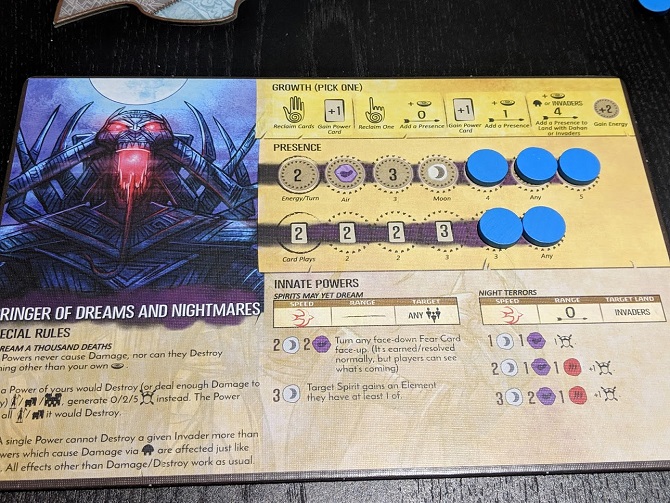
There are eight spirits within the game, and while some are stronger than others, they’re all radically different and all start extremely weak. Each turn throughout the game begins with a Growth Phase where you’ll have the opportunity to grow these spirits in several different directions.
However, growth isn’t your only option during these times. Sometimes, you’ll need to spend this growth phase to gain resources or refresh your hand instead.
This is perhaps the easiest decision you’ll make playing Spirit Island but that doesn’t mean it’s easy. Selecting the wrong option during this phase may have far-reaching consequences for the game. Oftentimes you’re forced into choosing between what you need to survive this turn, and what you need to win the game.
This type of short-term vs long-term decision-making is a cornerstone of Spirit Island, taking as many forms as Mystique from X-Men. The answer is never straightforward, but constantly re-figuring your approach to the game is satisfying beyond measure.

Growth and invaders
After the growth phase, it’s time to dig into the real meat of the game. Where you pick and pay for the cards you’ll be playing this round. Cards have an ability, range, energy cost, placement restrictions, elements, and speed. Which can be fast or slow.
These cards are so versatile that it depends on the current situation you’re in. Finding the best play for the current turn is another difficult and deeply engaging decision you’ll have to make.
While you have to consider all of the card’s attributes, the most important one to keep an eye on is speed. Fast cards activate before the colonists invade allowing you to affect the board before they damage the land and spread. Whereas slow cards activate afterwards, meaning not only do you have to anticipate the board state, but you also might have to sacrifice the Dahan or take some land damage (blight).
Figuring out a future board state isn’t as simple as it sounds.
First, you and the other spirits play your fast cards.
Then the invaders get a turn, which starts by drawing an invader card showing one or two land types. They then carry out:
- Exploring your coastal land and colonised areas on this land type
- Building on any areas of this land type they have currently explored
- Ravage the land if there are either two explorers or a building on an area of the land type
These are carried out in reverse order from above, with Ravage being the one you need to keep an eye on. These can kill off the island natives and cause the island blight, and too much blight will lose you the game.
Island determinism
The deterministic nature of the invaders and the speed at which they attack answer the immediate question of what should you be doing this turn. What’s awesome about Spirit Island, is it provides you with the freedom to figure out the how.
For instance, beyond abilities, a played card also provides your spirit with elemental power. This then can be used to activate your spirit’s powerful innate abilities. So there’s another decision, do you play a card for its abilities, or for the elements it provides?
Then once played, a card goes into your discard pile.
Usually, this means you won’t be able to get it back and use it again until a future growth phase. So you need to think about the timing of when to use cards, as you may not see the same card again for a while.
These restrictions, and mechanics all intertwine to make Spirit Island a top-tier game. Because there’s so much you can do, you almost always come up with a better way to play the cards you’ve been dealt. Making the card play so rewarding and satisfying.
And if that wasn’t enough, there’s another gratifying puzzle in the Dahan.
While you can’t directly control the Dahan, you can influence them around the board. They fight off the invaders for you, but can easily die to ravages if not protected. Figuring out the best way to use them is yet another Rubik’s cube for you to solve.

Serving up fear and cooperation
How you win Spirit Island depends on the victory condition which changes based on how much fear you’ve generated. The more fear you generate, the easier it is to win.
Oftentimes, you’re generating fear at the cost of protecting the island, so this becomes the controlling factor for the pace of the game. If you want a fast and frantic game of Spirit Island, generate more fear. If you want it slower and more controlled, then generate less.
Fear by itself is a great mechanic but it’s also behind the worst part of Spirit Island.
Where in most cooperative games you start with the end in sight. Spirit Island blurs your vision with an army of plastic colonists and engaging gameplay that you don’t see the goalposts moving until they’re on top of you.
By that I mean, the end of the game sneaks up on you. And after spending the last hour or more working your butt off and instead of relief for winning, you instead feel confusion.
It’s like waking up late on a Friday, rushing to get dressed and get to work. Only to realise when you get there that it’s a Saturday. You’ve just put in all this effort but feels like it goes unrewarded.
While that’s a downside of the intense engagement I felt playing Spirit Island, there’s an upshot too – outside of the awesome gameplay experience.
And that’s the communication between players.
Whereby, in cooperative board games, we normally talk at the micro-level: What should I do? In Spirit Island we could only do this at the macro level: These are the areas I can cover. What can you protect?
This meant that no one player could dictate the moves of another, and we truly had to work together.
One more thing…
New players will struggle to pick up Spirit Island. It’s a complicated game, and because it’s so involving it isolates you from other players. Great for when playing with people of equal skill, but when someone sits across from you with no idea of what to do. It can be frustrating for all involved.
New players get no help from the rulebook either, as it’s written by someone who knows the game inside and out, for people who already know how to play. Making it a fantastic resource for when you need to find a rule or a quick refresher. But terrible if you’re new to the game. Thankfully the One Stop Co-op Shop rules tutorial has got that covered for you.
Otherwise, I love Spirit Island and think it’s a board game every board gamer should play, if not own. It nails almost all aspects of board gaming and is an absolute blast to play and strategise for. The elegance of the mechanics and the variety in how your spirit grows throughout the game are unmatched in any game I’ve played.
However, it’s the number of rules, the lack of setup time, and minimal turn upkeep when compared to the depth of decision-making that makes this game a work of black magic. If you told me R. Eric Reuss wasn’t a game designer but a wizard. I would not be surprised.
Is Spirit Island the best board game ever made?
If not, it’s pretty damn close.
Similar Games You Might Like

Gloomhaven: Jaws of the Lion Review – All of the Strategy None of the Shelf Space
Blow up dungeon walls and clear scenarios straight out of a spiral-bound book. A streamlined tactical crawl that kills off quarterbacking.

The Crew: Mission Deep Sea Review – From Trick-Taking Hater to 5-Star Convert
Work together in silence to complete tricky underwater missions before oxygen runs out. A brilliant, twenty-minute cooperative card game you’ll want to play over and over.

The LOOP Review – Combos So Good They Should Be Illegal
Harness temporal energy to reset your hand and unleash multi-card combos against the mad Dr Faux. A deeply satisfying cooperative challenge that drags a bit at higher player counts.
A score tells you if it’s good, but the leaderboard tells you if it’s worth the shelf space.

 Loading ...

For fans of abstract, dry, repetitive, non-epic games where the game ends out of nowhere in an unmemorable way and with a development in the game with 0 epic moments… this, this is the “game”-
Wow! That’s take is so hot it’s going to go supanova! I find Spirit Island to be quite thematic in how the spirits evolve in ways that evoke their element, and often feel like I’m getting overwhelmed by colonists. So really surprised by your comments, and sucks it seems you didn’t enjoy it.
Is there another game you would recommend? Love to hear your thoughts.
Land doesn’t belong to any human modern, Aboriginal or from any other era. The earth has never and will never ever belong to anyone other than for a fleeting moment bound by laws devised for economic gain. Land will and has never been owned by humans.
In response to the naive quote “I acknowledge and pay my respects, to the Aboriginal and Torres Strait Islander people whose land I stand upon today.”
This quote is actually part of the reconciliation movement that’s happening in Australia. It comes in two parts. The one I listed here – which is an acknowledgement of country. The second part can only be done by an Aboriginal elder. And it’s called Welcome to Country.
It’s about respecting the history, culture and people who came before us.
You can read more about it here: https://www.commonground.org.au/learn/acknowledgement-of-country