Calico
Players: 1-4
Playing Time: 30-40 minutes
Designer: Kevin Russ
Publisher: Alderace Entertainment Group (AEG)
Calico is a gorgeous game of cats and quilts. The puzzle to solve can be mind-bogglingly difficult and twist your brain like a ball of yarn. But I find its lack of interaction personally unsatisfying.
Pros
- Cute cats doing cute things
- A challenging tile-laying puzzle that gets harder as more tiles are added to your board
- By the time you finish, you’ve made a beautiful-looking pattern
- Lots of ways to earn points, so you don’t have to rely on solving your initial objectives
- Plenty of different objectives keep this puzzle fresh
Cons
- Could have done a better job with cat-point tokens, at the moment it’s form-over-function
- Lack of interaction between players means there’s no difference playing solo or with another player
Love our reviews? Buying through our links earns us a small commission at zero extra cost to you, helping us table the next big release! Full disclosure here.
Let’s be honest. Who doesn’t want to play a game about getting cosy with cats? Seemingly nobody. Cats are in the board game spotlight at the moment with Isle of Cats, Fort: Cats and Dogs, Crazy Cat Lady, and Calico.
However, Calico isn’t only about cats.
It’s about making them comfy.
Let’s talk quilt making.
Each turn you’ll be adding a patch to your quilt board. Which patch you add, and where you add it, is how you gain victory points. With more complex patterns earning you more victory points.
For instance, if you place three patches of the same colour in a group you gain a button worth 3 points. However if you manage to connect a group of 6 of the same pattern you’ll attract Cira the cat, who’s worth 9 points!
Beyond these patterns, you also start the game with three objective tiles already placed. These tiles will give you an arrangement to form as well, which can be completed for the colour, pattern, or both. Where completing the arrangement for both showers you in points like cat fur in shedding season.
After placing your patch, you’ll refill your hand with two patches from a central marketplace. Continue playing until everyone’s quilts are complete and then count the cats and the points you’ve acquired throughout to find out the winner.
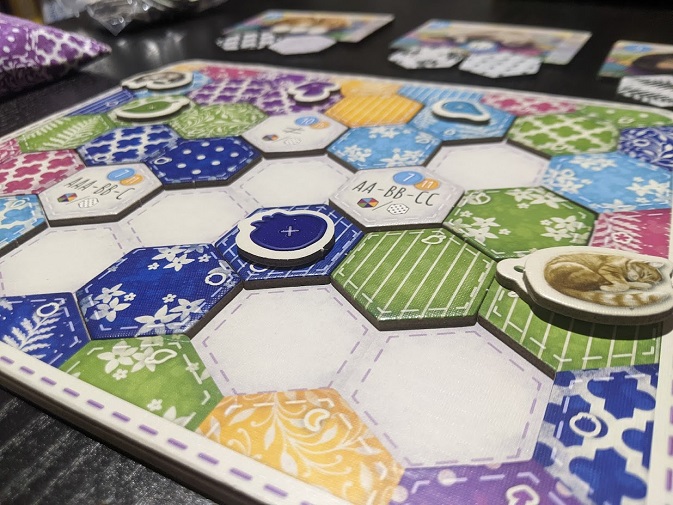
Deciding between patterns and colours
Enough is going on in Calico that you could fall over, accidentally place a tile, and still come away with 3 points. However, scoring the big numbers requires careful placement, planning, and sacrifice.
You start the game aiming to complete all three objective tiles for both colour and pattern. But with each tile taking a limited spot on your board, you don’t have much wiggle room for unwanted tiles. And if there’s one certainty in Calico it’s you’ll never get the tile that is both the colour and pattern you want.
This puts you at the crossroads between what you want to do, and what you can do. You’re always deciding what’s the best move to do with an imperfect tile. Even though you’ll do your best with what you have, you’ll slowly move away from the big point scorers – those starting objectives – one imperfect tile at a time.
So in the end, you end up playing yourself.
I found I spent the first half of Calico stringing together combinations and having fun collecting cats. And the second half cursing myself for the mess I’ve put myself into.
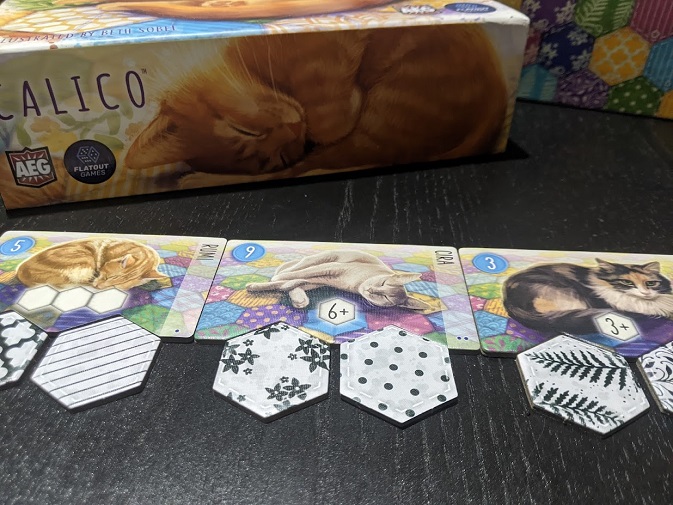
Do not believe the cute cat
Even after a few games of Calico, you’ll still find yourself in the same trap. Because even though you will instinctively pick up how to play the game – it’s quite barren of complex rules.
When you look at your board, you’ll be seeing colours with your left eye, and patterns with your right. Because at its core, it’s two puzzles overlaying each other.
It takes a lot of concentration to keep everything straight in your head, and even more to plan out future turns. Making Calico a game where you spend more time looking at your board than your opponents.
This is fine because even though you’re drawing from the same market there’s very little interaction between players. Given the game is so tight, there’s not even room to hate the draft.
Because of this limited interactivity, I found there to be little difference between playing with other people and playing solo. Still, I enjoyed puzzling and tormenting myself over every move.
But do not believe the cute cat on the cover, playing well requires deep concentration and heavy thinking. More so than other family-focused games.

Bringing the comfiness
Component-wise I wished they had generic cat tokens instead of individual tokens for different cats. These are a pain to sort through.
Otherwise, the boards are double-layered cardboard, which is my favourite type of component, and the tiles are a snug fit. It gives you the same experience as a well-produced puzzle.
Then, just like Wingspan, Beth Sobel’s illustrations are faultless. They’re all so cute and bring the feeling of comfort and cats to the forefront.
Overall, while Calico is enjoyable and a good abstract game, it’s let down by its lack of interaction. When compared to one of my favourite abstract games Azul, where there’s this constant worry that someone is going to take what you want. In Calico, you have no such concern. Your focus is squarely on the quilt in front of you.
As such, it feels like there’s no difference between playing Calico as a solo game or playing with other people. Some people will enjoy this non-confrontational experience. But for me, if we are sitting across the table from one another and can’t meaningfully interact, then the game would be better suited as a purely solo experience or a digital app.
Similar Games You Might Like

Harmonies Review – Finding Inner Peace in a 3D Wildlife Sanctuary
Stacking wooden rivers and trees for otter scoring just feels great. A serene set collection game let down by flimsy components in an otherwise fantastic box.

Flamecraft Review – A 5-Star Look with a 3-Star Engine
Cute dragons bake brilliant pastries, but don’t expect deep strategy. A colourful family game that suffers from inconsistent shop combinations.

Splendor Review – The Satisfying Snap of a Perfect Engine
All that glitters is actual victory points. The modern classic engine-building sprint where lightning-fast turns leave zero room for error.
A score tells you if it’s good, but the leaderboard tells you if it’s worth the shelf space.


 Loading ...