Disclaimer: Sushi Boat was provided for free from Japanime Games, though the writing and opinions of this article are my own.
Sushi Boat
Players: 2-5
Playing Time: 30-75 minutes
Designers: Dario Massarenti, Francesco Testini
Publisher: Japanime Games
Sushi Boat is a surprisingly fun romp. Never getting too serious with its gameplay or memory mechanics it just lets you have a good time, and laugh at yourself for never remembering what sushi you got.
Pros
- Wonderfully wooden-crafted sushi boat
- Fun memory challenges that delight instead of annoy
- Light strategy in planning where to go next and what sushi you need to collect
- A great board game to play with the family
Cons
- Because of the length of the sushi boat, it’s difficult to store
- Memory mechanics aren’t going to appeal to “serious” board gamers
Love our reviews? Buying through our links earns us a small commission at zero extra cost to you, helping us table the next big release! Full disclosure here.
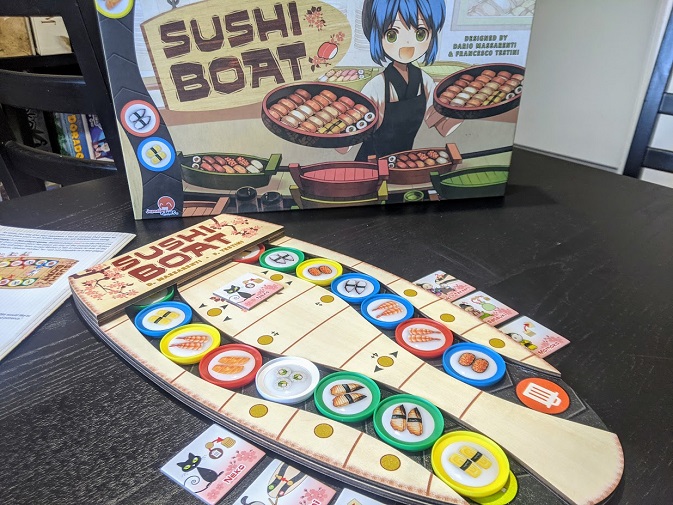
Prepare your Instagram feeds Sushi Boat is coming with the weirdest, yet coolest board game component I’ve ever seen: a 30+cm dual-layered sushi train. Made of real wood, it has a beautiful design of cherry blossoms painted upon it.
However, what’s more remarkable than its looks or craftmanship is how it integrates into the gameplay.
Sushi Boat is a game about eating the finest sushi dinner possible. But like a real sushi train, you can only eat the sushi within reach. In real life, this is the length of your arm, in Sushi Boat this is sushi that’s adjacent to your token.
So to get the best sushi you must change chairs (or action spots) more times than you would playing musical chairs. However, when it comes to sushi, Newton’s first law applies. Once the sushi is on the conveyor belt and moving, it tends to stay moving.
Making it difficult to assess where to best sit to maximize those sweet sushi gains.
If that wasn’t enough to think about, each action spot has a staff member assigned. Granting you a special ability, from getting a sushi plate from the trash to giving you go-go gadget arms and allowing you to grab a plate from the far side of the restaurant.
Between these two mechanisms, you’re often caught in limbo between two or three equally good action spots. Deciding between them is a delicious course of decision-making.
Do you remember the last sushi you ate?
When it comes to modern board game design there are two mechanics designers need to avoid at all costs: roll and move, and memory-based mechanics.
These are overused, antiquated mechanics. Where roll and move don’t allow for player agency, and memory-based mechanics aren’t interesting as they’re not testing your decision-making or critical thinking.
I mean it’s the information age, who needs to remember anything?
Sushi Boat bucks the trend by relying heavily on memory mechanics. Yet it does so in a way that blows every preconception about memory mechanics out of the water. Or soy sauce, if we’re staying on theme.
At its heart, Sushi Boat is a set collection game. Whereby collecting different collections of sushi will net you different points.
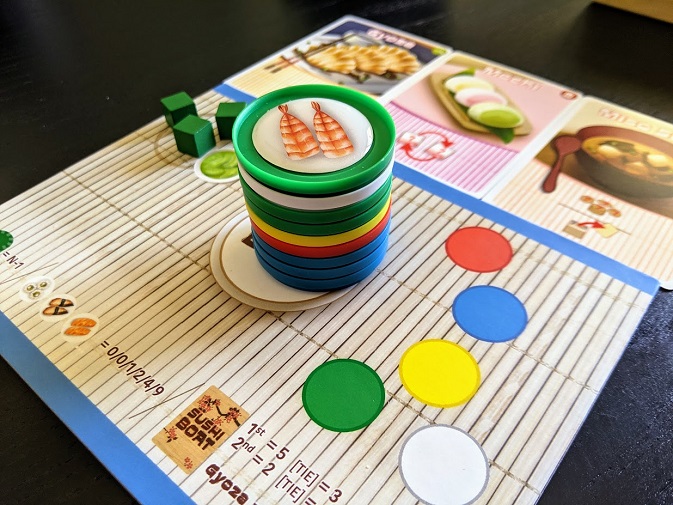
However, once a plate of sushi is collected and eaten it’s added to your stack of previously collected sushi plates. The thing is though, outside of one ability, you’re never allowed to look at what’s in your stack. Instead, you only see the last plate of sushi you ate.
Given everything else going on within the game, it’s almost guaranteed you’ll forget what was on the bottom plates. Creating fun, but agonizing, moments throughout the game where you want to look inside your stack, but can’t.
While this might annoy or frustrate “serious” gamers I found it fitting of Sushi Boat, which trades seriousness and calculating gameplay for fun.
Probing your memory
But the memory games don’t stop there.
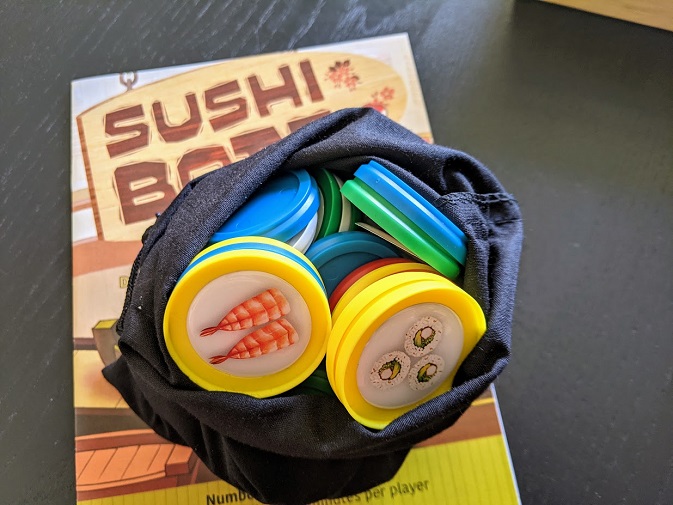
Throughout Sushi Boat, you’ll draw cards to see if the sushi moves or not. Except when someone draws the wasabi challenge. At that point, the game stops, and players need to guess the colour of the two plates hidden within the tunnel of the sushi boat.
Despite the wasabi challenge interrupting gameplay, and again puts up victory points as stakes for correct guesses. The whole activity is hilarious rather than challenging.
It’s like a card gets drawn and everyone’s first thought is:
Oh, $#&%.
From there you try to probe your memory for the answer. But you’ve seen so many plates of sushi, of different colours, that you can seldom be sure which ones just passed.
After you get it wrong, you begin this cycle of false promises.
Whereby you promise yourself to be more judicious next time. But then promptly forget your promise, as you instead spend your time thinking about what’s in your sushi stack. Then, before you know it, the next wasabi challenge card is drawn.
You can’t help but laugh.
These conflicting memory challenges are a lot of fun to play with, as they feed on each other. Making them both harder as a result.
Serving up sushi and fun
The amazing thing about Sushi Boat is that it never lets the gameplay get too competitive.
It stays at the level of being a light family-friendly game in both theme and mechanics. In doing so, it captures the fun of board gaming. It doesn’t have that big sprawling narrative or the constant puzzling over your every move – although there is a bit of that. It’s the game you bring out with friends and family, and go: this is what modern board gaming has to offer.
The only concern I have over Sushi Boat is the price point. Given the luxuriousness of the conveyor belt, it’s going to add a lot to the price. However, if Japanime Games can somehow make it affordable. Then Sushi Boat will prove itself a tasty treat for anyone who plays.
Similar Games You Might Like

Magic Maze Review – Bow Before the Pawn of Passive Aggression
Slam a massive red pawn down to silently scold your baffled team. A frantic real-time mall heist that turns total silence into muffled cries of bewilderment.

Evolution Review – Playing God in a Cardboard Ecosystem
Evolving long necks and fat stores gets tricky once the watering hole runs dry. A clever science-based simulation where you react more than you plan.

Dice Forge Review – Stranded Between Space Base and Dominion
A chip off the old die. A stunning, tactile family game where popping off dice faceplates creates a choppy, stop-start table rhythm.
A score tells you if it’s good, but the leaderboard tells you if it’s worth the shelf space.


 Loading ...