
Dune: Imperium
Players: 1-4
Playing Time: 60-120 minutes
Designer: Paul Dennen
Publisher: Dire Wolf
Dune: Imperium is one of the tensest board games I’ve ever played. Every point is hard-fought over, and you have no idea who’s won until the end of the game. A brilliant board game and an absolute masterclass in game design.
Pros
- Figuring out how, or if, to enter the end-of-round combat
- Limited actions so you must think hard about the best way to use them
- Deciding which cards to use, and which to keep for their bonuses is another excellent mechanic
- End-of-round combat is always volatile, with Bene Gesserit cards possibly giving people the edge
- Reputation tracks for each of the great houses are also fun to battle over
Cons
- Can be too stressful, or confrontational for some players
- The game is tied in with the movie, which might be an issue for some players
- Deck-building isn’t as strong as a pure deck-building game
Love our reviews? Buying through our links earns us a small commission at zero extra cost to you, helping us table the next big release! Full disclosure here.
When I reviewed Paul Dennen’s previous game Clank! A Deck-Building Adventure, my overall feeling was that it was good, but missed something special to make it a great board game. Dune: Imperium has no such flaw. It’s as Owen Wilson puts it:
Wow.
Dune: Imperium is a phenomenal board game. So much so, that it’s turned me into a Dune fan – helped of course by the excellent 2022 movie as well. But when I began playing Dune: Imperium I had no idea how to pronounce Bene Gesserit, and my only memory of the franchise was an old PC game released in 1992.
That’s all to say, I had no pre-existing fandom for the game. But I do have a pre-existing fandom of great board games.
Dune: Imperium takes the best parts of worker placement and deck-building games and makes a board game that’s disarmingly easy to learn. But has some of the toughest decisions in board gaming.
Whereas most board games usually offer a handful of tough decisions per game. Dune: Imperium throws them at you from turn one, until the end of the game.
Everything in Dune: Imperium is based around player interaction. There are reputation tracks, where only the player with the highest reputation gets the spoils. Worker placement spots that can be blocked by, or owned by other players – making you pay a tariff to use them. But most importantly, at the end of each round, is the conflict.
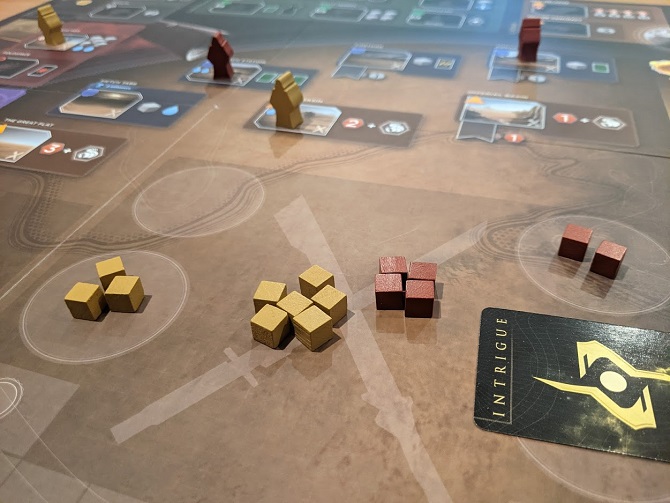
When you send in soldiers to fight over rewards in a no-holds-bar battle to the death.
Where does it begin?
It starts with you drawing five cards, and then each turn, you’ll play one of these cards and carry out its ability. Of equal import, is that this played card also dictates the spaces you can send one of your two workers to. Leaving you to question, is the card ability worth more than the space ability the worker could get on another card?
Given you only have two workers, that means you’ll only be playing two cards a round. Out of a five-card hand. This can be a devastatingly tough decision when all five options are good.
Fortunately, the cards you don’t use during the round will still be useful in the reveal turn. When you show the rest of your hand to the table and use the reveal bonuses most cards have. This can be an influence to buy new cards, combat power to add to the conflict, or some other extremely powerful ability.
This is yet another point of constant tension you face in playing Dune: Imperium. Where you never know if you want to play a card for its action and worker space or keep it for the reveal phase. It’s a case of robbing Peter to pay Paul, except in this case you have a split personality and are both Peter and Paul.
All of these choices create a disgustingly great decision space.
But it gets better.

Bringing the conflict to Arrakis
Moving from the hand of cards to the board actions, there is a multitude of great worker placement spots on the board. But the strongest ones are found as part of the four factions: the Bene Gesserit, the Fremen, The Spacing Guild, and the Emperor.
These spots, not only have the strongest powers, but they also give you a reputation with their faction when you claim them. Reputation is one of the few ways, outside of the conflict, to gain victory points. Ten of which, you need to win the game.
So you might be thinking, why not just continuously use these spots? Well, outside of them not generating the resources you might need. They might also not allow you to put troops into the conflict – the main way you get victory points.
From the beginning of each round, a conflict card is turned face up. This lets everyone know what’s at stake for the conflict at the end of the round. Most of the time, the winning player gets a victory point. But later in the game this can become two victory points, or have some other added benefits.
Once everyone has their Reveal turn. Everyone who’s sent their brave cubes into the battle has a chance to win the conflict card.
This gives you a whole round to figure out if you want to be in the conflict for this round. While also letting you strategise how you’re going to enter the conflict this turn. Whether it be through cards, spaces, or intrigue cards.

After the conflict
After the conflict, all troops sent to fight are returned to the supply as casualties. It’s difficult to create an army in Dune: Imperium. So any cubes you send into the conflict, you need to be 100% sure their sacrifice won’t be in vain.
But then this becomes a mind game in itself. As the strength of armies can come from three different places: cubes, revealed card bonuses, and intrigue cards, you’re never 100% what everyone’s bringing to the conflict.
The cards within Dune: Imperium are incredibly powerful, and remind me of Empyreal Spells & Steam. Where, because of their power, you can have these massive turns when everyone looks at you with their mouth agape like a cartoon character.
The other awesome thing about these cards is the size of the deck you get with the game. During our plays of Dune: Imperium we rarely saw the same card combination appear multiple times. Given how powerful these cards are, they would radically change the viable strategies within the game.
After all of this, I don’t have a bad word to say about Dune: Imperium. It’s a fantastic game, one of my favourites.
The decisions you must make throughout the game are hard, impactful, and constant. I’ve found that in each game, I’ve done something new and unique based on the game’s circumstances. Still, most of these games came down to the wire.
Similar Games You Might Like

Heat: Pedal to the Metal Review – Managing the Fire and the Finish Line
Floor it through a hairpin turn and flood your hand with useless heat cards. A high-speed racing puzzle that makes risk management exhilarating.

Revive Review – Engineering a Hopeful Post-Apocalypse
Rebuild civilization through clever card-slotting and branching tech upgrades. A post-apocalyptic strategy hit where choosing how to power up is as satisfying as the win itself.

Merchants of the Dark Road Review – The Best Game of 2022 (That I Played in 2021)
Piggybacking on a rival’s dark road delivery feels fantastic until someone freeloads on yours. A crunchy, system-dense economic quest.
A score tells you if it’s good, but the leaderboard tells you if it’s worth the shelf space.

 Loading ...

This game seems so awesome! Deckbuilding is awesome, and WP is awesome. Totally getting it for someone in the family (me) for Christmas. ;D
You won’t be disappointed! I love this game, it’s so much fun… But so tense. Make sure to come back and tell me how it goes. 😀
Amazing review. How does its worker placement + deckbuilding combo compare to Arnak’s, Endless Winter’s, and Copycat’s?
Hey Revimfadil, thanks for the comment.
I haven’t played Arnak, or heard of Copycats. But I have Endless Winter kickstarted, so come back in 6 months haha.
How about you? Have you played them?
I take it back! I have heard of Copycat. The 2012 Friedman Friesse game. Haven’t played it though. I remember there being some buzz about it at the time.