Heat: Pedal to the Metal
Players: 1-6
Playing Time: 30-60 minutes
Designers: Asger Harding Granerud, Daniel Skjold Pedersen
Publisher: Days of Wonder
Heat: Pedal to the Metal starts with cars screaming off the starting line and doesn’t stop until they cross the finish line. Managing your heat while keeping up with the competition is a heart-pounding challenge.
Pros
- Challenging decisions around when and how to use heat, adding strategic depth
- Captures the tension and adrenaline of a real race
- Authentic race dynamics as cars spread out on straights and cluster in corners
- Realistic dynamics as cars spread out on straights and bunch up in corners
- Packed with content: four unique tracks, engaging modules, and championship mode
- Scales well for both small and large groups
Cons
- Early games without modules may feel overly simplistic for seasoned players
- The adrenaline catch-up mechanic can feel too forgiving or artificial
- Modules add complexity that might intimidate casual or first-time players
Love our reviews? Buying through our links earns us a small commission at zero extra cost to you, helping us table the next big release! Full disclosure here.
If you’ve set foot in a board game forum, store, or convention over the past year, chances are you’ve heard the buzz about one game: Heat: Pedal to the Metal. It’s been the talk of the tabletop community, and after nine months of out-of-stock alerts and shipping delays, I finally got my hands on a copy.
Now it’s time to hit the track and see if it lives up to the hype.
How to play
In Heat: Pedal to the Metal, you’re racing across one of four tracks, battling to cross the finish line first. So grab your racing goggles, head to the starting grid and get ready to race. You’ll need to manage your speed cards, navigate sharp corners, and push your engine to its limit with heat card if you’re going to go home with the trophy.
Each round begins with choosing your gear, which dictates how many speed cards you’ll play. In first gear, you’ll play one card; in fourth gear, you’ll play four. However, you can only shift up or down one gear per round, so you’ll need to plan ahead. Go too high, and you might crash through a corner. Stay too low, and you’ll eat the dust of faster racers.
After locking in gears, all players pick their speed cards and reveal them simultaneously. Speed cards (numbered 1–5) determine how far you’ll move on the track that round.
But speed isn’t the only thing in your hand:
- Stress cards force you to draw a random card, adding unpredictability to your turn.
- Heat cards clog up your hand until you cool your engine, limiting your options.
You’ll need to manage these “hanger-on” cards carefully. Stress cards must be played to be removed, while heat cards are only shed through specific cooling actions. As your deck cycles repeatedly throughout the race, these cards will show up more frequently, limiting your ability to race effectively.
Once cards are revealed, players take turns moving, starting with whoever’s in the lead:
- Move your car the total distance of your played speed cards.
- Decide whether to boost (add a heat card to draw a random speed card) or cool down (remove a heat card, available only in first or second gear).
- Use adrenaline (if you’re in last place to) to move an additional space.
- Slipstream if you land on, or just behind the same space of another car, gain an extra two spaces.
- Check the corners. If your total speed exceeds a corner’s limit, you must add heat cards equal to the excess to your deck.
Maintaining your heat is critical, you want to push it to increase your speed, but push too hard, and you’ll overload your engine. Play it too safe, and you’ll watch the pack leave you behind.
If you speed through a corner but don’t have enough heat to pay the penalty, you’ll spin out. This forces you back to first gear, kills your momentum, and adds a stress card to your deck – a setback that can haunt the rest of your race.
The pattern repeats: pick your gear, choose cards, and move until everyone crosses the finish line. Only the first to cross claims victory and earns the right to spray champagne all over your living room. Or, you know, gloat mercilessly until the next race.
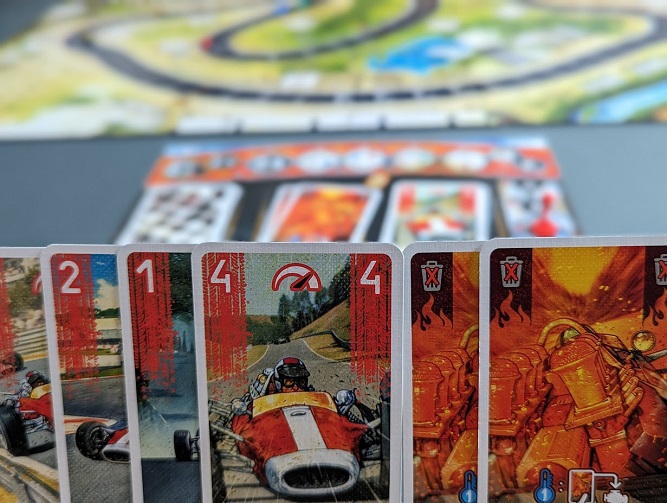
Excitement and strategy combine in glorious metal
From the moment you set those racing car miniatures on the starting grid, you can feel the heat. The roar of the engine, the thrill of the race, and maybe even the faint echo of Ricky Bobby’s dad yelling, “If you ain’t first, you’re last!”
Heat: Pedal to the Metal keeps you laser-focused on one thing: winning. Whether you’re leading the pack with rivals hot on your tail or clawing your way back from behind, every turn cranks up the pressure to push your car to its limits.
The game’s namesake heat is your secret weapon. It lets you pull off some jaw-dropping moves: jumping multiple gears, blasting through corners at breakneck speed, or squeezing out an extra burst of movement. But the more heat you burn, the more you risk. Push it too far, and your engine will start to groan, your hand will clog with useless cards, and you’ll be stuck watching the pack leave you in the dust.
Continue to play recklessly, and your car might even explode… Yes, there are rules for that.
That’s where the genius of this game lies. Heat: Pedal to the Metal captures the wild, reckless energy of racing while layering in a surprising amount of strategy. Every turn is a balancing act: do you unleash a high-risk maneuver to rocket ahead, or play it safe and keep your engine cool?
Corners bring this drama to the forefront. Their speed limits act like natural choke points, forcing players to decide: do you slow down and play it smart, or ignore the warnings, burn precious heat, and hope you don’t spin out?
However, if everyone’s playing it safe, a bold, rule-breaking move might be your only shot at victory. Hurtling through a corner at full tilt, burning heat like there’s no tomorrow, feels as exhilarating as it is risky. And when it pays off? Absolutely glorious. When it doesn’t? Well… you’ll at least have a front-row seat to your rivals speeding away.
This constant push-and-pull between risk and reward, chaos and control, is what makes Heat: Pedal to the Metal such a standout. It’s not just about how fast you can go, it’s about knowing when to go fast.

Heavy-handed catch up
Heat: Pedal to the Metal is destined to be a game we’ll be talking about for years, but that doesn’t mean it’s right for everyone.
The game thrives on the thrill of the race, with excitement acting as the devil on your shoulder, whispering, “Take the risk. Burn the heat.” But strip away the exhilarating risk-taking and racing feel, and Heat can start to feel a little samey. Every turn boils down to the same fundamental question: How fast can I push it? Unlike other strategy games like Suburbia, where you can chase multiple win conditions, Heat has one clear goal, and everyone’s charging toward it on the same track.
The adrenaline catch-up mechanic adds to the drama, ensuring races often end in nail-biting finishes. But it can feel a little heavy-handed. Sometimes, the closeness of the race feels less like a testament to your skill and more like a quirk of the system keeping things artificially tight.
Slipstreaming, on the other hand, captures the feeling of wheel-to-wheel racing beautifully. It rewards players who stick with the pack, creating a dynamic sense of momentum and competition. However, if you’re lagging far behind, or leading the charge, without anyone nearby to draft off, you lose out on those crucial bonus spaces each turn, making it feel impossible to stage stage comeback or hold a lead. It’s frustrating, sure, but also part of the design that forces you to think carefully about your position on the track.
And that’s where Heat splits opinions. The rubber-banding mechanics, the adrenaline boosts, the slipstreaming, and the natural bottlenecks at corners, keep the game thrillingly tight but can also feel like they downplay player skill. For some, that creates a cinematic, high-stakes race. For others, it might feel like the game’s holding your hand a little too much.
Still, for better or worse, this is the system working as intended. It’s what keeps Heat fast, frantic, and fun. But if you prefer letting skill and strategy take the wheel, then you may need to add in some modes and modules.

Modes, modules and everything else
Heat: Pedal to the Metal packs so much content into its box that it practically deserves its own pit crew to unpack. First you’ll find the four distinct tracks each offer their own flavour of racing. Italy’s tight corners demand finesse and calculated risks, while Great Britain’s wide-open layout encourages you to let loose and floor it. Each track feels like a new puzzle, pushing you to adapt your to the layout.
Then there’s the Weather and Road Conditions module, which spices things up with randomised track effects. Maybe you’ll hit a corner where the speed limit is suddenly more forgiving, allowing for a daring maneuver. Or perhaps a section disables slipstreaming entirely, forcing you to reconsider your position on the track. These tweaks make every race unpredictable, forcing players to stay on their toes and adapt on the fly.
The Garage module cranks the strategy up a notch by letting you draft upgrades for your car before the race begins. These advanced cards offer powerful benefits but come with equally significant trade-offs. Take the Tires card: it cools down three heat when played but reduces the speed limit for every corner you pass. Suddenly, you’re not just thinking about how fast you can go but also about how to manage the costs of your decisions.
For those chasing long-term glory, the Championship System turns Heat into an epic campaign. Multiple races are strung together, with players drafting upgrades, adapting to changing weather, and carrying over points between events. It’s a mode that rewards not just individual wins but consistency and strategic foresight, making every race feel like part of a bigger story.
The Tournament mode is perfect for more competitive groups. Or, if you’re flying solo, there’s a surprisingly robust Solo mode featuring AI opponents. These bot racers are surprisingly competent, simulating the thrill of racing against human players.
With all these modules and modes, Heat: Pedal to the Metal offers an incredible range of experiences. But be warned: the complexity ramps up when you start layering these extras onto the base game. While the core rules are straightforward and perfect for newcomers, adding modules like the Garage or Championship systems can push it into more advanced territory. For experienced players, though, these options are what elevate Heat from a great game to an unforgettable one.

Is Days of Wonder back?
As a longtime board gamer, it’s relieving to see another standout release from Days of Wonder. While Ticket to Ride and Small World remain staples of the hobby, it feels like it’s been ages since they truly stole the spotlight with something new. There was a time when they seemed to dominate the scene year after year with gems like Five Tribes and Yamatai. Games that still sit proudly on my shelf.
While it might be too soon to call it a full-fledged comeback, Heat: Pedal to the Metal is undeniably one of the best board games I’ve played in years. Days of Wonder has absolutely delivered, from the impeccable production quality to the incredible depth of content packed into the box.
Perhaps the highest compliment I can give comes from a member of my gaming group who works in the Supercars Championship. They were genuinely impressed with how accurately the game captures the essence of real-life racing. They particularly praised how the cars naturally cluster around corners and spread out on straightaways, a detail that adds a layer of authenticity to the experience.
For me, as a board gamer, it’s simply a joy to watch the cars go fast.
All the waiting for Heat: Pedal to the Metal has been worth it. It’s been one of my most-played games of 2023, a constant request at game nights, and a testament to why Days of Wonder remains a powerhouse in the industry.
Similar Games You Might Like

Challengers! Review – The Ultimate “Sit Back and Watch” Game
Tinker with your card combo, then unleash it into raucous, hands-off duels. A fast-moving autobattler tournament that makes every matchup a spectacle.

Dune: Imperium Review – Robbing Peter to Pay Paul Atreides
Throws agonizing, high-stakes decisions at you from the very first turn. A razor-sharp clash of worker placement, deck-building, and volatile combat.

5-Minute Dungeon Review – Don’t Make Me Crawl Back to the Baby Barbarian
Expect shouting, card-flinging, and absolute blind panic. A thrilling five-minute sprint that unfortunately runs out of fresh ideas all too fast.
A score tells you if it’s good, but the leaderboard tells you if it’s worth the shelf space.


 Loading ...