
Fantastic Factories
Players: 1-5
Playing Time: 45-60 minutes
Designers: Joseph Z Chen, Justin Faulkner
Publisher: Metafactory Games
Fantastic Factories with its LEGO aesthetic makes for a great introduction to modern board gaming and specifically engine-building games. However, its engine pieces don’t fit together too well, so your engine never builds as fast as you want.
Pros
- Great introduction to what modern board games are capable of
- Friendly and charming aesthetic
- Dice rolling adds spontaneity to how you play and how you must react
- Deciding between blueprints and contractors
Cons
- Engine building could have been better
- Not enough variability with the cards
- Low interaction between players
Love our reviews? Buying through our links earns us a small commission at zero extra cost to you, helping us table the next big release! Full disclosure here.
My gaming group is on an engine-building binge, together we’ve filled a kiddy pool drooling over the thought of another three-hour session of Terraforming Mars. Unfortunately, we never get the time to play a board game for so long. So in my search for something shorter, I came across Fantastic Factories, a simpler game with a much shorter playtime.
A game of Fantastic Factories starts with everyone receiving a headquarters board, four blueprint cards, and a couple of resources.
Then the round begins with a draft. Players can either gain a blueprint card for free or a contractor card by discarding a blueprint of the same tool type. Buying and building blueprints is how you build a presence within the game. But if nothing catches your eye, contractors can provide a powerful boost to your turn.
Once everyone has a card, every player rolls four dice. These can be placed on your headquarters for resources (steel, energy, or cards), or on buildings you’ve previously built. For example, the Concrete Plant requires you to place two dice of equal value on it before it grants you a crate of goods.
To build a blueprint card, pay its cost and discard another blueprint card matching its tool type. Buildings usually come with either passive or active benefits and several prestige points – used for calculating the winner. Some buildings also produce goods, which are also used in end-game calculations.
Once everyone finishes their actions, a new draft phase begins.
This interesting combination of dice placement, and engine building continues until one player creates twelve goods, or builds 10 buildings. Then, combine your goods and prestige points, with the winner being whoever has the highest sum.
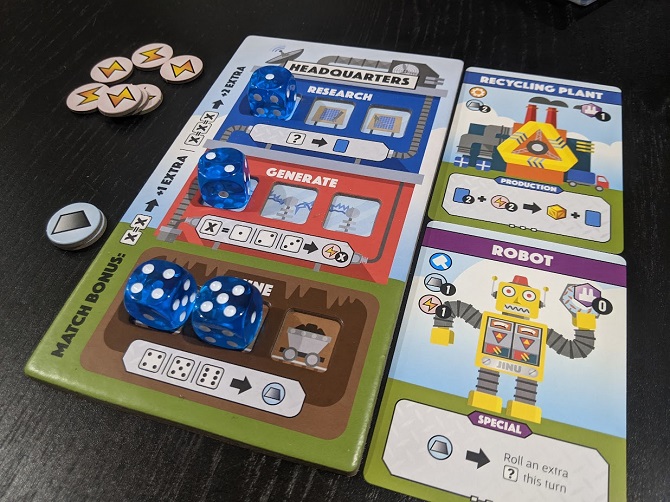
Putting cards together like LEGO bricks
Fantastic Factories stays true to the well-worn engine-building formula, where each turn you add cards to your engine and become more powerful. However, since you’re restricted by a number of dice, your growth trajectory isn’t as exponential as in other games in the genre.
Sometimes you don’t grow at all. As some cards only activate on specific die values or take two or three dice to activate themselves. So instead of each building being a direct increase to your power, they instead provide you with more options. Some of these options won’t be activated due to poor dice rolls, or you not having enough dice.
Thankfully, there are ways to reduce the impact of bad luck through contractor cards or buildings that allow you to manipulate your dice. However, there’s not enough mitigation to stop bad luck from tanking your game.
This is perfectly OK. Because the game isn’t meant to be as serious as this review makes it out to be. It’s meant to be a quick, fun game that you can knock out in half an hour.
However, it’s the disjointed feeling of the engine-building in Fantastic Factories that lets it down. The cards lack synergy, and because of that, you can’t build any long-term strategies around specific ideas or cards. So instead of large, unique engines based around specific themes or mechanics, you build these little pods of buildings that work together. But don’t connect with the others you’ve built.
It’s the difference between receiving a set of LEGO bricks, and getting instructions that direct you on what to build, versus the same box without instructions. Fantastic Factories drops the LEGO bricks and runs.
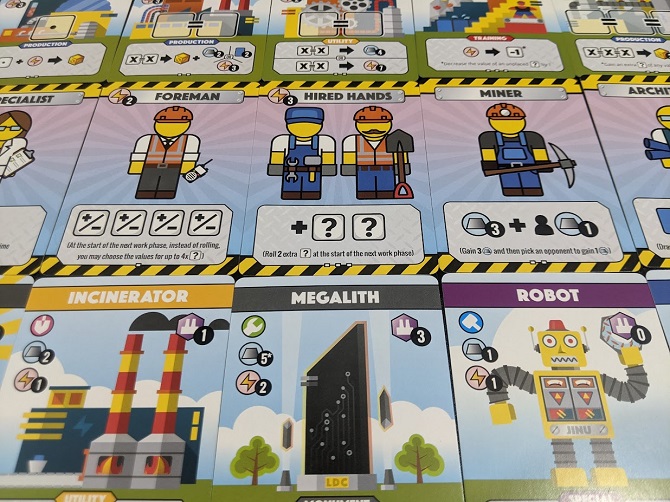
Gateway gaming goodness
Fantastic Factories is never going to replace the wonderful slog of Terraforming Mars, but it also isn’t trying to. It caters more for that gateway gaming and lunchtime crowd. Given both its playtime and its ruleset it would make for a perfect double feature alongside Arcane Academy.
With its straightforwardness in both mechanics and art style, it still has some tense and brain-tickling moments where you have to decide the best activation spots for your dice.
These choices are never too strenuous, and you never feel like the game depends on them. However, they’re fun all the same. Additionally, with the amount of luck involved in determining the winner. Even your friends who haven’t played a board game since Monopoly will still have a chance of sneaking out a victory after a couple of games.
From that perspective, Fantastic Factories serves its purpose as an excellent gateway in the world of board gaming – specifically the engine-building part. But for genre enthusiasts, it’s an enjoyable experience, if not lacking in the card interconnectivity that makes engine-building games so good.
Similar Games You Might Like

Revive Review – Engineering a Hopeful Post-Apocalypse
Rebuild civilization through clever card-slotting and branching tech upgrades. A post-apocalyptic strategy hit where choosing how to power up is as satisfying as the win itself.

Arcane Academy Review – Eric Lang’s Magic Miniature-Free Marvel
Back to school, and your desk is already a total mess of exhaustion tokens. A clever, family-weight engine game that hits hard in under an hour.

Splendor Review – The Satisfying Snap of a Perfect Engine
All that glitters is actual victory points. The modern classic engine-building sprint where lightning-fast turns leave zero room for error.
A score tells you if it’s good, but the leaderboard tells you if it’s worth the shelf space.

 Loading ...

This is one of my faves! I have the two expansions but haven’t tried them yet. Will have to do that soon
Let me know how you get on, it was your blog that inspired me to get this game in the first place!